










The mystery of how the Ancient Egyptian pyramids has been reignited by the death of a Swiss author, who famously argued that early human civilisations received help from extra-terrestrial visitors.
Erich Von Daniken, who died on January 10 at the age of 90, has prompted renewed debate over his controversial theories about ancient societies.
He achieved global fame with his 1968 book "Chariots of the Gods," which proposed that alien visitors shared advanced technology with early human societies including the Egyptians and Mayans.
The book became an international phenomenon, establishing him as what many consider the founding figure of ancient alien archaeology.
His central argument was that monuments such as the Great Pyramid demonstrated a level of engineering precision beyond what ancient peoples could have achieved working alone.
In his landmark work, Mr Von Daniken argued that cosmic visitors had directly assisted in the construction of structures that would otherwise have been impossible to build.
He pointed to what he regarded as unexplained aspects of pyramid construction, including the transportation of enormous stone blocks, the apparent absence of lighting within the structures, and what he described as sophisticated mathematical knowledge beyond ancient capabilities.
The author also highlighted what he saw as striking numerical coincidences, questioning whether it was mere chance that the Great Pyramid’s height multiplied by a billion roughly equalled the distance between the Earth and the Sun.
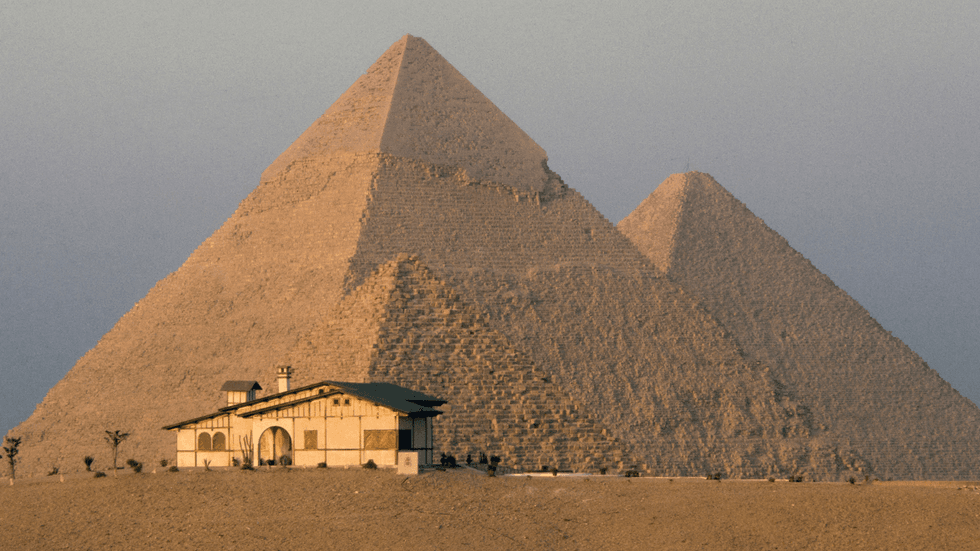
The mystery of how the Ancient Egyptian pyramids has been reignited
|GETTY
Mr Von Daniken further claimed that these otherworldly beings had promised Egyptian rulers a “second life”, which he believed explained mummification practices and the burial of treasures alongside pharaohs.
“Drawings and sagas actually indicated that the ‘gods’ promised to return from the stars to awaken the well-preserved bodies to new life,” he wrote.
Despite the popularity of the author's theories, archaeologists and historians have consistently rejected his conclusions.
Excavations at pyramid sites have uncovered extensive evidence of human construction efforts, including entire settlements where labourers lived during building projects.
ARCHAEOLOGY - READ THE LATEST:

Erich Von Daniken died on January 10 at the age of 90
|GETTY
Archaeological records document how workers were provided with food and accommodation, while nearby cemeteries containing their remains have also been identified.
Quarries where stone blocks were cut and prepared for transport have been found close to the monuments, further undermining claims of non-human involvement.
Research indicates that large, organised workforces were present in ancient Egypt, contradicting Mr Von Daniken’s assertion that such feats required otherworldly intervention.
Although he lacked formal training in archaeology, the Swiss author travelled widely across Egypt and Latin America, using books, lectures and films to promote his ideas to a global audience.
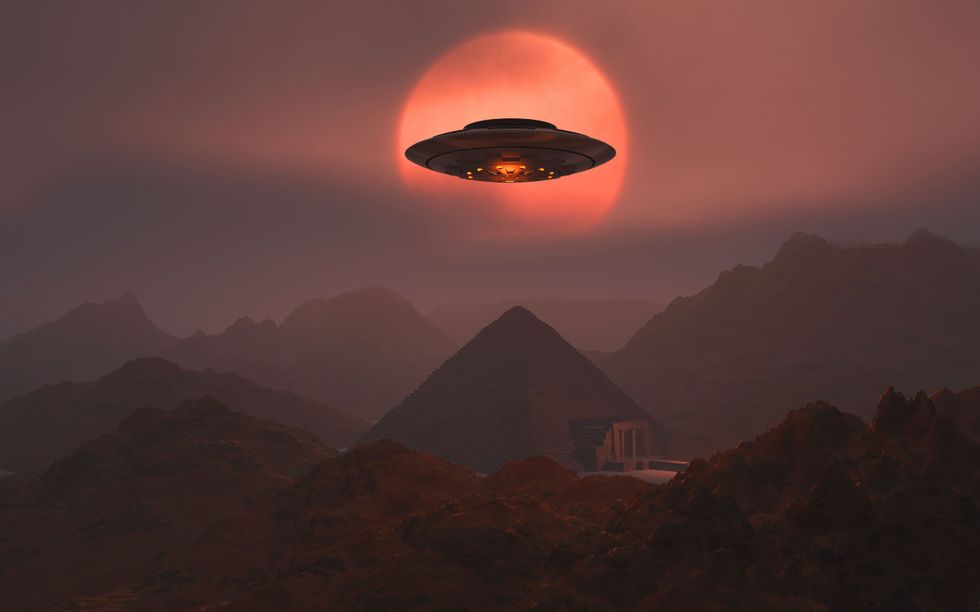
The Swiss author proposed that alien visitors shared advanced technology with early human societies
|GETTY
His books sold more than 60 million copies across 32 languages, and he went on to publish 25 further titles exploring similar themes.
In July 2020, Elon Musk echoed the idea on social media, posting: “Aliens built the pyramids obv.”
Nigel Watson, author of Portraits of Alien Encounters Revisited, offered a mixed assessment of Mr Von Daniken’s legacy.
“Thumbing his nose at mainstream archaeology, he claimed aliens either directly built the pyramids or helped humans to build them,” Watson said.
“It did not matter what sceptics said, as this was all based on belief rather than facts.”
“Some will see him as a cynical conman, others as a fearless pioneer who fought mainstream science.”
Our Standards: The GB News Editorial Charter