










A faded reddish hand stencil discovered inside an Indonesian cave has claimed the title of the world's oldest known rock art, taking the title off Europe.
The ancient image, found on the island of Muna in the Sulawesi region, dates back at least 67,800 years.
The discovery pushes back the timeline of human artistic expression and strips Europe of a record it previously held.
Scientists from Griffith University in Australia published their findings in the journal Nature.
TRENDING
Stories
Videos
Your Say
Scientists determined the artwork's minimum age through uranium analysis of the mineral deposits that formed over the pigment.
The discovery surpasses a hand stencil at Maltravieso cave in Spain, previously dated to approximately 64,000 years ago and attributed to Neanderthals, by nearly 4,000 years.
"Clearly they had some deeper cultural meaning but we don't know what that was," senior researcher Adam Brumm said.
"I suspect it was something to do with these ancient peoples' complex symbolic relationship with the animal world."
Researchers noted this distinctive pointed-finger style appears exclusively in the Sulawesi region.
Nearly identical examples were found in better condition at nearby sites.
The Spanish Maltravieso hand stencil, which had stood as evidence of Europe's ancient artistic heritage, has now been definitively overtaken by the Indonesian discovery.
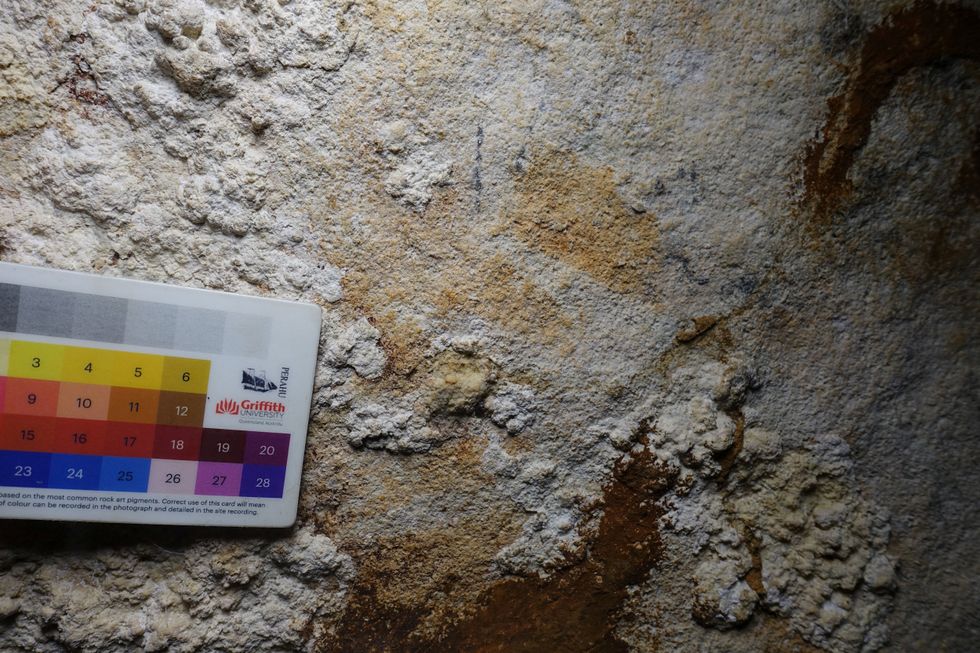
The faint image of a hand stencil
|REUTERS
That European example, thought to be the work of Neanderthals rather than modern humans, dates to around 64,000 years ago, making it roughly 3,800 years younger than the newly analysed Sulawesi artwork.
The Indonesian hand stencil also predates another significant find from the same region: a cave painting at Leang Karampuang in southwestern Sulawesi depicting three human-like figures interacting with a pig, dated to at least 51,200 years ago.
Maxime Aubert, an archaeological science specialist at Griffith University who co-led the research, confirmed the oldest hand stencil belongs to a style found nowhere else but Sulawesi.
The discovery carries significant implications for understanding when modern humans first reached Australia, a question that has long divided scientists.
LATEST DEVELOPMENTS
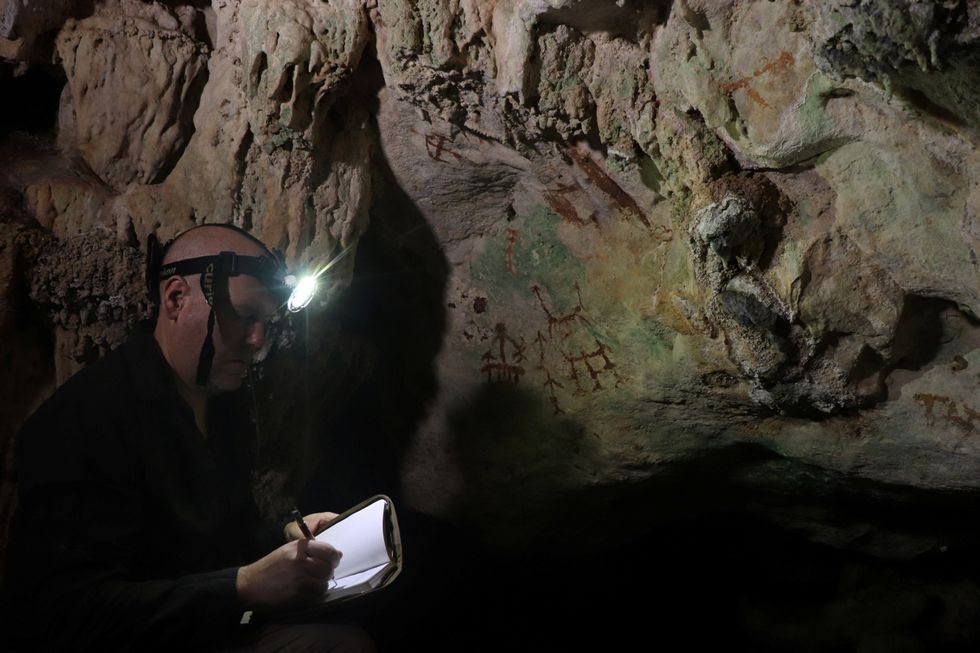
Researcher Maxime Aubert examines an ancient cave painting in a limestone cave called Liang Metanduno
|REUTERS
"For many years, scientists have debated when and how the first people reached Australia," Dr Aubert explained, noting two competing theories
A "short chronology" suggesting arrival around 50,000 years ago and a "long chronology" proposing settlement between 60,000 and 65,000 years ago.
The newly dated rock art now provides the oldest direct evidence of modern humans in the Indonesian region.
Recent genetic research supporting an Australian arrival closer to 60,000 years ago.
"Together, the archaeological and genetic evidence now strongly supports the 'long chronology' and shows that the ancestors of Indigenous Australians were moving through Southeast Asia and creating symbolic art as they traveled," Dr Aubert said.
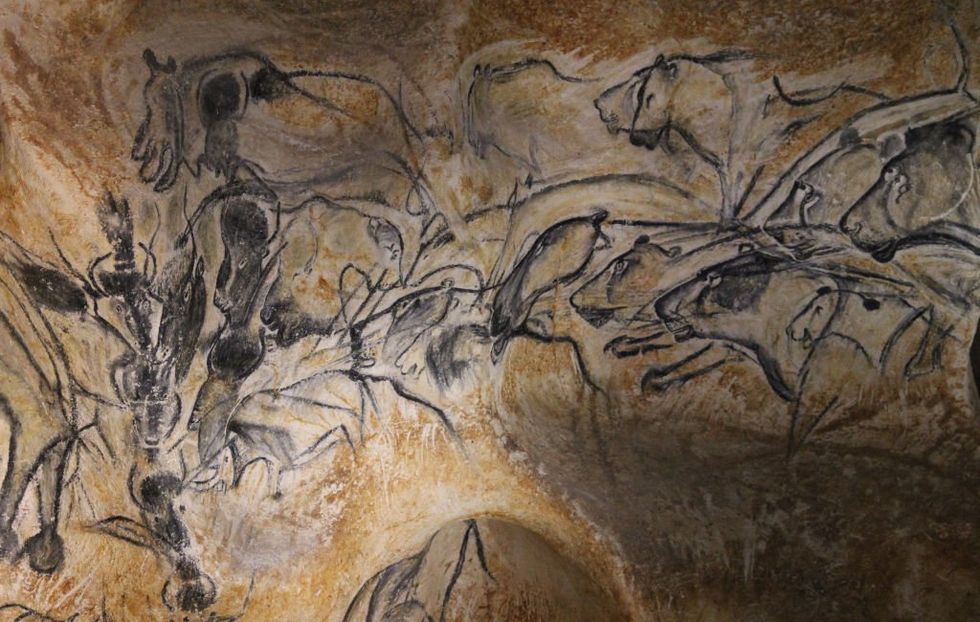
Painting in the Chauvet cave, 32,000-30,000 BC. Found in the collection of Grotte Chauvet.
The most famous prehistoric painting was in the Grotte Chauvet, near the Ardèche River in southern France, dating back over 20,000 years.
The cave was closed off by a rock fall approximately 20 millennia ago and remained sealed until its discovery in 1994, which helped to keep it in pristine condition.
The Unesco description of the site reads: "The cave contains the best-preserved expressions of artistic creation of the Aurignacian people, constituting an exceptional testimony of prehistoric cave art.
"In addition to the anthropomorphic depictions, the zoomorphic drawings illustrate an unusual selection of animals, which were difficult to observe or approach at the time. Some of these are uniquely illustrated in Grotte Chauvet.
"As a result of the extremely stable interior climate over millennia, as well as the absence of natural damaging processes, the drawings and paintings have been preserved in a pristine state of conservation and in exceptional completeness."