










Scientists have identified a previously unknown microscopic roundworm living in Utah's Great Salt Lake.
Nematode, formally named Diplolaimelloides woaabi, joins brine shrimp and brine flies as the only animals capable of surviving in the hypersaline environment.
The discovery upends longstanding assumptions the lake's salt levels excluded all but two hardy animal groups.
Measuring less than a millimetre in length, the worm had escaped detection despite decades of scientific study, living unnoticed among microbial formations on the lakebed.
TRENDING
Stories
Videos
Your Say
Researchers from the University of Utah collaborated with the Northwestern Band of the Shoshone Nation when selecting a name for the species, with tribal elders proposing "Wo'aabi", an Indigenous term for worm.
Assistant professor Michael Werner led the investigation, which required approximately three years of laboratory work to confirm initial suspicions about the organism's novelty.
"We thought that this was probably a new species of nematode from the beginning, but it took three years of additional work to taxonomically confirm that suspicion," said Julie Jung, who conducted early sampling expeditions by kayak and bicycle while working as a postdoctoral researcher in Mr Werner's laboratory.
Ms Jung now holds an assistant professorship at Weber State University.
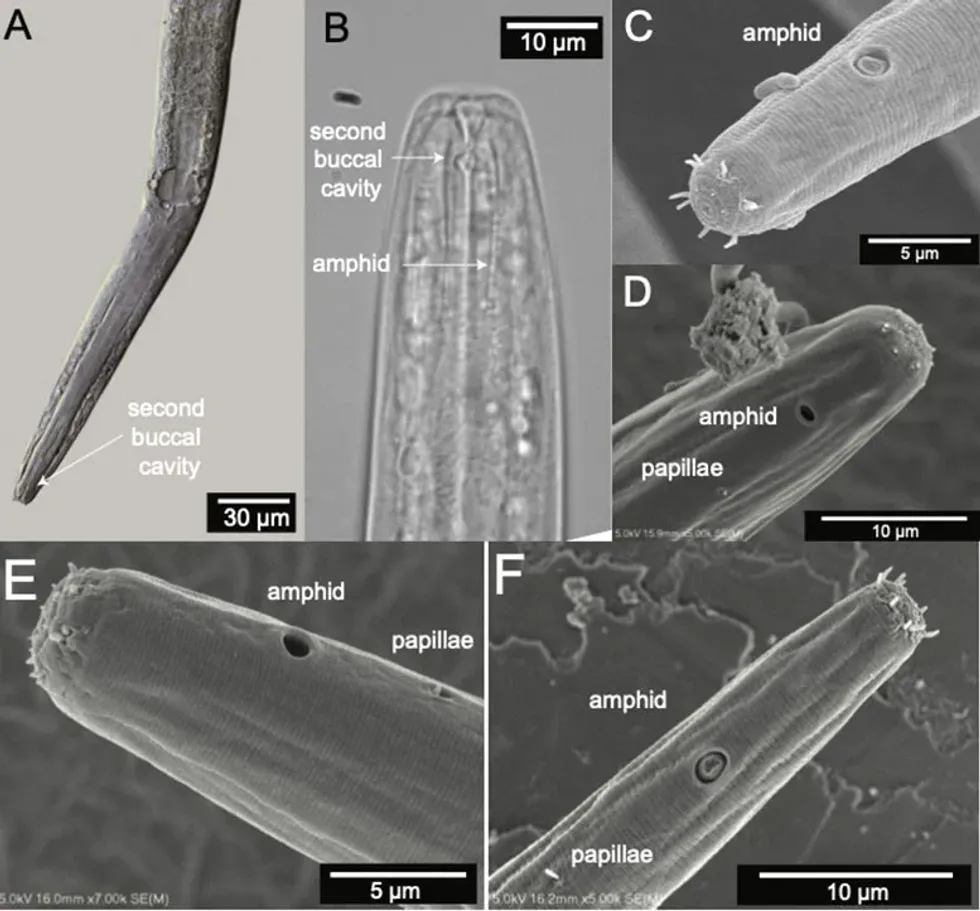
Competing theories have emerged to explain the worm's unlikely location
|UOU
The presence of a coastal nematode genus in a landlocked lake situated 4,200 feet above sea level and 800 miles from the nearest ocean presents researchers with a perplexing puzzle.
Two competing theories have emerged to explain the worm's unlikely location.
Byron Adams, a nematologist at Brigham Young University, suggests the species may be a relic from the Cretaceous Period, when Utah bordered an ancient marine waterway that bisected North America.
"The null hypothesis is that they're here because they've always kind of been here," Mr Adams said.
LATEST DEVELOPMENTS

The Great Salt Lake in Utah
|GETTY
Mr Werner offered an alternative explanation, proposing migratory birds may have transported the nematodes from distant saline lakes in their feathers.
The species could prove valuable as an early warning system for monitoring the Great Salt Lake's deteriorating health.
Nematodes serve as bioindicators, with their population numbers and distribution patterns revealing shifts in water quality and salinity levels.
"When you only have a handful of species that can persist in environments like that, and they're really sensitive to change, those serve as really good sentinel taxa," Mr Adams explained. "They tell you how healthy is your ecosystem."
The findings were published in the Journal of Nematology.
Our Standards: The GB News Editorial Charter