









Astronomers have spotted a "rogue planet" hurtling through space entirely alone after being "ejected" by its host star.
The mystery world was picked up by scientists in China, using telescopes on Earth and the Gaia space telescope, 1.5 million kilometres away from our planet.
Subtle differences in when the light reached these two points allowed researchers to calculate both the planet's mass and its distance from Earth.
The wandering world is roughly twice the size of Earth - though considerably smaller than Jupiter, the largest planet in our solar system.
The speed at which the planet is travelling suggests it was forcefully thrown out by one of its original host stars.
Its location places it approximately 10,000 light-years from Earth, situated towards the centre of our galaxy.
The research was led by Professor Subo Dong from the National Astronomical Observatories at the Chinese Academy of Sciences.
The findings have been published in the journal Science.
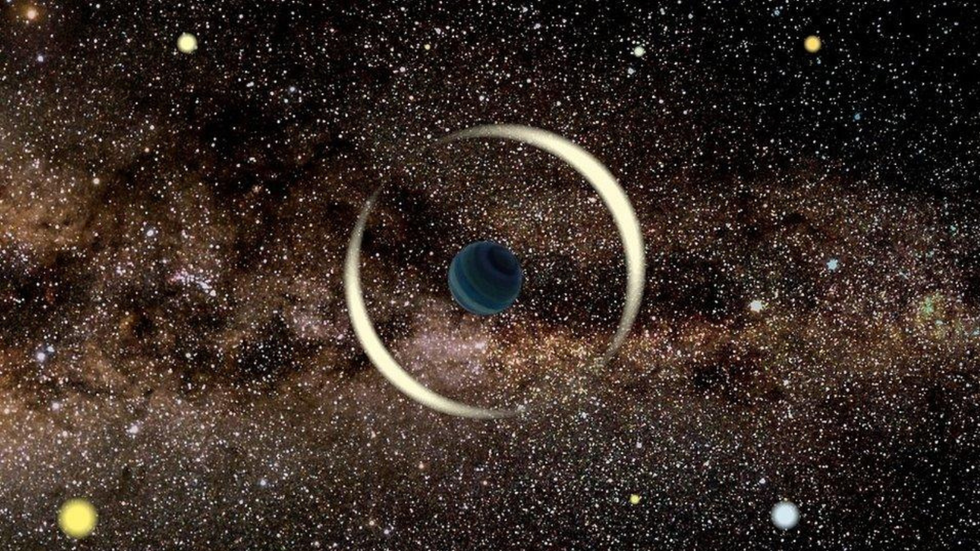
PICTURED: An artist's impression of an 'invisible' rogue planet
|UNIVERSITY OF WARSAW
These free-floating worlds are nearly impossible to detect because they emit no light and have no sun to illuminate them.
Scientists believe billions of such planets may exist within the Milky Way, though the first was only identified 25 years ago.
The discovery relied on a technique called gravitational microlensing, which works when a rogue planet passes directly between Earth and a distant background star.
The star's light bends around the planet, briefly revealing its presence to observers.
LATEST SPACE HEADLINES FROM GB NEWS:
Rogue planets are thought to begin their existence orbiting stars, much like the worlds in our own solar system.
However, they can be violently expelled from their home systems through gravitational chaos.
This ejection typically occurs when nearby planets interact with one another or when unstable stellar companions disrupt the orbital balance.
After the recent find, astronomers are optimistic about uncovering more rogue planets in the years ahead.
Nasa's Nancy Grace Roman Space Telescope, scheduled for launch in May 2027, will significantly boost detection capabilities.
The new instrument will offer a field of view at least 100 times greater than the Hubble Space Telescope, which has been operational since 1990.
Over its lifetime, the Roman telescope could potentially measure light from a billion galaxies.
This vastly expanded observational power should help astronomers identify and study many more of these elusive wandering worlds that drift through the darkness between stars.