










Archaeologists have uncovered the complete skeleton of a dog dating back roughly 5,000 years under a lakebed.
The discovery, made in Sweden, gets more intriguing given the canine is buried alongside a finely crafted bone dagger.
Archaeologists believe it appears to be an ancient ritual.
The discovery came to light during construction work on the Östlänken high-speed railway near the hamlet of Gerstaberg, about 20 miles southwest of Stockholm.
TRENDING
Stories
Videos
Your Say
The team from Arkeologerna, part of the Swedish National Historical Museums, announced their findings in mid-December.
"Finding an intact dog from this period is very unusual, but the fact that it was also buried together with a bone dagger is almost unique," said Linus Hagberg, project manager at Arkeologerna.
The dog itself was a sturdy male, standing around 52 centimetres at the shoulder, and experts believe it was between three and six years old when it died.
Bone analysis suggests this was an animal that lived a physically demanding life.
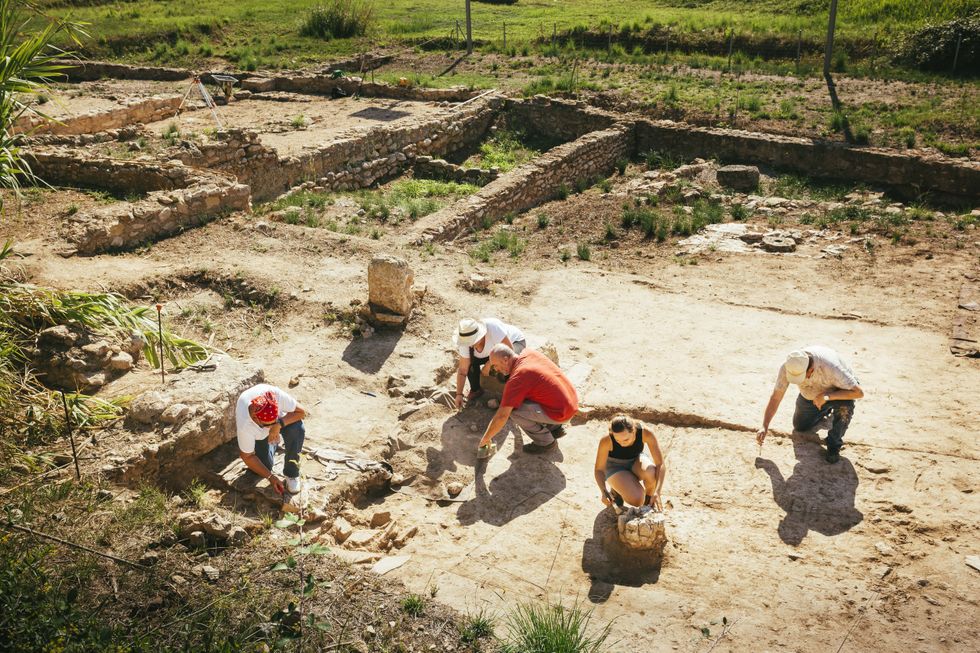
Archaeologists have uncovered the complete skeleton of a dog dating back roughly 5,000 years under a lakebed
|GETTY
The dog was placed inside a bag fashioned from animal hide, then was weighed down with stones so it would sink to the lakebed.
The burial spot sat roughly 35 metres from the ancient shoreline, at a depth of about 1.5 metres.
"It is a known phenomenon that dogs were used in ritual acts during this period," Mr Hagberg noted.
The site itself turned out to be a treasure trove of Stone Age fishing activity.
LATEST DEVELOPMENTS
Five thousand years ago, this boggy patch was a clear lake where people came to catch fish.
The archaeologists found wooden stakes hammered into the lakebed, likely the remains of platforms or walkways that once extended from the shore.
They also discovered a two-metre-long fish trap woven from willow branches, complete with footprints preserved in the surrounding mud.
"Adjacent to the fish trap are trampled areas where it is possible to see that people have stood and moved about on the lakebed," Mr Hagberg explained.
"Perhaps they were checking their traps."
Scientists now plan to carry out radiocarbon dating to pin down exactly when this potential ritual took place.
DNA analysis could reveal how this ancient canine relates to other prehistoric dogs.
Isotope testing will shed light on what the animal ate during its lifetime, and whether it shared meals with its human companions or hunted for itself.
"The dog's life history can in turn tell us more about how the people who owned the dog lived and ate," Mr Hagberg said.
The bones, dagger, and wooden structures have all been removed for conservation as researchers prepare for the next phase of analysis.
Our Standards: The GB News Editorial Charter