










Experts have called on the Government to remain headstrong and make use of Brexit freedoms to support the transition to electric vehicles after the EU rolled back its net zero targets.
Earlier this week, the European Commission confirmed that it would be ditching its goal of banning the sale of new petrol and diesel cars by 2035.
Under the new rules, which have been backed by EU President Ursula von der Leyen as "innovative", manufacturers will need to comply with a 90 per cent tailpipe emissions reduction target from 2035 onwards.
The remaining 10 per cent of emissions will need to be compensated through a range of factors including low-carbon EU steel, e-fuels or biofuels.
TRENDING
Stories
Videos
Your Say
Manufacturers have been split over the EU's decision to end the sale of new petrol and diesel cars, especially given market changes in recent years.
Some of the largest and most well-established automakers have cited concerns around waning uptake of electric vehicles and strong, emerging competition from Chinese brands offering cheaper alternatives.
The EU's backtrack on its net zero targets prompted concerns from the UK auto industry over whether the Government would take a similar route.
Any changes would have a dramatic impact on the Zero Emission Vehicle (ZEV) mandate, which requires manufacturers to have a minimum percentage of car and van sales be electric.
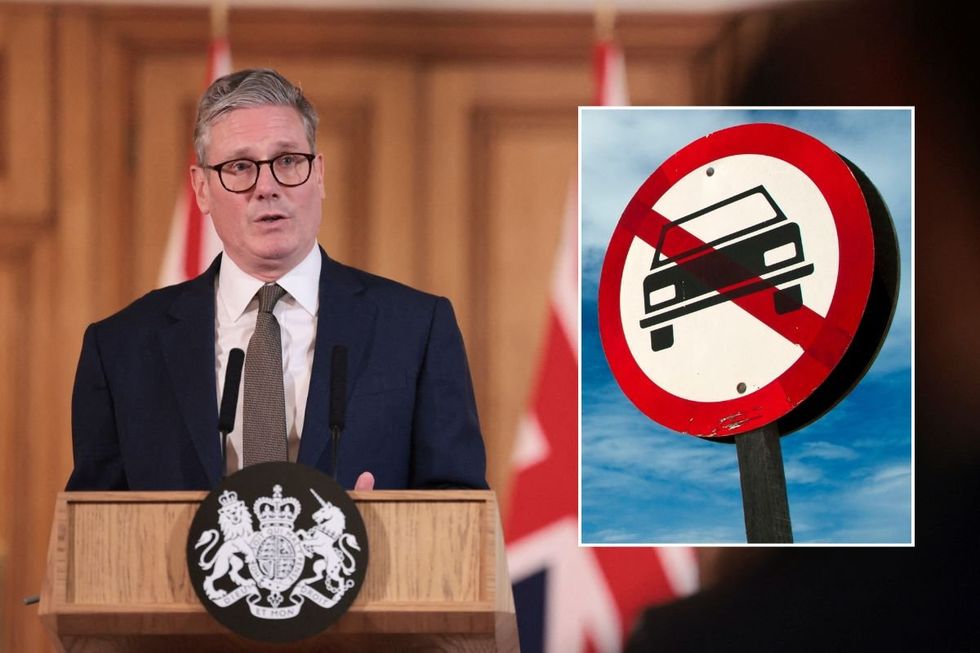
Experts have called on the UK Government to ignore the EU's change to the 2035 petrol and diesel car ban
|PA/GETTY
By the end of the year, manufacturers must meet a 28 per cent target for cars and 16 per cent for vans, before rising to 80 and 70 per cent at the end of the decade, respectively.
This will enable the UK to ban the sale of new cars with internal combustion engines from 2030. Only zero emission vehicles will be sold after 2035.
Ginny Buckley, the chief executive of Electrifying.com, said: "Brexit gives the UK the freedom to take a different path from the EU, particularly where its policy risks slowing progress.
"In fact, wasn't that the whole point of Brexit? But the UK Government must make a stronger - and more consistent - case for why drivers should switch and how net zero can power jobs, investment and growth."
LATEST DEVELOPMENTS
She warned that diluting the 2035 zero emission vehicle target would leave UK and European manufacturers "fighting with one hand tied behind their backs".
It would also provide a major boost in sales to South Korean and, most notably, Chinese brands, which are accelerating with the development and European expansion of impressive and affordable electric cars.
The European Commission confirmed that it would allow plug-in hybrids, range extenders, mild hybrids and internal combustion engine vehicles to "still play a role beyond 2035".
President von der Leyen said the new proposals were developed following "intense dialogues" with the automotive sector, civil service organisations and key stakeholders.
Calls for the UK to stick with the ZEV mandate were echoed by the CEO of Electric Vehicles UK, Tanya Sinclair, who noted that Brexit allowed the Government to launch the "ambitious and effective" ZEV mandate.
"Set aside the wider economic debate on Brexit, and this point is simple: the UK gained the ability to set clear, forward-looking electrification targets for manufacturers," Ms Sinclair added.
A Government spokesperson confirmed to GB News that it would not be changing the 2035 phase-out date of non-zero emission vehicles, adding that Labour "remained committed".
To accelerate the uptake of cleaner vehicles, the Government has boosted the funding of the Electric Car Grant incentive scheme to almost £2billion.

Ursula von der Leyen praised the EU's move to axe the 2035 car ban deadline
| GETTYMore than 40,000 drivers have used the Grant to save up to £3,750 off the price of more than 40 eligible electric vehicle models.
The spokesperson continued, saying: "We're investing over £7.5billion to support drivers and manufacturers make the switch to zero emission.
"This includes £4billion investment to back British manufacturing and R&D, create jobs, and drive growth in the sector."
Chancellor Rachel Reeves also supported the EV charging sector with £200million in funding during the Budget to accelerate the installation of EV chargers in communities across the country.