










Most of us experience an itch from time to time and know it's usually nothing to worry about.
But when scratching becomes persistent, it could actually be your body trying to tell you something far more serious.
A cancer specialist has shared some important information on social media about why ongoing itching shouldn't be ignored.
Oncologist Amit Garg, who posts on TikTok under the handle @blooddocdad, regularly shares insights about cancer symptoms with his followers.
TRENDING
Stories
Videos
Your Say
In a recent clip, the doctor outlined several types of cancer that can cause itching as an early warning sign; something many people might not realise.
Hodgkin lymphoma
First on Dr Garg's list is Hodgkin lymphoma, which can trigger severe itching across the whole body.

Some cases of itching may not clear up on their own
|TIKTOK / GETTY
This type of itching tends to be particularly bad at night and may even appear before any swollen lymph nodes become noticeable, the oncologist noted.
Polycythemia vera
Polycythemia vera is a condition characterised by the production of too many blood cells.
People with this illness often experience what's called aquagenic pruritus - essentially, intense itching after a warm shower, but without any visible rash.
What's fascinating is that this itching can show up years before the condition is actually diagnosed.
The overproduction of blood cells causes high levels of histamine and cytokines to be released, which trigger those maddening itch signals.
LATEST DEVELOPMENTS
Warm water appears to be a major trigger, with the temperature change – particularly cooling down afterwards – playing a key role in setting off these nerve endings.
Gall bladder and pancreatic cancer
Gall bladder and pancreatic cancers can also cause intense itching, though for a completely different reason.
When these cancers block the bile duct, bile salts build up and get deposited in the skin. Along with the itching, people might notice yellowing of the skin, darker urine, and pale stools.
T-cell lymphoma
Finally, there's cutaneous T-cell lymphoma, a rare and slow-growing cancer affecting the skin. It can cause severe itching alongside red, scaly patches that look similar to eczema.
Of course, it's worth remembering that itchy skin is usually nothing to be concerned about.
The NHS points out that most cases aren't serious and tend to clear up on their own within a few weeks with simple self-care.
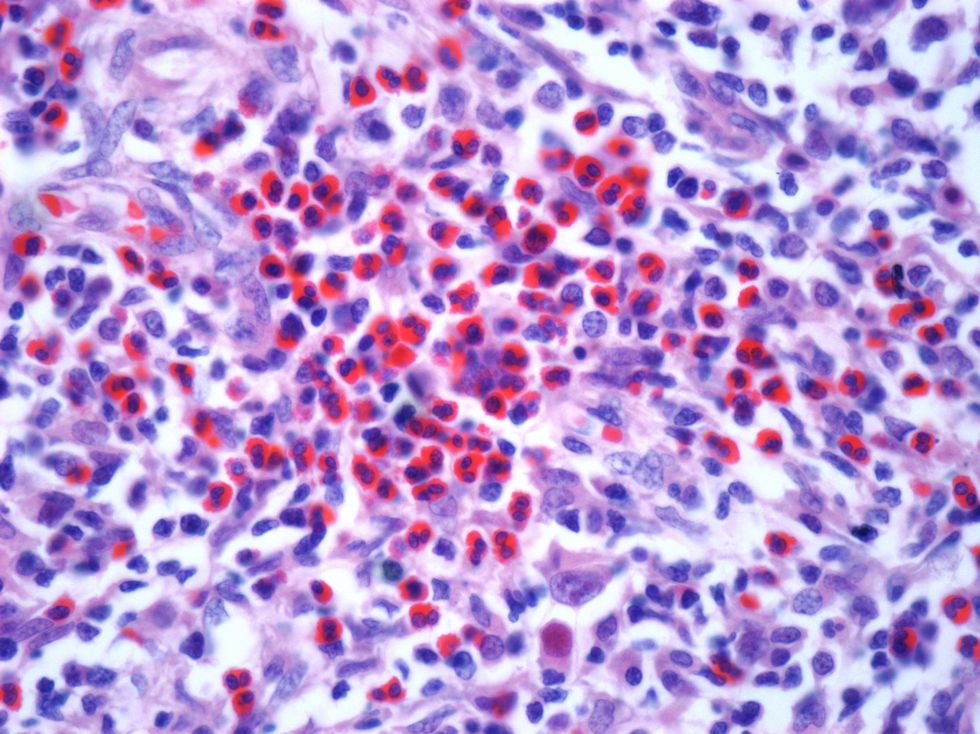
T-cell lymphoma can cause severe itching alongside red, scaly patches
|GETTY
However, the health service does note that in some less common cases, persistent itching can signal something more significant going on beneath the surface.
Conditions affecting the thyroid, liver, or kidneys can all cause itchy skin as a symptom.
So if you're experiencing ongoing itching that just won't shift, it might be worth having a chat with your GP.
Our Standards: The GB News Editorial Charter