










Do you use Google Chrome? You should update your web browser immediately.
Google has just rolled out a crucial security patch to millions of users worldwide that addresses an eye-watering 74 vulnerabilities in its browser, and one of these flaws is already known to hackers and being used in cyberattacks.
The nasty bug, which has been given the codename CVE-2026-11645, is what security experts call a "zero-day vulnerability". This means hackers have already discovered the glitch and will be leveraging it to hack into devices worldwide. This latest vulnerability lets fraudsters steal personal information and passwords to either impersonate you ...or drain your bank account!
Google has confirmed it's aware of ongoing cyberattacks using this flaw in Chrome — the most popular browser on the planet, though the company is keeping specific details under wraps until most users have downloaded the fix. This is intentional to avoid copycat attacks from enterprising hackers.
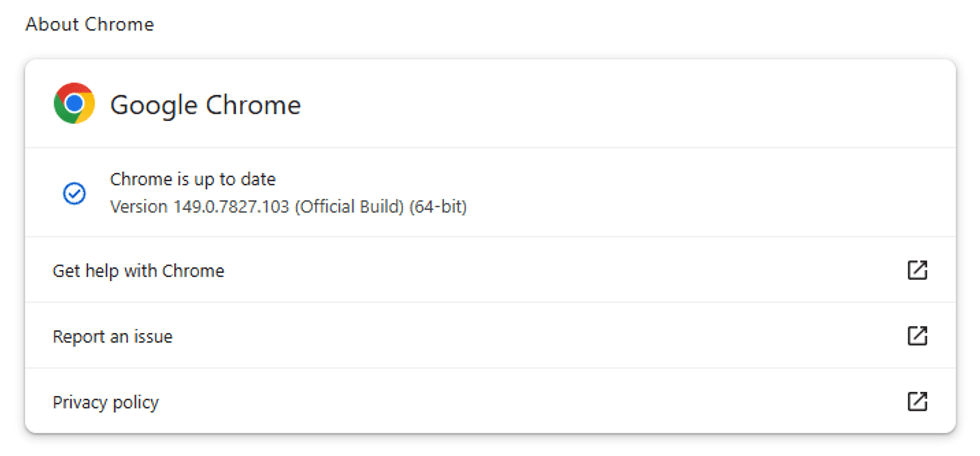
The above is the latest version of Chrome, which will protect you against the 74 security vulnerabilities detected
|So what makes this particular vulnerability so dangerous? It all comes down to Chrome's V8 engine – a piece of software that runs JavaScript on websites you visit.
The flaw allows attackers to read and write data outside the areas of memory they should be able to access. Essentially, this lets them mess with critical parts of your computer's memory and potentially slip malicious code in.
Google describes it as: "Out of bounds read and write in V8 in Google Chrome prior to 149.0.7827.103 allowed a remote attacker to execute arbitrary code inside a sandbox via a crafted HTML page."
The scary part? Simply visiting a dodgy website with specially crafted content could trigger the attack. While the malicious code runs within Chrome's sandbox – a restricted environment – hackers often chain multiple vulnerabilities together to cause more serious damage.
LATEST DEVELOPMENTS
So what can you do to stay safe? When you open your browser, click the menu and head to "About Google Chrome." This page shows your current version and will automatically download the latest update if you need it. It's important to make sure you restart your browser to finish the installation.
The latest safe versions are 149.0.7827.102/.103 for Windows and Mac users, and 149.0.7827.102 for those on Linux. These will be rolling out over the coming weeks, but there's no need to wait.
 Google Chrome will be moving from a four-week update release schedule to a fortnightly one, kicking off on September 8, 2026. | GOOGLE PRESS
Google has experienced a few security vulnerabilities in the last few months. For instance, the tech firm just released a "critical" update across Android devices.
The flaw tricks your phone's graphics system into making a mathematical error. This error then corrupts your device's memory – the bit that keeps everything running smoothly. Once that memory is scrambled, hackers can essentially walk right through your phone's security gates and take over without you knowing.
To combat these security concerns, the US tech firm has also confirmed it's doubling the amount of free updates released for its online browser. Chrome will move from a four-week release schedule to a fortnightly one, kicking off on September 8, 2026.
This increased release schedule applies whether you're browsing on a Windows or Mac computer, Android phone or tablet, iPhone, or iPad – everyone is getting the same treatment.
It's quite a shift. Back in 2021, Google moved from six-week gaps between major releases to four weeks. Now they're halving that, meaning you'll get fresh versions of Chrome every fortnight across all your devices.