










Several powerful solar flares have been emitted from the Sun after what scientists describe as a "complex eruption".
The bursts of energy occurred four times within 24 hours and originated from a sunspot called Region 4366.
The US National Oceanic and Atmospheric Administration (NOAA)'s Space Weather Prediction Centre said the sun produced one X8.1 flare at 11.57pm on Sunday.
Solar flares are strong bursts of energy which can impact navigation signals, radio communications, electric power grids and "pose risks" to spacecraft and astronauts, Nasa explained.
TRENDING
Stories
Videos
Your Say
The NOAA stated: "Flares of this magnitude in and around solar maximum are generally not common, although not necessarily unusual."
"Modelling of the associated coronal mass ejections (CMEs) indicates that a bulk of the material will pass by Earth to the north and east late on the February 5 UTC-day delivering possible glancing influences," it added.
"Region 4366 continues to produce M and X-class flares as of early Monday morning."
X-class flares are considered to be the most powerful kind of solar flares.
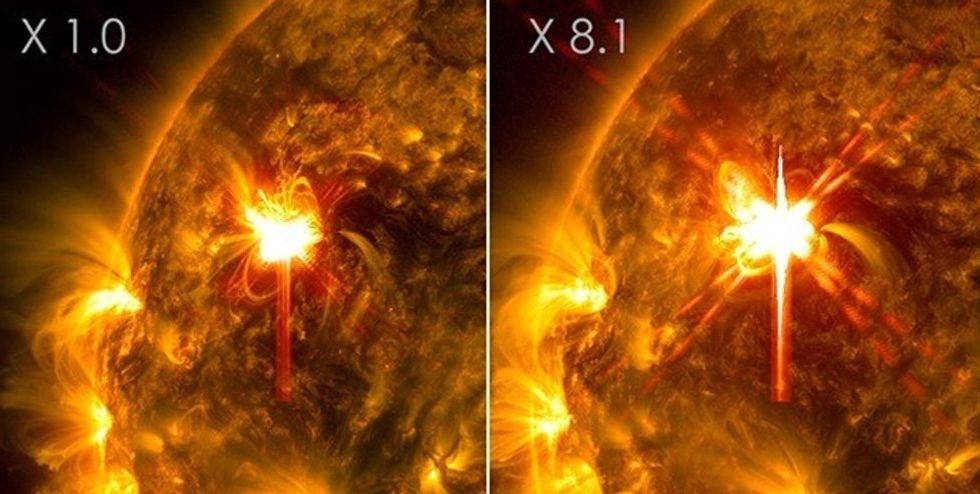
Pictures of the solar flares were captured by Nasa's Solar Dynamics Observatory spacecraft
|NASA/SDO
Dramatic pictures of the energy bursts were captured by Nasa's Solar Dynamics Observatory spacecraft, which watches the Sun constantly.
The flares could mean Northern Lights (also known as aurora borealis) will be visible on Thursday.
Northern Lights often occur during increased solar activity and can be caused when CME's interact with Earth's magnetic environment.
The NOAA said a "complex eruption" resulting in "possibly three CMEs" was associated with the recent solar flares, Forbes reports.
LATEST DEVELOPMENTS
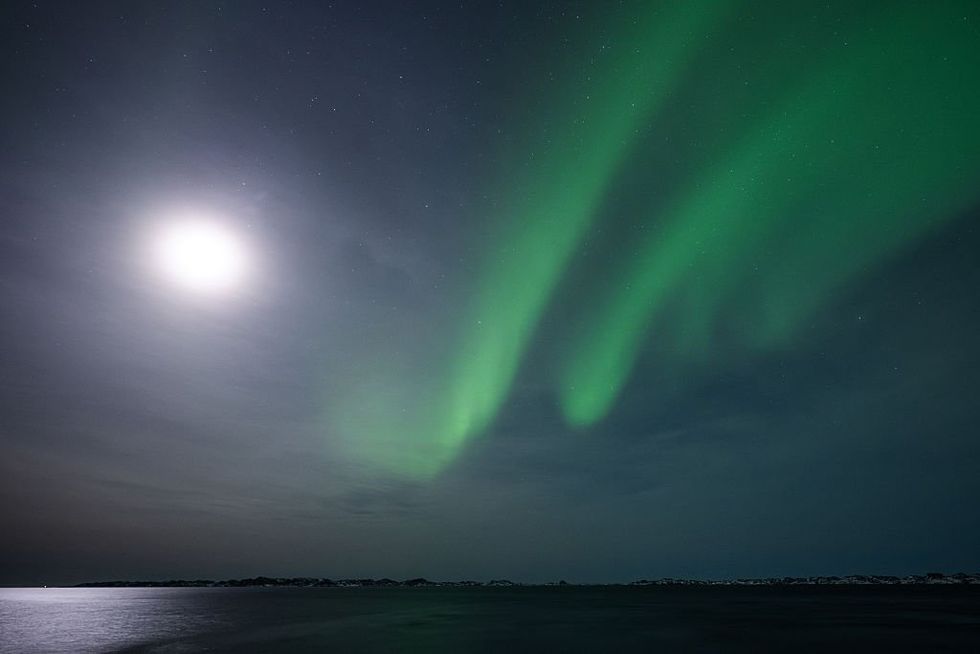
Northern Lights appear in a variety of colours
|GETTY
Northern Lights appear in a variety of colours such as pink and purple purple or green and blue.
Due to the UK being located south of where the natural aurora belt occurs in the Arctic, it takes a strong geomagnetic storm for them to be visible over Britain.
The lights will be more visible if it is a clear night and is in a dark location with no light pollution.
The Met Office explains: "The Northern Lights can produce a spectacular light show sometimes seen as far south as Scotland and Northern England/Ireland - if skies are clear.
"The distance to the aurora belt, compounded by light pollution or twilight, means it can be difficult for the naked eye to see the phenomenon clearly and it is often portrayed much brighter in pictures than it appears to the naked eye."