










Scientists at the Natural History Museum have pioneered a groundbreaking laser technique capable of determining what preservation fluids are contained within specimen jars without ever unsealing them.
The innovative method involves directing lasers through the glass containers and examining how the light disperses, enabling researchers to decode the chemical composition of the liquids inside.
This non-invasive approach addresses a longstanding challenge facing museum curators: the risk of exposing staff to hazardous substances or damaging priceless specimens when attempting to identify unknown preservatives.
The research findings have been published in the scientific journal ACS Omega.
The museum's spirit collection houses approximately 23 million specimens preserved in fluid, representing centuries of scientific endeavour.
Among these treasures are original samples gathered by Charles Darwin during his legendary HMS Beagle expedition nearly two centuries ago, including finches and mockingbirds that proved instrumental in shaping his revolutionary ideas about evolution.
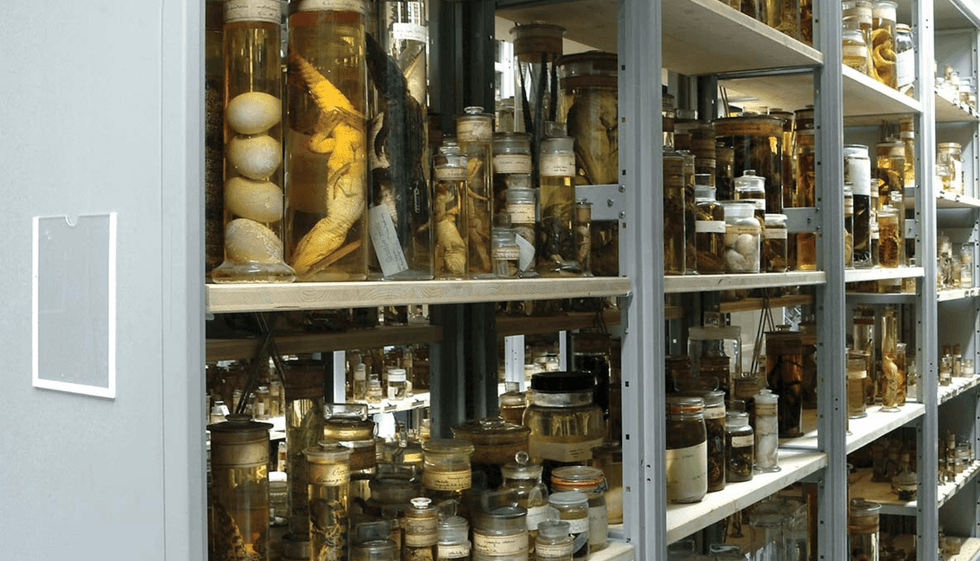
The museum's spirit collection houses approximately 23 million specimens preserved in fluid
|TRUSTEES OF THE NATIONAL HISTORY MUSEUM
LATEST DEVELOPMENTS
However, the precise chemical makeup of many preservation fluids remains a mystery, as historical records were often incomplete or inaccurate.
Opening containers without knowing their contents poses significant dangers, potentially exposing researchers to toxic substances or causing irreversible deterioration to specimens that cannot be replaced.
The technique successfully identified the contents of nearly 80 per cent of jars examined, while partially determining the composition of 95 per cent of samples tested.
Chelsea McKibbin, Senior Conservator at the museum and co-author of the study, emphasised the significance of the breakthrough for safeguarding irreplaceable collections.
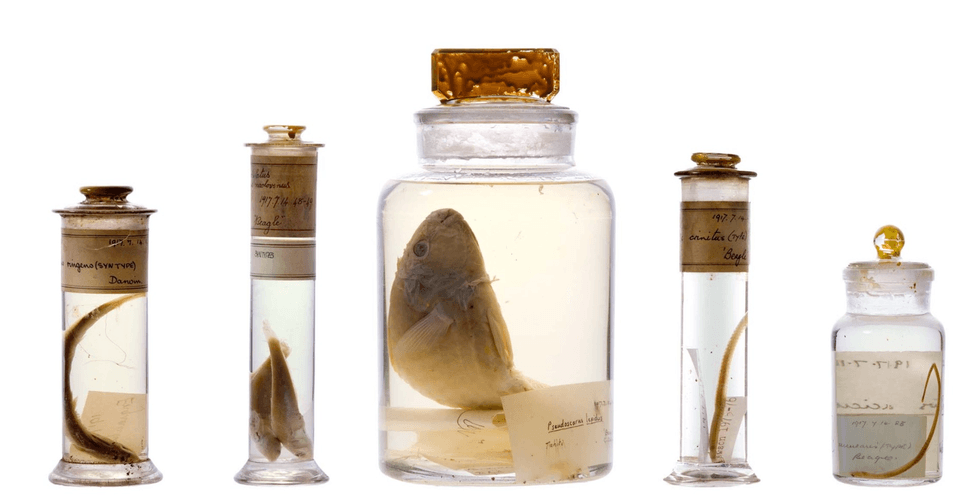
The practice of preserving specimens in fluid dates back to the 1600s
|TRUSTEES OF THE NATIONAL HISTORY MUSEUM
"The specimens used in this study represent 200 years of scientific collecting, including Darwin's original samples that helped shape our understanding of evolution," she said.
"Being able to analyse their preservation without opening their containers means we can maintain the integrity of these historical materials while ensuring they remain available for future generations to learn from and be inspired by."
The practice of preserving specimens in fluid dates back to the 1600s, when Dutch scientist Frederik Ruysch experimented with solutions containing water, alcohol and spices including clove, pepper and cardamom.
Concentrated alcohols such as rum and whisky were historically favoured for their antimicrobial properties, though modern curators typically use pure methanol or ethanol.
Formaldehyde-based solutions became widespread from the late 1800s, but some historic preservatives contain hazardous substances including mercury compounds and picric acid, which can become explosive.
Dr Sara Mosca, from the Science and Technology Facilities Council's Central Laser Facility, noted: "This technique allows us to monitor and care for these invaluable specimens without compromising their integrity."