

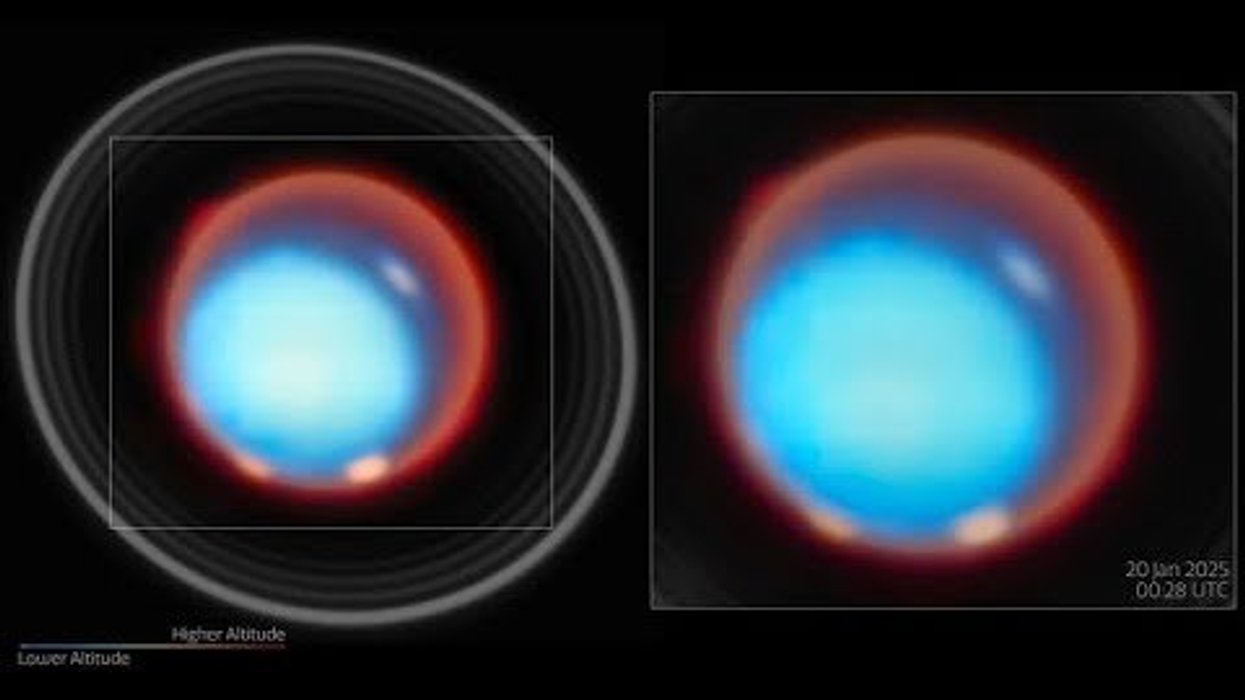









Scientists at a British university have produced the first 3D map of Uranus, offering an unprecedented view of the ice giant's upper atmosphere.
A research team at Northumbria University utilised Nasa's James Webb Space Telescope to observe the distant planet through nearly a complete rotation.
Their work mapped temperature and ion density within Uranus's electrically-charged atmospheric layer situated approximately 3,100 miles above the cloud tops.
Uranus remains among the least studied planets in our solar system, and sits more than one billion miles from Earth.
But the new findings, led by Paola Tiranti, provide the clearest picture to date of where the planet's distinctive auroras - like Earth's Northern Lights - come from.
Observations revealed two bright auroral bands positioned near the planet's magnetic poles.
These poles are notably lopsided and tilted at nearly 60 degrees from the planet's axis.
This unusual orientation causes the auroras to move across the planetary surface in intricate patterns.
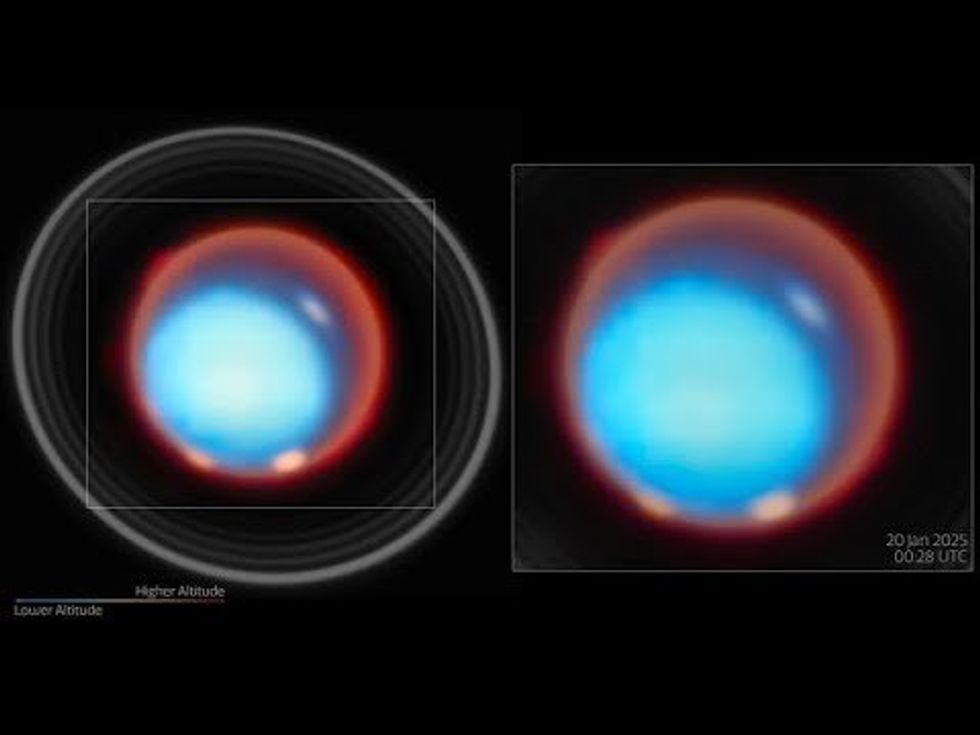
PICTURED: Astronomers' 3D view of Uranus.The new views provide the clearest picture to date of where the planet's distinctive auroras come from
| HUBBLEWEBBESA/YOUTUBEThe James Webb data also identified a zone of reduced emission and lower ion density between the two auroral bands.
Researchers believe this feature may relate to how the planet's magnetic field channels charged particles.
Similar behaviour has been observed on Jupiter.
The auroras release energy that produces a characteristic glow which can be picked up by the telescope's sensitive instruments.
"This is the first time we've been able to see Uranus's upper atmosphere in three dimensions," Ms Tiranti said.
SPACE HEADLINES - READ MORE:
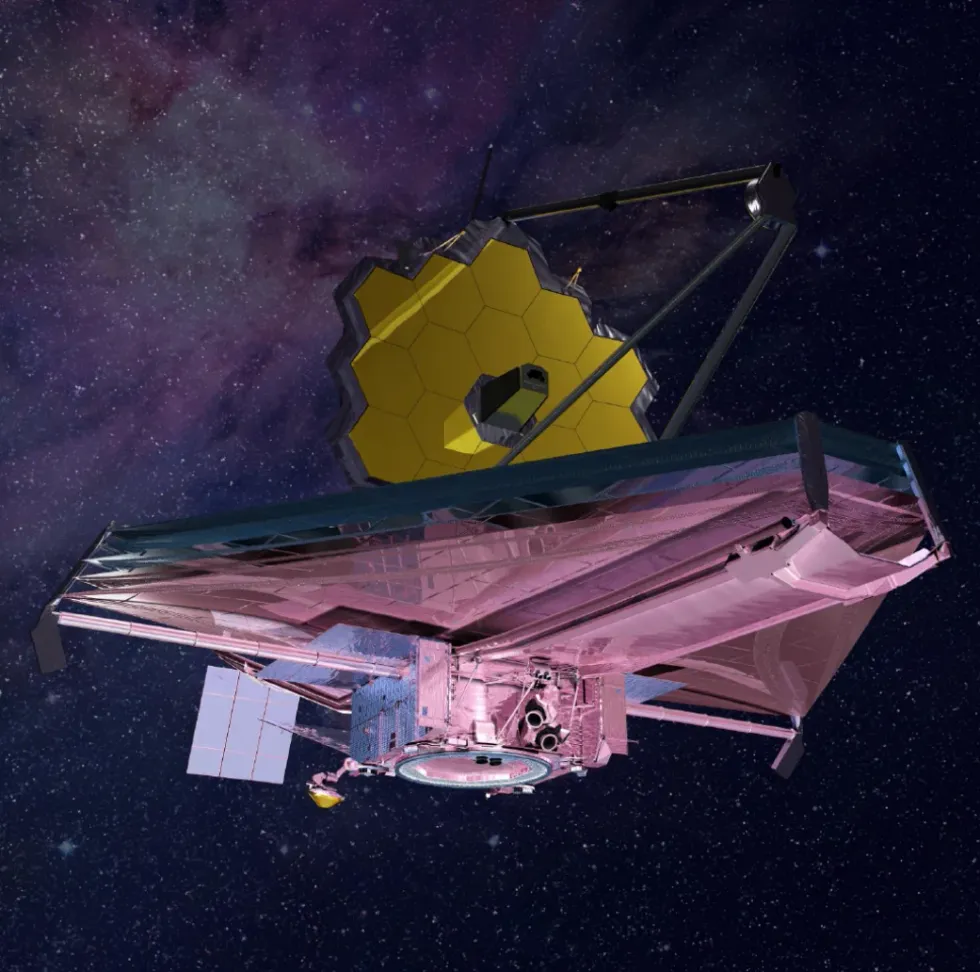
The new imagery was taken by the James Webb Space Telescope
| NASA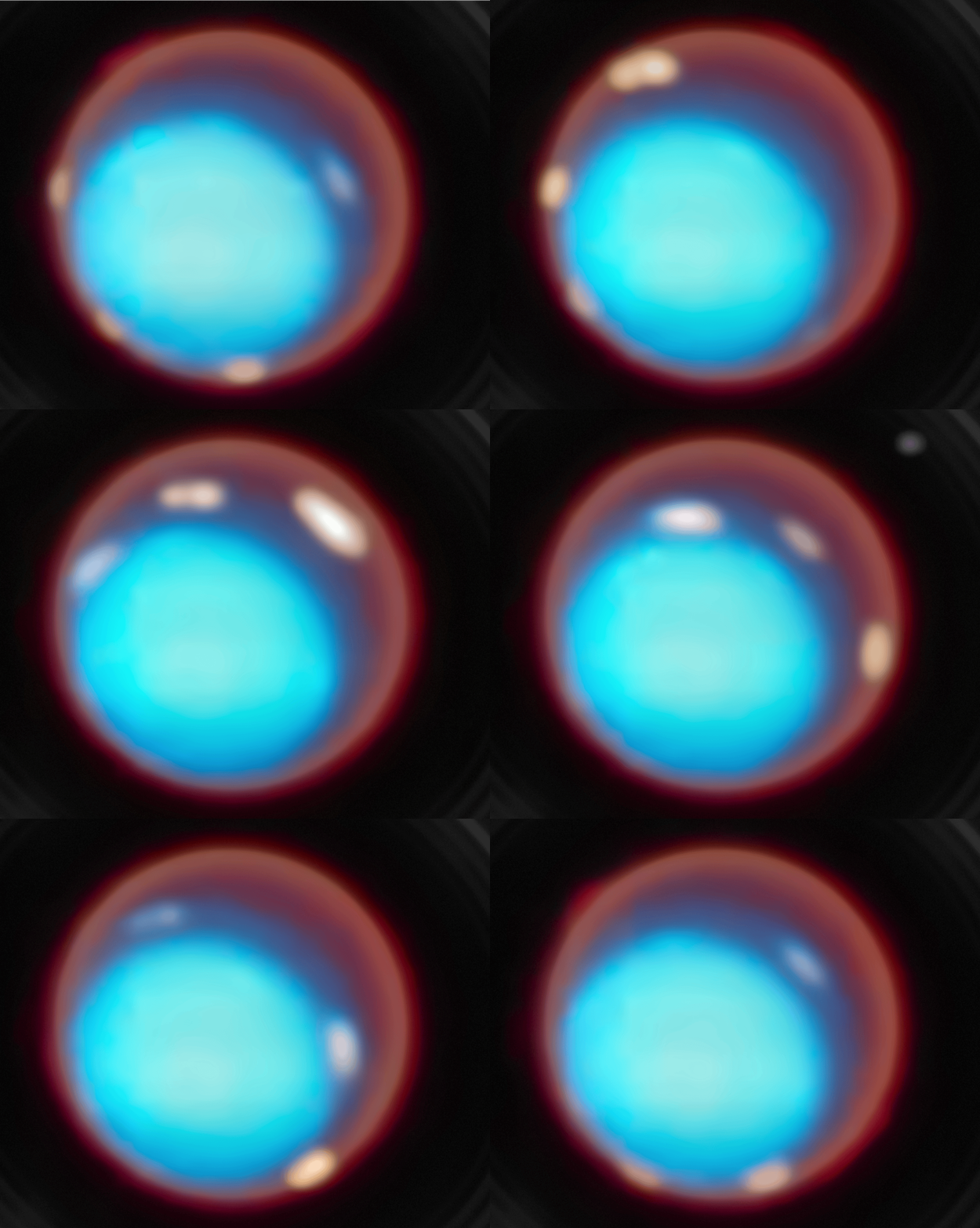
Scientists saw two bright auroral bands positioned near the planet's magnetic poles
|HUBBLEWEBBESA
"With Webb's sensitivity, we can trace how energy moves upward through the planet's atmosphere and even see the influence of its lopsided magnetic field."
Temperature measurements showed peaks between 1,864 miles and 2,485 miles above the cloud tops.
Ion densities reached their highest concentration at around 621 miles high.
"By revealing Uranus's vertical structure in such detail, Webb is helping us understand the energy balance of the ice giants," Ms Tiranti said.
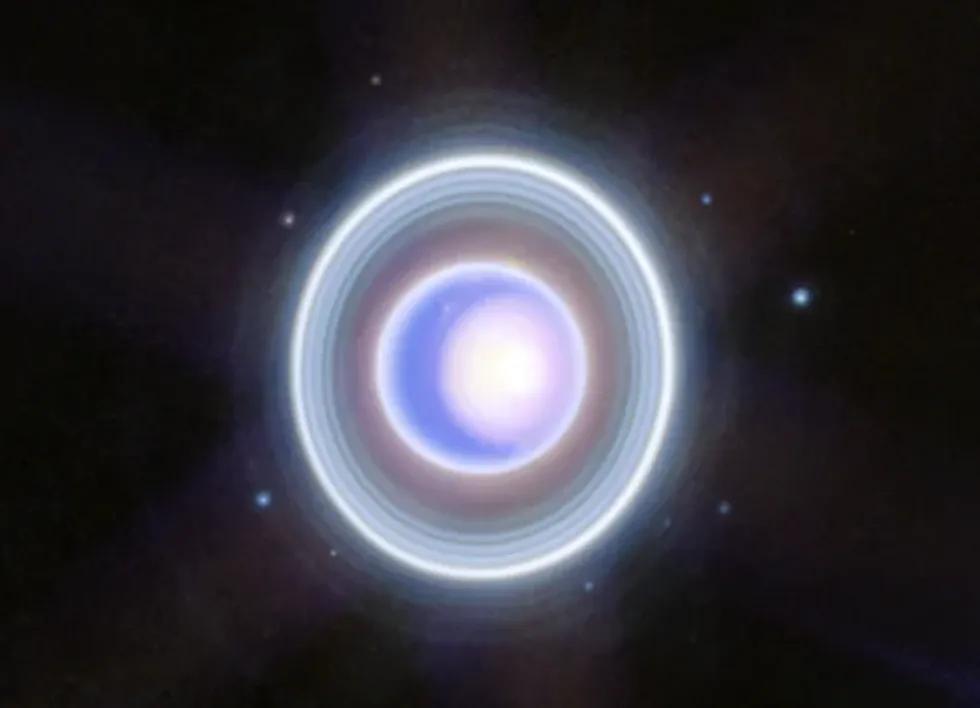
The research confirmed that Uranus's upper atmosphere is still cooling
|NASA
"This is a crucial step towards characterising giant planets beyond our Solar System."
The research confirmed that Uranus's upper atmosphere is still cooling, extending a pattern first detected in the early 1990s.
Scientists recorded an average temperature of approximately 426 Kelvin - roughly 150C, which is lower than previous ground-based or spacecraft measurements.
Understanding this cooling trend could offer vital insights into how ice giant planets manage their atmospheric temperatures.
The new findings appear in Geophysical Research Letters as part of an international collaboration involving the European Space Agency and Canadian Space Agency.