










Scientists at the University of Warwick have been left baffled after discovering a planetary system that appears to be configured in reverse.
The team identified four worlds orbiting a dim, cool red dwarf star they have designated LHS 1903.
What makes this system remarkable is its apparent defiance of established astronomical conventions.
"This strange disorder makes it a unique inside-out system," said Dr Thomas Wilson, the study's lead author.
The arrangement has left researchers astonished, as the system's architecture contradicts what astronomers typically observe when examining how planets position themselves around their host stars.
In conventional planetary systems, worlds nearest to their star tend to be rocky, with gaseous planets occupying more distant orbits.
Our own Solar System exemplifies this pattern, with Mercury and Mars composed of rock while Jupiter and Neptune retain their thick gaseous envelopes.
The explanation lies in stellar radiation, which strips away atmospheres from close-orbiting planets, leaving only dense solid cores behind.
 Astronomers left stunned after discovering bizarre ‘inside-out’ planetary system |
 ESA
Planets positioned further from their star can maintain their gas-rich compositions.
Yet LHS 1903 upends this understanding entirely: while its innermost planet is rocky and followed by two gas giants, the outermost world is unexpectedly composed of rock.
"Rocky planets don't usually form far away from their home star, on the outside of the gaseous worlds," Dr Wilson noted.
The research team employed the European Space Agency's CHEOPS satellite to examine the system, detecting the rocky planet at its outer reaches.
SPACE - READ THE LATEST:
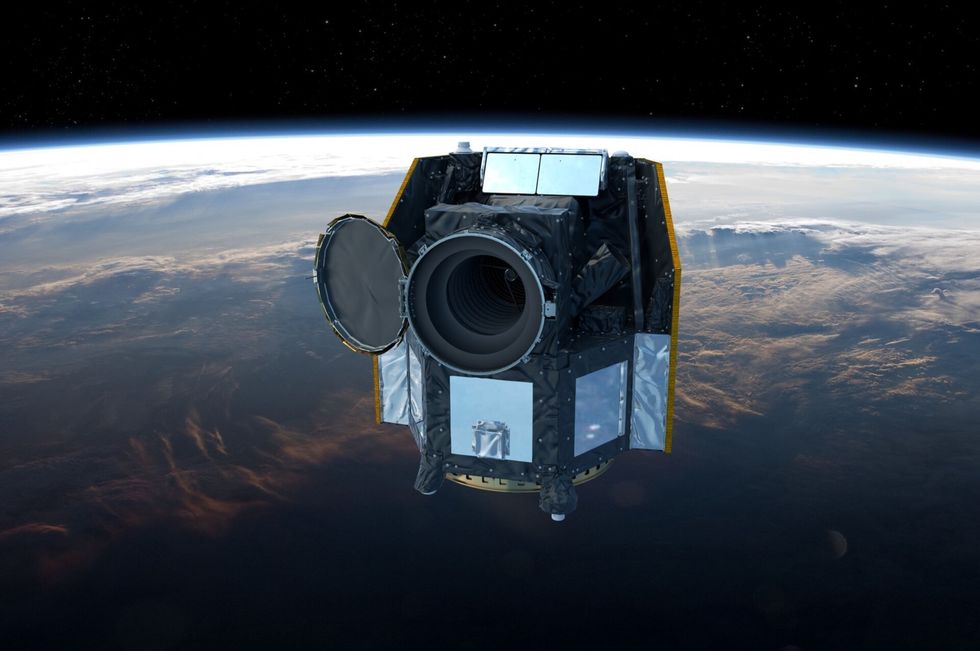
The research team employed the European Space Agency's CHEOPS satellite to examine the system
|ESA
Initially, scientists considered whether the rocky and gaseous worlds might have exchanged positions over time, or perhaps the distant rocky planet had lost its atmosphere through a violent collision.
However, both of these possibilities were subsequently dismissed.
Evidence instead pointed to a sequential formation process, with planets emerging one after another from the innermost to the outermost position.
By the time the final outer planet came into existence, the system had apparently exhausted its gas supply, which astronomers consider essential for planetary formation.
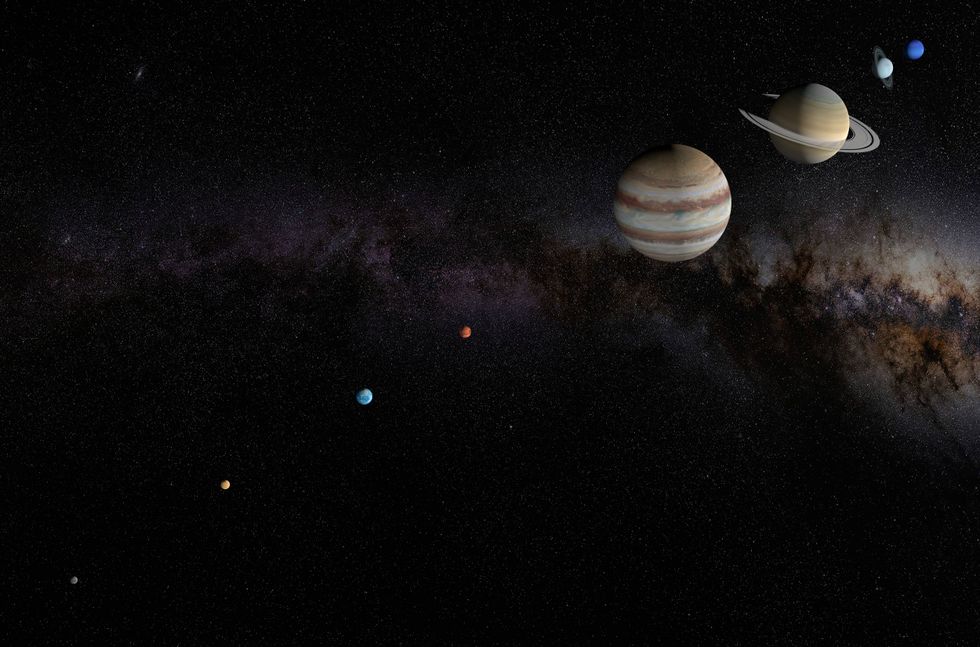
Our own Solar System exemplifies this pattern, with Mercury and Mars composed of rock
|GETTY
"By the time this final outer planet formed, the system may have already run out of gas, which is considered vital for planet formation," Dr Wilson explained.
"Yet here is a small, rocky world, defying expectations. It seems that we have found first evidence for a planet that formed in a gas-depleted environment."
Whether this peculiar inverted system represents a unique anomaly or hints at similar configurations elsewhere remains unknown.
"Much about how planets form and evolve is still a mystery," said ESA scientist Maximilian Günther
"Finding clues like this one for solving this puzzle is precisely what CHEOPS set out to do."
Our Standards: The GB News Editorial Charter