










A team of South Korean researchers have uncovered evidence behind how our universe could end after a breakthrough telescope discovery.
Scientists have said that mysterious dark energy might bring about the universe's demise through a phenomenon called the "Big Crunch".
Their analysis points to a scenario where the constant expansion of the universe could start going backwards, with gravity drawing galaxies back towards one another.
Should a "Big Crunch" occur, the first visible signs would appear in the night sky - with clusters of galaxies merging and stars colliding above us.
Telescopes would detect the cosmic microwave background warming dramatically, eventually reaching thousands of degrees Celsius.
Currently, this background radiation sits at roughly minus 270 degrees Celsius.
Ultimately, all matter would condense into a single, vast fireball.
The scientists behind this research believe they may be approaching one of astronomy's most significant breakthroughs in decades.
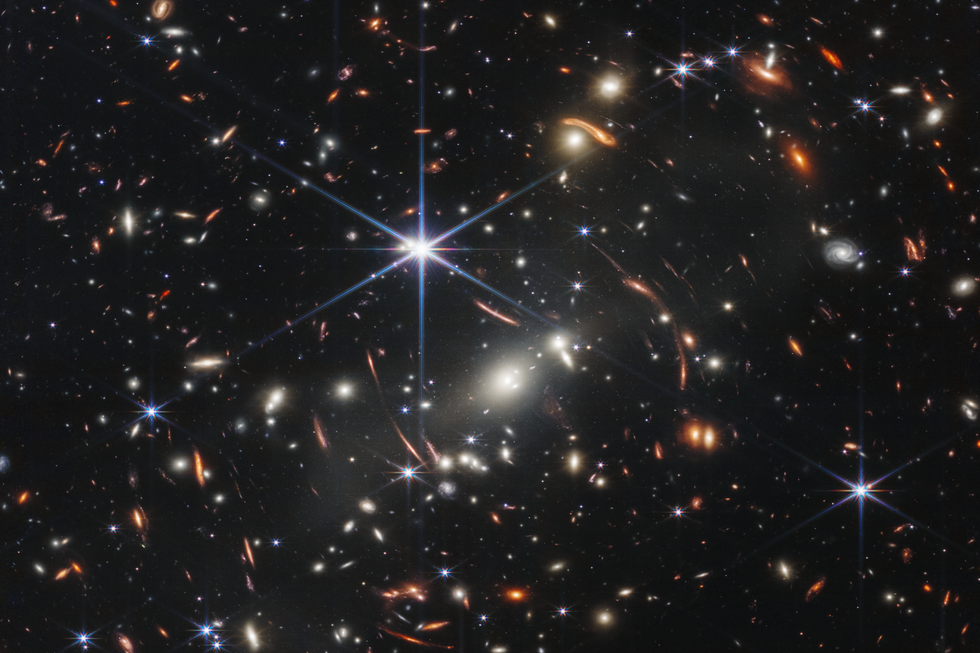
A team of South Korean researchers have uncovered evidence behind how our universe could end
|NASA
And while other experts in the field have challenged their conclusions, they have been unable to throw them out altogether.
Rather than continuing to spread apart indefinitely, cosmic matter could eventually collapse inward if these findings prove accurate.
Prior to 1998, astronomers had assumed the universe's post-Big Bang expansion would gradually slow down due to gravitational effects.
That year, however, scientists identified dark energy as a force accelerating cosmic expansion.
Some theoretical models predicted this would eventually scatter stars so far apart that the night sky would appear virtually empty.
Alternative hypotheses went further still, proposing a "Big Rip" scenario in which even atoms would be torn apart.
LATEST SPACE HEADLINES FROM GB NEWS:
These earlier predictions assumed dark energy would remain constant or strengthen over time.
But the new South Korean research says the mysterious force may actually be weakening.
Professor Young Wook Lee of Yonsei University in Seoul led the team that revisited supernova data first used to identify dark energy nearly 30 years ago.
After making adjustments to their analysis, the researchers concluded dark energy had not only varied over time but that cosmic acceleration was actually diminishing.
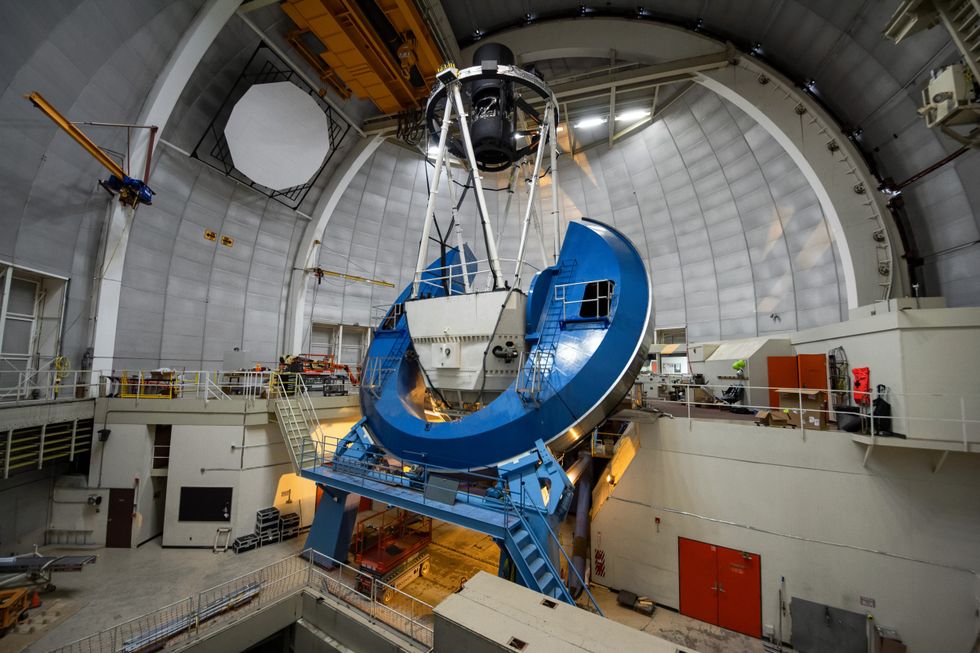
Data gathered in March from the Dark Energy Spectroscopic Instrument (pictured) in Arizona's desert suggested galactic acceleration had shifted over time
|WIKIMEDIA COMMONS
"The fate of the universe will change," Prof Lee said.
Separately, surprising data in March from the Dark Energy Spectroscopic Instrument (Desi) in Arizona's desert suggested galactic acceleration had shifted over time.
Professor Ofer Lahav of University College London told the BBC: "Now with this changing dark energy going up and then down, again, we need a new mechanism. And this could be a shake up for the whole of physics."
But Professor George Efstathiou of Cambridge University's Institute of Astronomy has disputed Professor Lee's theory.
Prof Efstathiou branded the idea "weak", adding he thought the idea was "just reflecting the messy details of supernovas".