










Nasa's James Webb Space Telescope has identified an extraordinary gas giant that scientists say defies all conventional understanding of planetary formation.
The Jupiter-sized world, designated PSR J23222650b, possesses a distinctive lemon shape and an atmosphere composed of carbon and helium - a combination never before observed on any exoplanet.
Within its superheated upper atmosphere, clouds of soot drift through the extreme conditions.
Deep within the planet's core, these carbon particles condense under immense pressure to form diamonds.
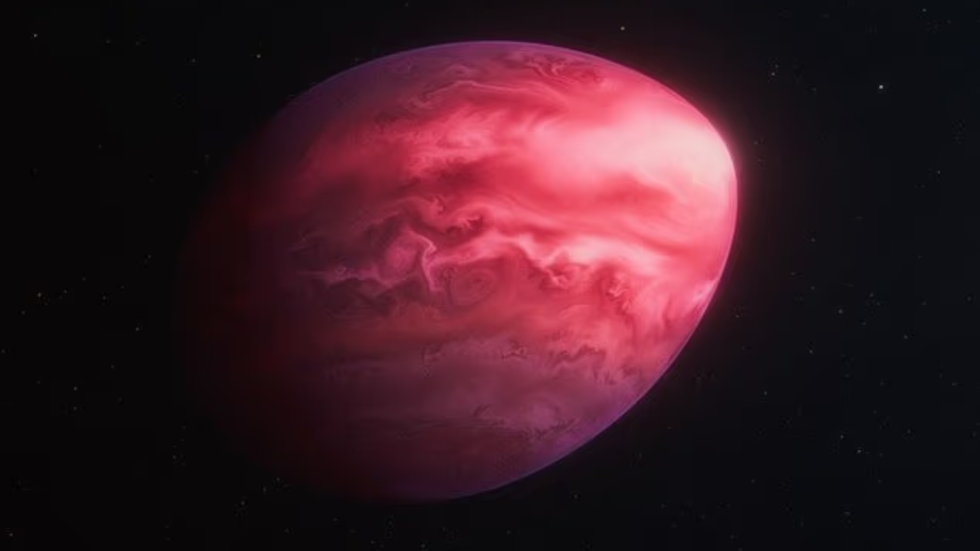
The Jupiter-sized world possesses a distinctive lemon shape and an atmosphere composed of carbon and helium
|NASA
What makes this discovery particularly remarkable is the planet's host.
Rather than orbiting a conventional star similar to our Sun, PSR J23222650b circles a pulsar - the incredibly dense remnant of a collapsed star that packs solar mass into a city-sized sphere.
Situated some 750 lightyears from Earth, this pulsar subjects its companion world to a relentless barrage of gamma radiation whilst simultaneously warping it through gravitational forces into its unusual citrus-like form.
The result is one of the most extreme thermal environments ever recorded on a planetary body.
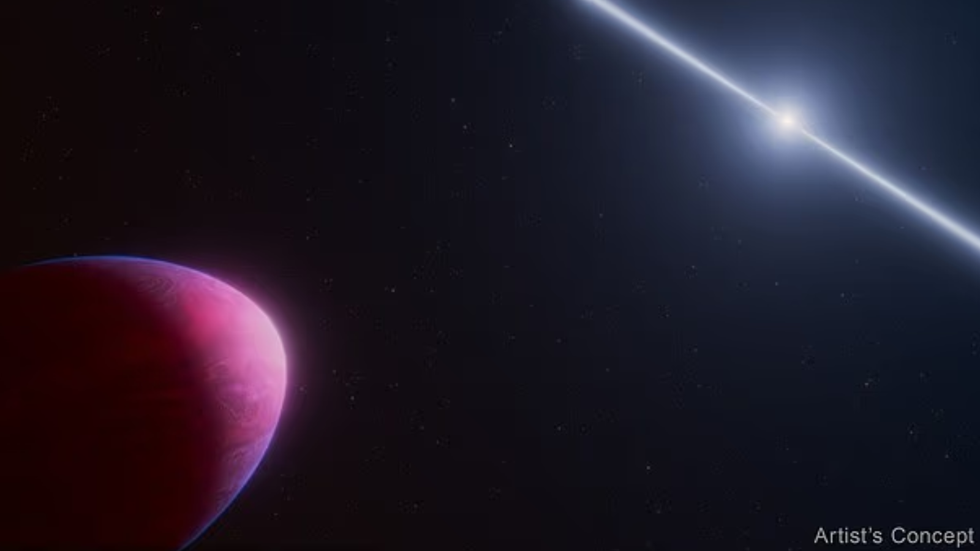
The result is one of the most extreme thermal environments ever recorded on a planetary body
|NASA
Daytime temperatures soar to approximately 2,030°C, whilst the night side cools to around 650°C - a staggering differential of nearly 1,400 degrees.
The planet's proximity to its stellar remnant is equally extraordinary, orbiting at merely one million miles distance.
By comparison, Earth sits roughly 100 million miles from the Sun.
This tight orbit means a complete year on PSR J23222650b lasts just 7.8 hours as the world hurtles around its host at tremendous velocity.
SPACE - READ THE LATEST:
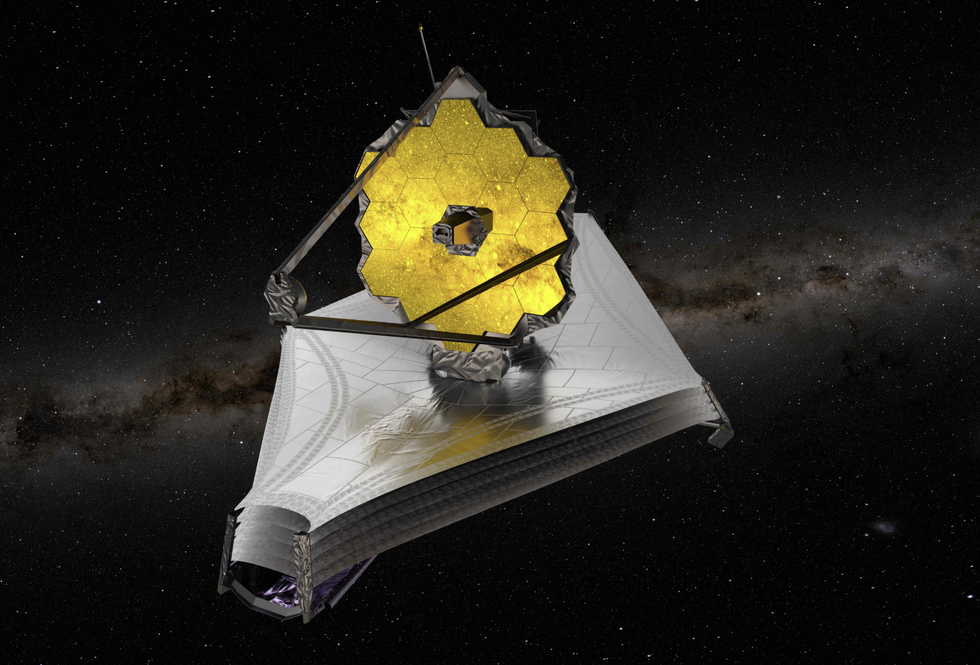
The remarkable exoplanet was identified by the James Webb Space Telescope
| ESAAmong approximately 6,000 known exoplanets, this remains the sole gas giant discovered orbiting a neutron star.
The atmospheric composition represents what researchers describe as an entirely new category of planetary atmosphere.
Dr Peter Gao, of the Carnegie Earth and Planets Laboratory and study co-author, recalled the team's initial reaction: "I remember after we got the data down, our collective reaction was 'What the heck is this?' It's extremely different from what we expected."
Rather than detecting typical exoplanetary molecules such as water, methane, and carbon dioxide, the researchers found molecular carbon in the forms C3 and C2.
Dr Michael Zhang, of the University of Chicago, stated: "This is a new type of planet atmosphere that nobody has ever seen before."
The finding is particularly perplexing because at such extreme temperatures, carbon would normally bond with other atmospheric atoms.
Molecular carbon can only dominate when oxygen and nitrogen are virtually absent - a condition observed in none of the roughly 150 exoplanets previously analysed in detail.
The planet's origins remain a complete enigma to the scientific community.
Dr Zhang explained: "Did this thing form like a normal planet? No, because the composition is entirely different."
Formation through stripping a star's outer layers has also been dismissed, as stellar nuclear reactions do not produce pure carbon.
"It's very hard to imagine how you get this extremely carbon-enriched composition. It seems to rule out every known formation mechanism," Dr Zhang added.
The team's leading hypothesis suggests carbon and oxygen may have crystallised within the planet's interior during cooling, with pure carbon crystals rising to mix with helium.
Yet Professor Roger Romani, of Stanford University, acknowledged this explanation remains incomplete.
He said: "Something has to happen to keep the oxygen and nitrogen away.
"And that's where the mystery comes in. But it's nice not to know everything.
"I'm looking forward to learning more about the weirdness of this atmosphere. It's great to have a puzzle to go after."
Our Standards: The GB News Editorial Charter