










Researchers have picked up a "heartbeat" pulse from a mysterious "interstellar object" approaching Earth.
The visitor, named 3I/ATLAS, reaches its nearest point to our planet today, passing within 170 million miles of us.
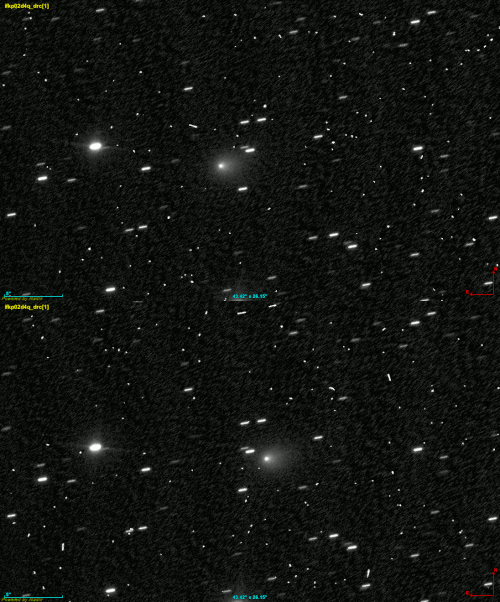
Amateur astronomers can spot the cosmic traveller using modest telescopes or cameras.
But its visit comes as a range of unexplained anomalies puzzle scientists studying the visitor.
One study has linked 3I/ATLAS to cosmic calendars employed by ancient civilisations.
Independent researcher Andrew Collins claims to have identified a mysterious 'heartbeat' emanating from the object.
Summer observations recorded rhythmic bursts occurring every 16.16 hours.
Then, newer data from Spain's Two-meter Twin Telescope in September revealed this cycle had shifted to 15.48 hours as the object approached Earth.

3I/ATLAS reaches its nearest point to our planet today
| NASAMr Collins claims these "heartbeats" correspond with Earth's ancient calendars.
The researcher found the new cycle fits exactly into 387 units of a 144-second measurement used by old Chinese clocks and Indian meditation practices.
Earth's 24-hour rotation divides into 600 of these same units.
Mr Collins claims this alignment is too perfect to be coincidental - and has hinted intelligent design may be behind the beat.
READ MORE ON THE 'INTERSTELLAR OBJECT'
 PICTURED: Hubble Space Telescope images of the 'object' hurtling through space | NASA
Professor Avi Loeb, who leads the Galileo Project searching for extraterrestrial life, has repeatedly said there may be more to 3I/ATLAS than meets the eye.
"How do you explain the large mass of the object quantitatively, not just say 'oh, comets are weird and some of them are unusual and therefore it's okay.' That's not an explanation," Prof Loeb told the Danny Jones Podcast.
The Harvard astrophysicist has highlighted numerous anomalies including the object's three-mile length and its unusual 'anti-tail' pointing towards the sun rather than away from it.
Prof Loeb suggests this sunward stream could mean a spacecraft engine is turned on and thrusting.
The object's trajectory from the same direction as the famous 1977 "Wow!" signal has also raised eyebrows.

Nasa has long stressed the object poses no collision risk whatsoever, and has ruled out any artificial construction or signs of extraterrestrial life
| GETTYNasa has long stressed the object poses no collision risk whatsoever, and has ruled out any artificial construction or signs of extraterrestrial life.
Officials say the object is simply a large space rock originating from a distant solar system.
Both Nasa and the European Space Agency maintain that 3I/ATLAS is nothing more than an ordinary comet with an unusual chemical composition from its home solar system.
The space agency faced criticism following an October press conference that released poor-quality images despite Mars probes passing within 18 million miles of the object.
Amateur stargazers have managed to capture sharper photographs from Earth using standard equipment - fuelling speculation that Nasa may be withholding information.