










Astronomers have identified an extraordinary new type of cosmic entity which they are calling a "window into the dark universe".
The object, designated Cloud-9, sits approximately 14 million light-years from our planet and consists entirely of "gas-rich dark matter" without a single star.
Dr Andrew Fox, of the European Space Agency and the Space Telescope Science Institute, said the "ghost" can be thought of as "a failed galaxy".
Dr Fox said it was "a ghostly object that didn't quite have enough mass to become self-gravitating and cross the threshold into star formation".
The remarkable find represents a primordial remnant from the dawn of the cosmos - a fundamental galactic building block that never completed its transformation into a fully-fledged galaxy.
At the heart of Cloud-9 lies an enormous, dense sphere of neutral hydrogen measuring roughly 4,900 light-years across - more than a thousand times the distance separating Earth from Proxima Centauri, our nearest star after the Sun.
Despite having enough material to form a star, observations from the Hubble Space Telescope have verified that the cloud harbours no stars at all.
The primary indicator of dark matter within this structure is its sheer scale, Dr Fox told the Daily Mail.
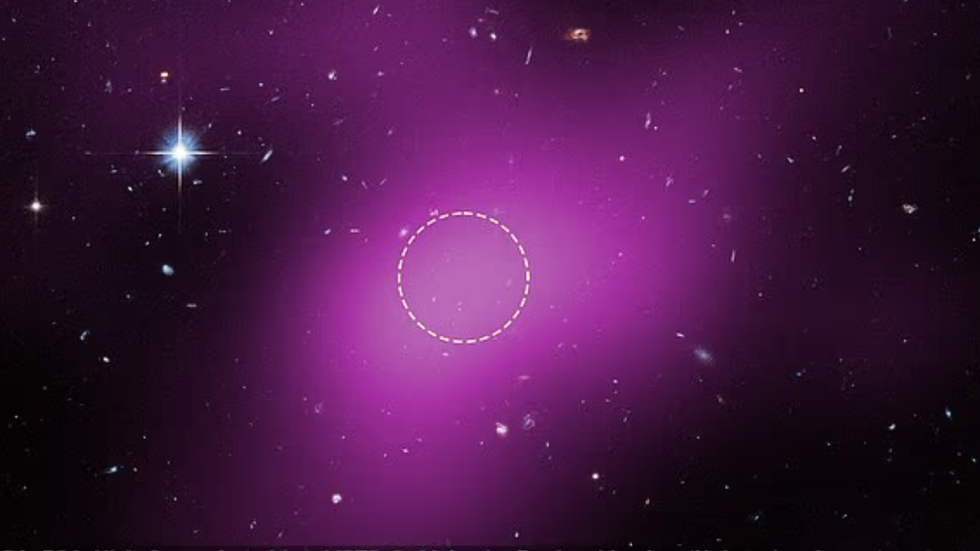
The object, designated Cloud-9, sits approximately 14 million light-years from our planet
|NASA
"A cloud this size needs a source of gravity to hold it together. There are no stars to provide this gravity, and the neutral hydrogen gas does not contain enough mass, so dark matter must be the culprit.
"Without it, the cloud would simply fall apart," he explained.
Researchers calculate the hydrogen's mass at approximately one million solar masses, whilst the dark matter required to maintain structural integrity totals around five billion solar masses.
Cloud-9 belongs to a category of objects previously existing only in theoretical models: a Reionization-Limited H I Cloud, or RELHIC.
SPACE - READ THE LATEST:
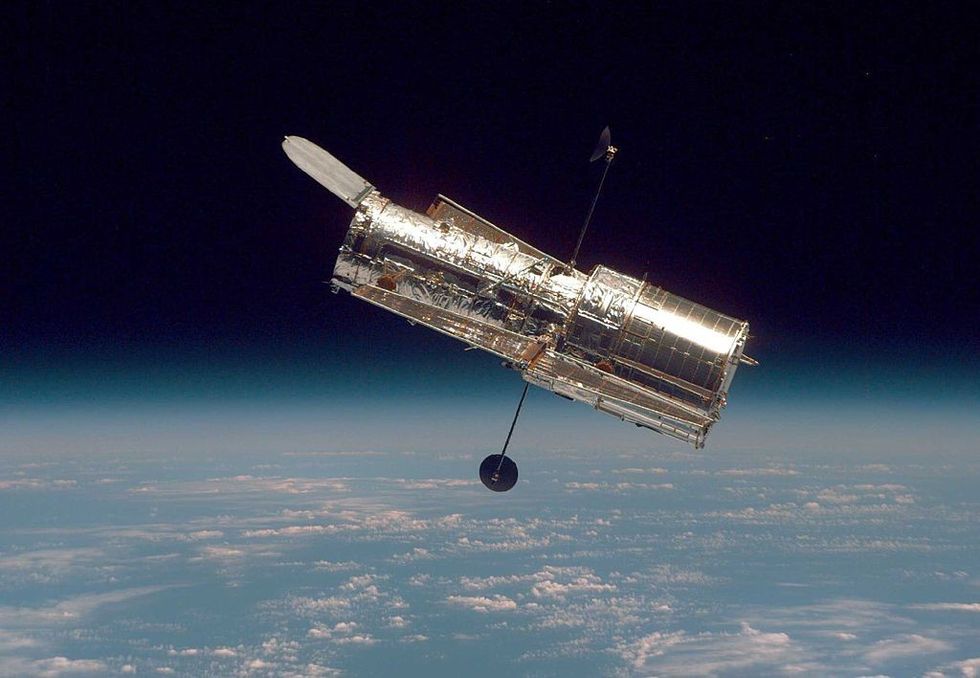
Observations using the Hubble Space Telescope have verified that the cloud harbours absolutely no stars
| GETTYDr Fox said: "Theories of galaxy formation predicted that there is a minimum threshold of dark matter required to ignite star formation and turn a dark cloud into a luminous galaxy.
"With Cloud-9, we have an example of an object just below this threshold, containing no stars."
Dr Alejandro Benitez Llambay, of Milano-Bicocca University, said: "Cloud-9 is a rare 'middle ground' survivor. According to our models, fewer than 10 per cent of halos in this mass range remain in such a pristine state, making Cloud-9 a 'missing link' in our understanding of how galaxies are born."
Cloud-9 was initially detected three years ago by China's Five-hundred-metre Aperture Spherical Telescope (Fast) in Guizhou province.
Cloud-9 consists entirely of gas-rich dark matter
|GETTY
Only now have scientists been able to employ Hubble to definitively establish the absence of stars, confirming its likely status as a RELHIC.
Lead author Dr Gagandeep Anand, of the Space Telescope Science Institute, said: "In science, we usually learn more from the failures than from the successes. In this case, seeing no stars is what proves the theory right. It tells us that we have found in the local universe a primordial building block of a galaxy that hasn't formed."
The findings appear in The Astrophysical Journal Letters.
Our Standards: The GB News Editorial Charter