










Scientists have discovered 45 "Earth-like" planets which could potentially harbour life.
Researchers at the Carl Sagan Institute at Cornell University have named 45 planets which lie within the habitable zone - a Goldilocks zone where it's not too hot and not too cold.
Earth lies in the Sun's habitable zone - where water can exist without boiling or freezing, and life can thrive.
Some of the planets named by researchers are only tens of light-years away, perhaps opening the door the possibility of future travel.
TRENDING
Stories
Videos
Your Say
Professor Lisa Kaltenegger, one of the authors of the study said: "Life might be much more versatile than we currently imagine, so figuring out which of the 6,000 known exoplanets would be most likely to host extraterrestrials could prove critical."
Until now, it was unclear which of the 6,000 identified exoplanets lie within the habitable zone.
According to the researchers, the most interesting planets are TRAPPIST-1 d, e, f, and g, all of which are 40 light-years from Earth.
But with current technology, it would currently take at least 800,000 years to reach the TRAPPIST-1 solar system, Nasa says.
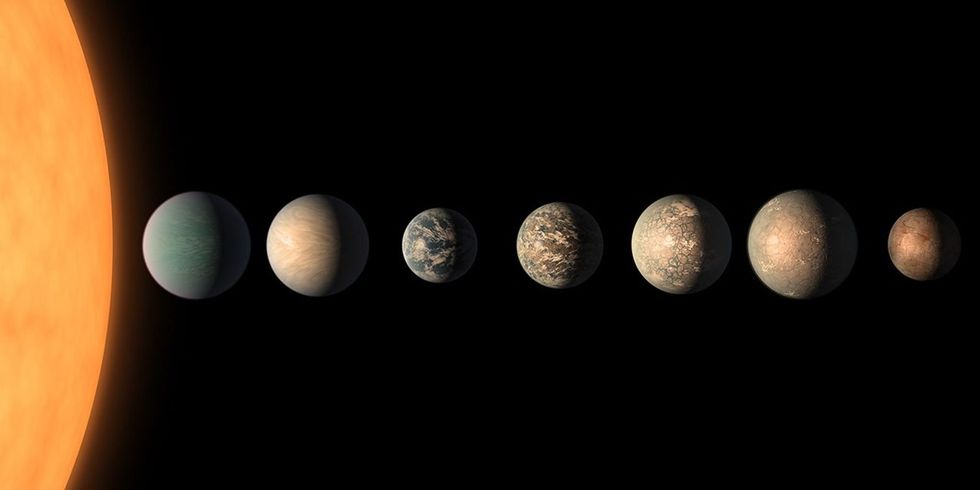
An artist's rendition of what the TRAPPIST-1 solar system, which contains several planets in the habitable zone, may look like
|NASA
Researchers are also interested in the planets which receive sunlight in a similar way to how Earth currently does.
These were named as TRAPPIST–1 e, TOI–715 b, Kepler–442 b, Kepler–1544 b, Kepler–1652 b, and the planets Proxima Centauri b, Wolf 1069 b, GJ 1002 b, and GJ 1061 d.
The study will also examine the planets on the edge of habitable zones to determine where it ends.
Study author Gillis Lowry said: "While it's hard to say what makes something more likely to have life, identifying where to look is the first key step.
LATEST SPACE NEWS:
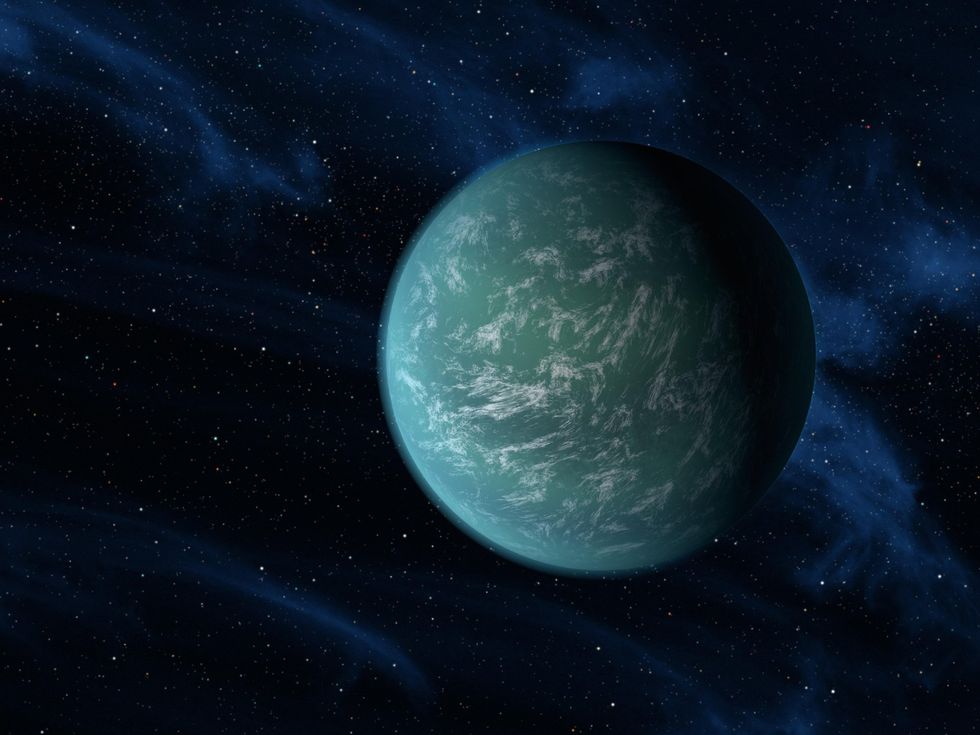
PICTURED: An artist's rendition of Kepler-22b, one of the first exoplanets found to be within the habitable zone of another solar system
|NASA
"So the goal of our project was to say 'here are the best targets for observation'."
The team also identified the best methods to observe the planets.
These include the James Webb Space Telescope, the Nancy Grace Roman Space Telescope, set to launch in 2027, and the Extremely Large Telescope (ELT).
When the ELT launches in March 2029, it will become the world's largest optical and infrared telescope, capable of observing 100 million times more light than the the human eye.
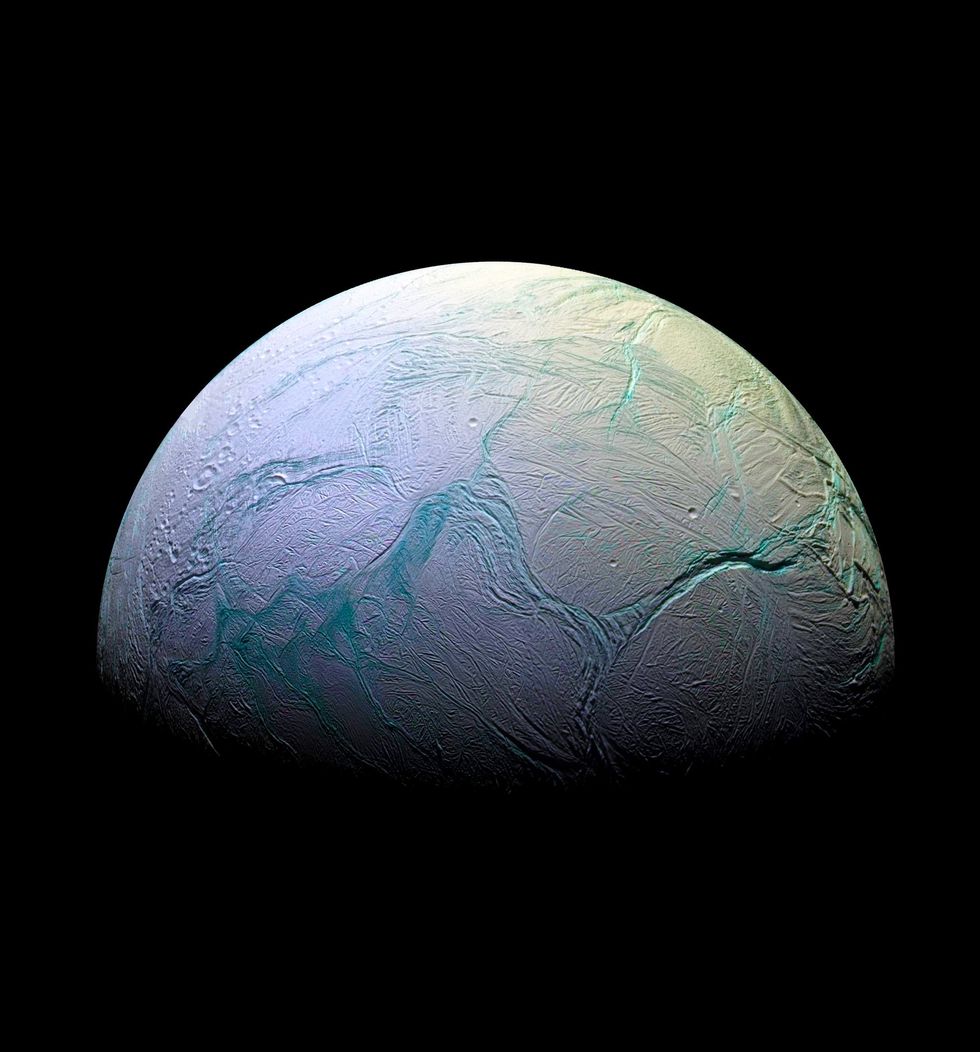
Photograph of Enceladus, Saturn's moon which may carry life
|GETTY
Within our own solar system, experts believe life could be found in the subsurface oceans of Jupiter or Saturn's moons.
Saturn's moon Titan, is considered one of the most likely places to find extraterrestrial life as the only place other than Earth to have liquid in the form of rivers, lakes, and seas.
Nasa's Dragonfly mission, set to be launched in July 2028, will examine the moon's chemicals to determine the possibility of life.
A study in October found another of Saturn's moon, Enceladus, carried more carbon-based substances in its liquid water than previously thought.