










Scientists have identified what is believed to be an entirely new type of planet made completely of molten lava.
The planet, designated L98-59d, is found approximately 35 light-years from Earth and measures roughly 1.6 times our planet's diameter, circling a compact red dwarf star.
Researchers had previously speculated that this distant planet might contain vast quantities of liquid water.
However, fresh analysis published in Nature Astronomy points to something far more extraordinary and unlike anything previously documented.
TRENDING
Stories
Videos
Your Say
Conditions on the surface are extraordinarily hostile, with temperatures soaring to approximately 1,900 degrees, while the gravitational pull from nearby planets generates enormous waves across the global ocean of magma.
The atmosphere contains high concentrations of hydrogen sulphide, producing an overwhelming smell of rotting eggs.
Dr Harrison Nicholls, astrophysicist at the University of Oxford, described the planet's remarkable physical state as "a mushy, molten state", likened to molasses; it's likely the planet's core would also be molten.
The extreme environment also makes the prospect of life existing there exceptionally small.
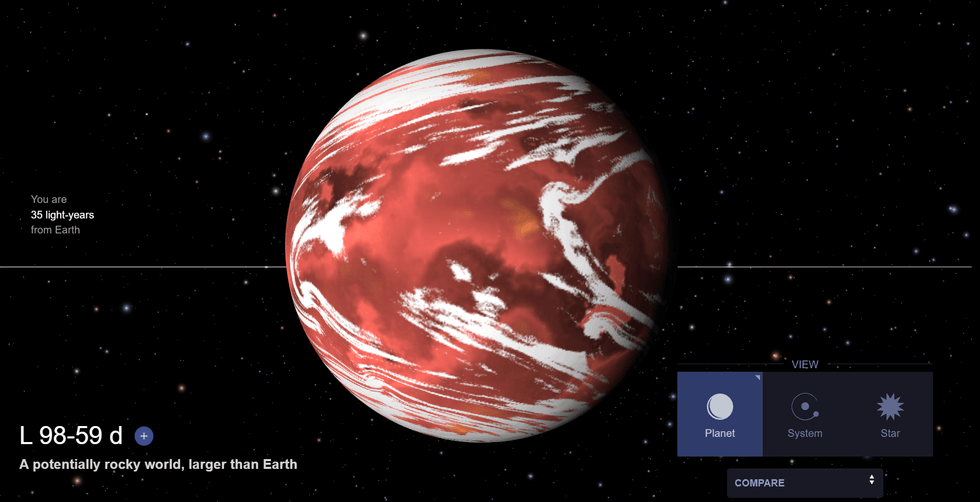
A visualisation of the planet L98-59d depicts the strange makeup of the planet
|NASA
"If there are aliens out there that could live in lava that would be amazing, but I don't think it's likely that it's habitable," Dr Nicholls explained. "It's nice to revel in the alienness of the planet itself."
While the overall conditions are not considered viable to support any form of life, the sheer strangeness of this world offers scientists a fascinating glimpse into planetary diversity beyond our solar system.
The James Webb Space Telescope proved instrumental in unlocking the planet's secrets, where, unlike earlier methods that relied on tracking planetary silhouettes passing before their host stars, this powerful observatory can analyse starlight filtering through the atmosphere to determine a planet's chemical composition.
LATEST SPACE DISCOVERIES
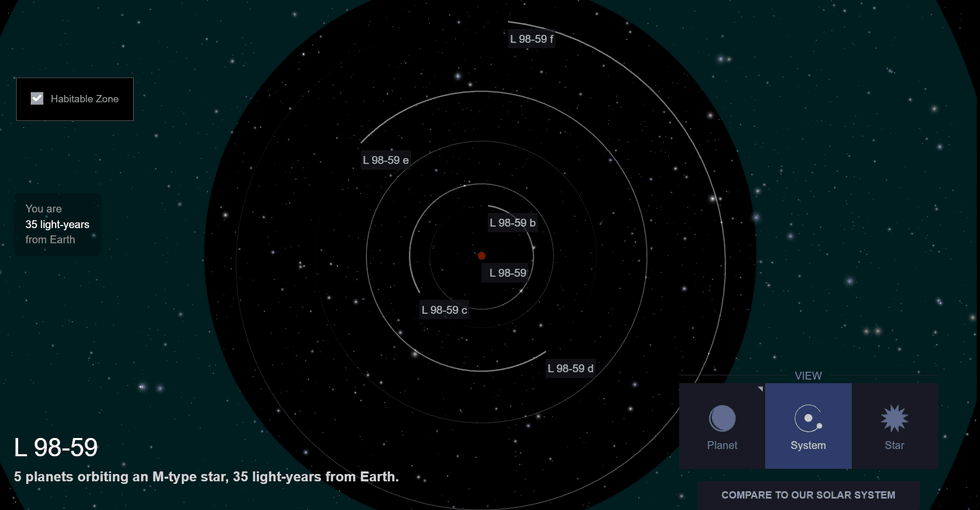
L98-59d is among five planets orbiting a star 35 lightyears from Earth
|NASA
Earlier observations had detected a sulphur-rich atmosphere surrounding L98-59d, which puzzled researchers.
Neither a rocky landscape nor a water-covered planet – the two standard categories for bodies of this size – could sustain such an atmosphere across the nearly five billion years of the planet's existence.
Through sophisticated computer modelling, scientists reconstructed the planet's evolution from its earliest formation to the present day.
This analysis indicated that L98-59d possesses a magma ocean stretching thousands of kilometres beneath its surface, potentially with a completely molten core.
"You can only really explain this planet if it has this deep magma ocean inside of it," said Dr Nicholls. "The magma ocean efficiently stores the gases and keeps the gases protected from physical processes that would otherwise remove them."
The research suggests that molten worlds may be far more prevalent than previously assumed, prompting scientists to reconsider how they classify potentially habitable planets.
"Some planets in the so-called habitable zone might not be very habitable at all, they might be these molten planets," Dr Nicholls noted.
"While this molten planet is unlikely to support life, it reflects the wide diversity of the worlds which exist beyond the solar system."
Dr Jo Barstow, a planetary scientist at the Open University who participated in the James Webb observations, said the research offered a convincing explanation.
She claimed the work suggests it could be "even more extreme" than Jupiter's volcanic moon.