







Astronomers have discovered a supermassive black hole awakening after 100 million years, with researchers capturing remarkable images.
"It's like watching a cosmic volcano erupt again after ages of calm," says Dr Shobha Kumari of Midnapore City College in India, who led the study.
The eruption has unleashed enormous plumes of superheated plasma extending across nearly one million light-years, roughly ten times the width of our own Milky Way galaxy.
The black hole resides within a vast galaxy cluster, held together by intense hot gas, creating an ongoing conflict between its explosive energy and the immense pressure from surrounding material.
TRENDING
Stories
Videos
Your Say
When supermassive black holes begin consuming nearby gas clouds, they transition from stable to active states.
Matter spiralling toward the event horizon accelerates dramatically, generating extreme temperatures through friction.
These violent forces eventually propel jets of superheated plasma outward, releasing powerful electromagnetic radiation.
The research team employed two major radio telescope systems to observe J1007+3540: the Low Frequency Array in the Netherlands and India's upgraded Giant Metrewave Radio Telescope.
 The supermassive black hole is awakening after 100 million years | LOFAR/PAN-STARRS/S.KUMARIETAL
LATEST DEVELOPMENTS
The paper, which appears in the Monthly Notices of the Royal Astronomical Society, shares how radio observations captured the hostile environment within the galaxy cluster, dramatically warping the black hole's outward jets.
Intense pressures bend, compress and twist the plasma streams as they push through surrounding gases.
The uppermost portion of the jet, known as the northern lobe, appears curved and displaced sideways by these powerful forces.
Beyond the bright inner jet, astronomers detected a surrounding shell of older, dimmer plasma remnants from previous eruptions now distorted by the extreme conditions.
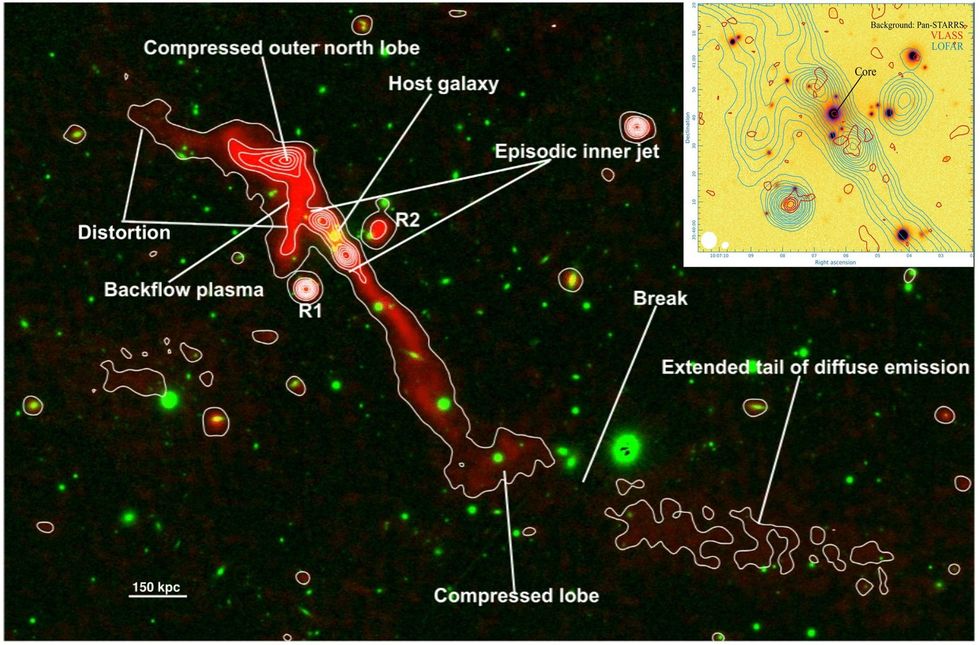
The same images with labels illustrate the compressed northern lobe
|LOFAR/PAN-STARRS/S.KUMARIETAL
Dr Kumari explained: "This dramatic layering of young jets inside older, exhausted lobes is the signature of an episodic AGN (Active Galactic Nucleus), a galaxy whose central engine keeps turning on and off over cosmic timescales."
The Milky Way's own central black hole, Sagittarius A*, currently lies in a dormant state.
Scientists believe it could eventually undergo a comparable awakening, producing plasma jets with the potential to fundamentally alter the cosmos.
Earth would likely remain shielded from any resulting radiation, though a direct strike from such a jet would possess sufficient power to eliminate the planet.
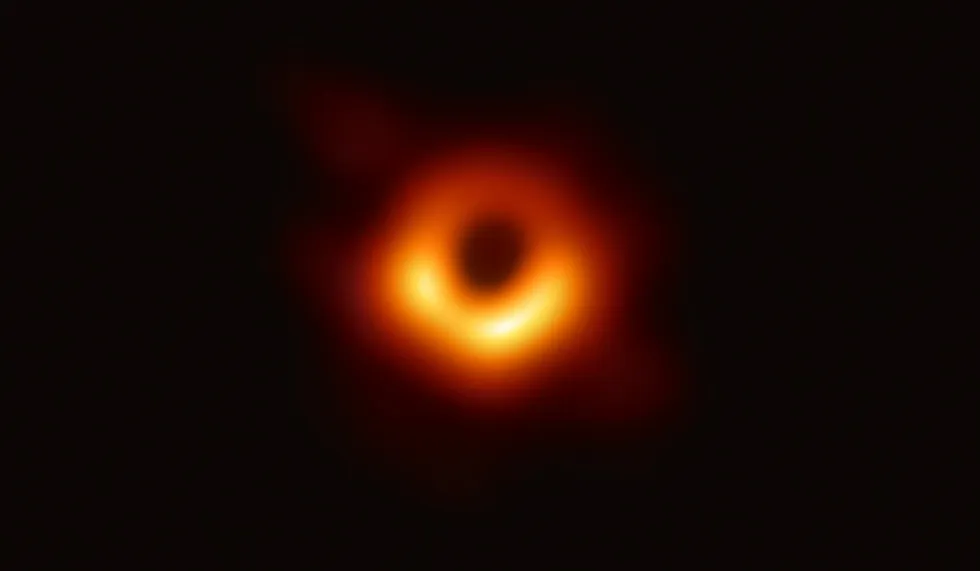
Earth would likely remain shielded from any resulting radiation caused by the black hole
| PAHowever, astronomers anticipate no such event until our galaxy merges with its neighbour, the Large Magellanic Cloud.
That collision remains approximately 2.4 billion years in the future, offering considerable reassurance for the present.
Our Standards: The GB News Editorial Charter