










Astronomers have stumbled upon a mysterious “iron bar” that could offer insight into how Earth may meet its end.
The strip of ionised iron atoms was observed stretching across the Ring Nebula, located approximately 2,283 light-years from our planet.
Scientists made the discovery using the Large Integral Field Unit (LIFU), an instrument attached to the William Herschel Telescope that employs hundreds of fibre-optic cables to analyse light wavelengths across an entire nebula.
Dr Roger Wesson, of Cardiff University and University College London, said: "When we processed the data and scrolled through the images, one thing popped out as clear as anything – this previously unknown 'bar' of ionised iron atoms, in the middle of the familiar and iconic ring."
The research team has put forward two possible explanations for the mysterious structure.
One theory points to an unknown process during the nebula’s formation, as its parent star collapsed.
The alternative suggests the bar could be made up of plasma left behind from a rocky planet that was destroyed as the star expanded.
Dr Wesson told the Daily Mail: “We know there are planets around many stars, and if planets once orbited the star that formed the Ring Nebula, they would have been vaporised when the star became a red giant.”
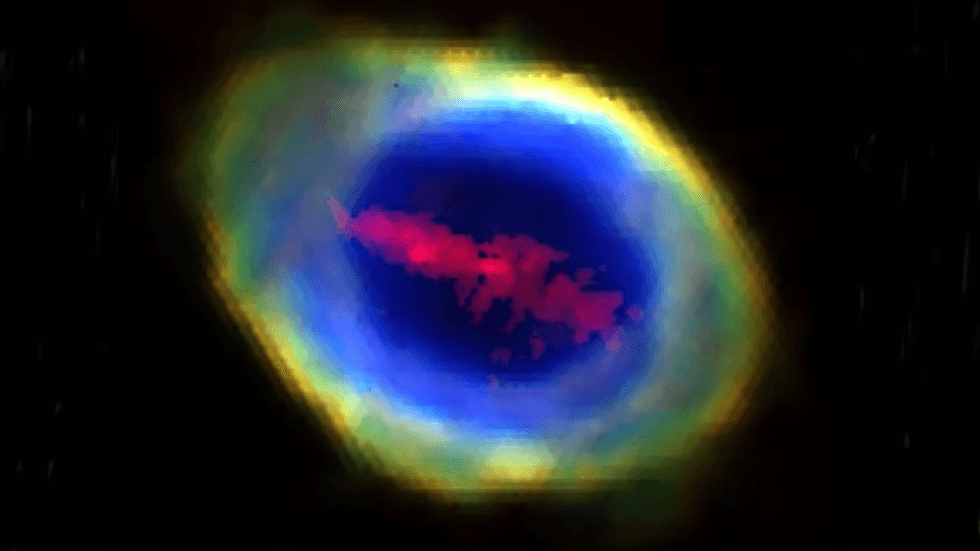
The strip of ionised iron atoms was observed stretching across the Ring Nebula
He added: "And the mass of iron in the bar is about what you'd expect from the vaporisation of a planet.
"If Mercury or Mars were vaporised, that would give a bit less iron than the bar in the Ring, while if Earth or Venus were vaporised, it would give a bit more."
Should this iron bar indeed originate from a destroyed planet, it offers a haunting preview of Earth's eventual demise.
Stars similar to our sun maintain stability through a delicate balance between gravitational forces pulling inward and nuclear fusion pushing outward.
Once hydrogen fuel depletes, this equilibrium collapses, triggering a dramatic transformation.
SPACE - READ THE LATEST:
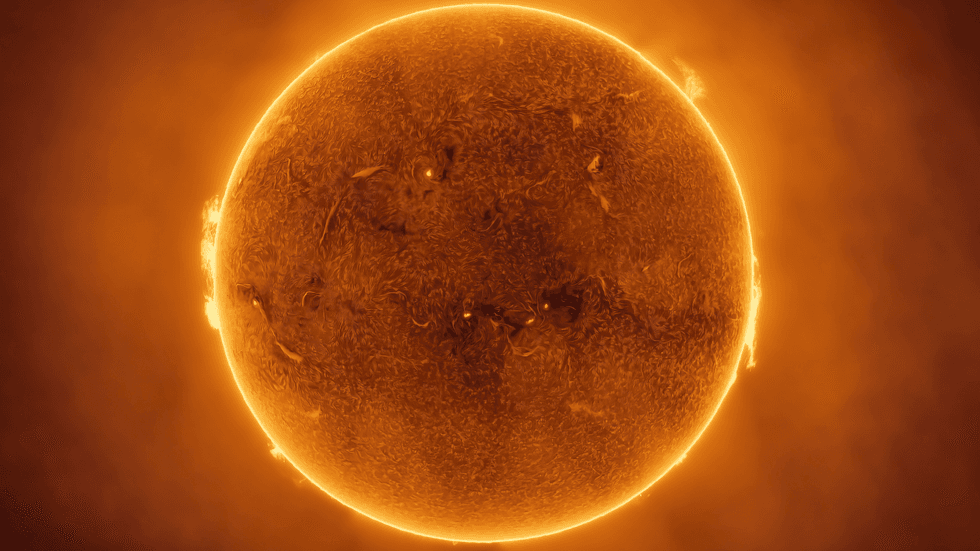
The sun will expand into a Red Giant in around five billion years time
|GETTY
The resulting pressure generates sufficient heat to fuse helium into carbon, sparking fusion reactions in the outer stellar layers.
These layers subsequently balloon outward, cooling as they expand into a Red Giant - a stellar body between 100 and 1,000 times its original size.
The sun will undergo this identical process in roughly five billion years time, destroying everything on Earth.
Our planet will either be incinerated by extreme temperatures or ripped apart by immense gravitational tidal forces.
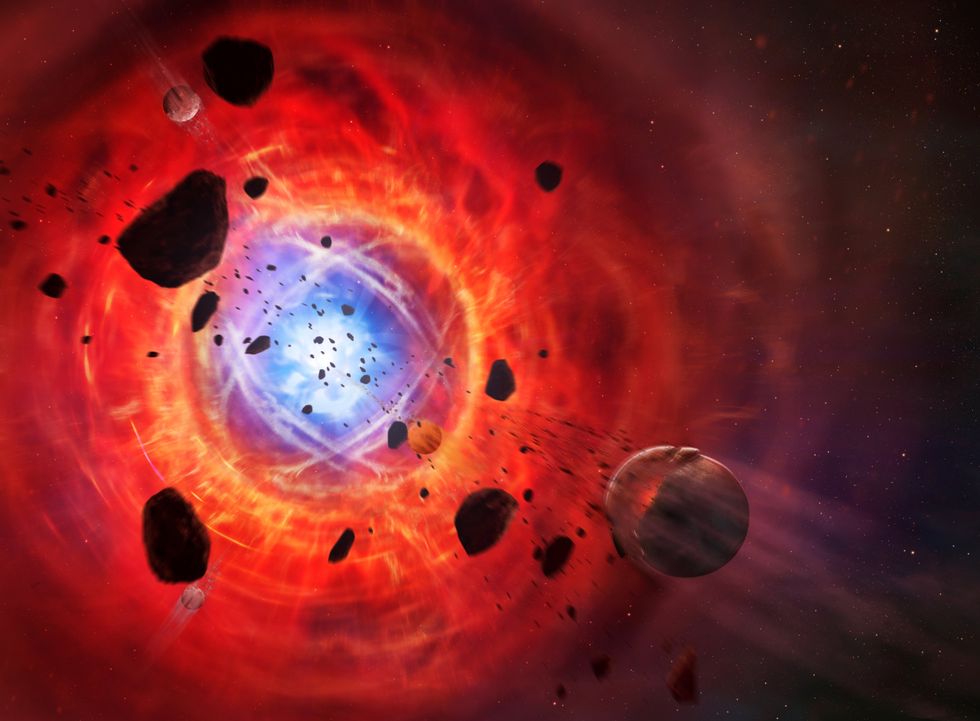
Scientists have suggested the 'iron bar' may be a vaporised planet
|GETTY
Researchers remain cautious about drawing firm conclusions about the bar's origins.
Dr Wesson said: "A vaporised planet is a possibility. But it's not the only possibility, and we'd have to work out how the iron ended up in a bar shape if it did come from a planet."
He believes similar iron formations likely exist elsewhere in the cosmos, waiting to be identified.
"The more we can find, the more information we will have to determine how they formed, so we're hunting for more of them," Dr Wesson added.
Our Standards: The GB News Editorial Charter