










Stargazers could soon witness what may become the brightest comet of 2026.
The celestial object known as C/2025 R3 (PanSTARRS) has been dubbed the "Great Comet of 2026" by astronomers.
It might be visible without any equipment, though binoculars or a small telescope could be needed.
Scientists remain uncertain about exactly how luminous the comet will appear - but it has the potential to outshine any other comet this year.
Last year brought several impressive comets into view, including Comet C/2025 A6 (Lemmon), which displayed a striking green colour.
The comet was only discovered in September 2025, making it a recent addition to astronomical records.
It was found by the Panoramic Survey Telescope and Rapid Response System, which gives the comet its PanSTARRS name.
This icy visitor takes an extraordinarily long time to complete its journey around the Sun.
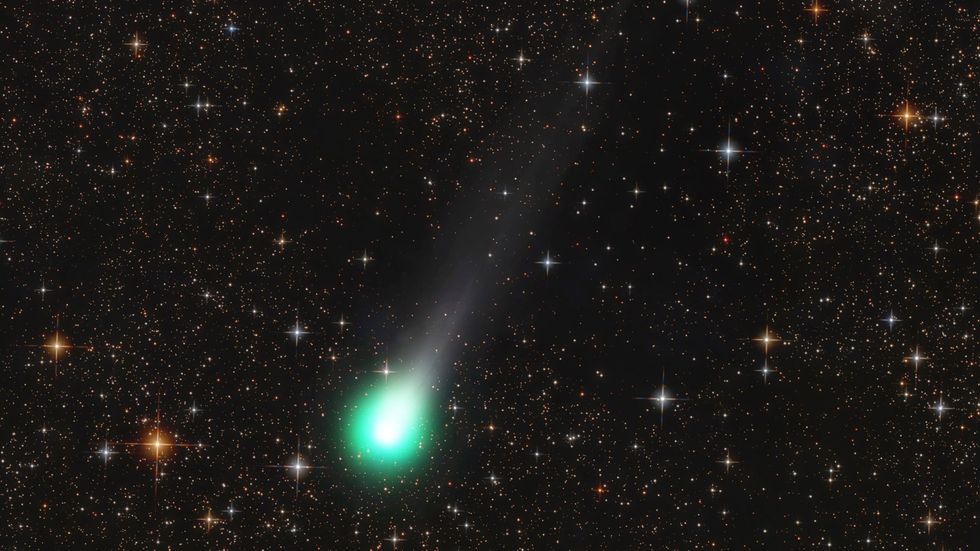
PICTURED: C/2025 R3 (PanSTARRS), which has been dubbed the 'Great Comet of 2026' by astronomers
|GETTY
Its orbital period exceeds 1,000 years, meaning few humans will ever get the chance to see it.
Such a lengthy orbit makes this a once-in-many-lifetimes opportunity for observers in the UK and beyond.
The comet will make its closest pass by the Sun on April 20.
Just one week later, on April 27, it will reach its nearest point to Earth.
LATEST SPACE HEADLINES FROM GB NEWS:
At that moment, the distance between the comet and our planet will be approximately 44 million miles.
In comparison, the Moon sits at an average distance of roughly 239,000 miles from Earth.
Those eager to catch a glimpse should mark April 17 in their diaries - it coincides with the New Moon, providing exceptionally dark skies for observation.
A bright Full Moon typically hampers stargazing, but the New Moon creates ideal conditions.
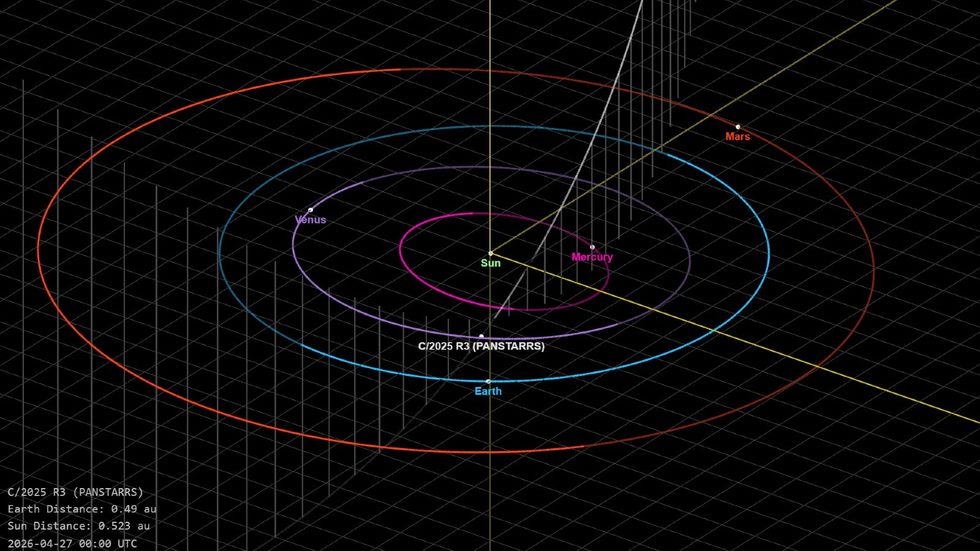
Nasa imagery of the comet's orbital path shows it will reach its closest point to Earth in April
|NASA JET PROPULSION LABORATORY
Visibility may decrease as the comet nears the Sun, then improve again in late April.
The best time to look up is just before dawn breaks, with stargazers told to direct their gaze towards the constellation of Pisces.
Astronomers say giving your eyes time to adjust to the darkness before searching the sky is vital.
Heading to the countryside offers the clearest conditions - while locations that are either elevated or completely flat work best for spotting the comet.