










A biblical disaster said to have struck at the moment of the crucifixion of Jesus Christ is being cited as real after a decade-old scientific study resurfaced online and reignited debate.
The Gospel of Matthew records “the earth shook” moments after Jesus cried out on the cross. And geologists reported in 2011 physical evidence may support that account.
Researchers examined sediment layers near the Dead Sea, around 25 miles from where many scholars believe the crucifixion took place, and found signs of at least two major earthquakes.
Their analysis identified a powerful quake around 31 BC and a smaller seismic event dated to between 26 and 36 AD.
TRENDING
Stories
Videos
Your Say
That window aligns closely with the period when Pontius Pilate served as procurator of Judea, the timeframe in which Matthew’s Gospel places the earthquake following Jesus’s death.
Many historians believe the crucifixion occurred around 33 AD, placing it squarely within the range identified by the scientists.
The researchers stressed, however, the evidence allows for several interpretations rather than definitive proof.
One possibility is that the disturbed sediments record the earthquake described in the Bible, while another is that a nearby quake was later woven into the Gospel narrative.

Many historians believe the crucifixion occurred around 33 AD
|GETTY
The study has surged back into public view after spreading on X, where some users hailed it as scientific confirmation of scripture, the Daily Mail reports.
“Science (once again) confirms the Bible as a true account”, one widely shared post claimed, drawing tens of thousands of views.
Others were more sceptical, with critics arguing that a dating range spanning a decade could not constitute proof of a specific historical moment.
Some dismissed the research outright, claiming it was impossible to date an earthquake more than 1,500 years old.
LATEST DEVELOPMENTS
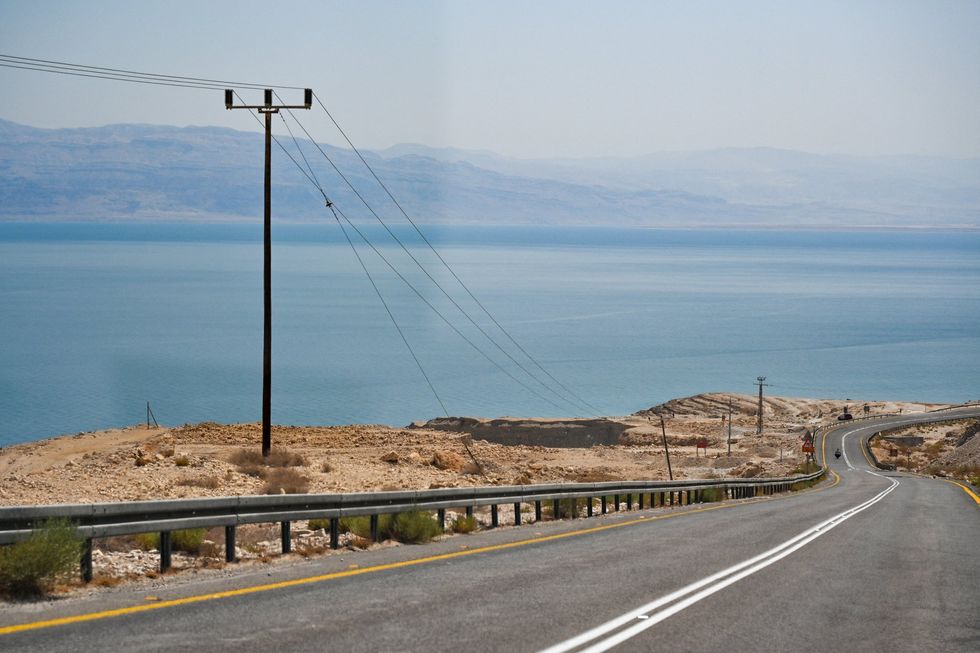
Ein Gedi in Israel is by the Dead Sea, where researchers believe the crucifixion took place over 2,000 years ago
|GETTY
Scientists counter that earthquakes can be identified thousands of years later using methods such as radiocarbon dating, sediment analysis and tree-ring studies known as dendrochronology.
The Dead Sea lies along the Dead Sea Transform, a major fault where tectonic plates slide past one another, making the region highly prone to earthquakes.
Geological records show the area has experienced frequent seismic activity for at least 4,000 years.
By drilling sediment cores near Ein Gedi in Israel, researchers were able to read the Earth’s history year by year using annual layers known as varves.
Each year produces a heavier winter layer and a lighter summer layer, allowing scientists to count time precisely and spot unusual disruptions.
Several layers were bent or broken, distortions the team interpreted as the result of ancient earthquakes.
Tracking these layers across multiple cores produced a detailed timeline from 31 BC to 31 AD.
The sediments also captured climate signals, including evidence of drought following the major quake in 31 BC.
That finding mirrors historical accounts by Josephus, who described famine and hardship in Judea during the same period.
Comparisons with other known regional earthquakes, including events in 19 AD, 37 AD and later decades, failed to produce a better match.
The researchers concluded the evidence leaves three possibilities: the earthquake described in Matthew truly occurred, a nearby quake was incorporated into the biblical story, or an otherwise unrecorded seismic event struck during the crucifixion period.
Our Standards: The GB News Editorial Charter