










A new study has revealed “notes” produced by the sun may be able to predict powerful solar eruptions that can disrupt satellites, communications and power grids on Earth.
By tracking the subtle shifts of notes during quiet periods, scientists have been able to identify “standing waves” that resonate and produce a clear pitch amid the turbulent outer layers of the sun.
Sound waves bouncing around pockets of the sun begin to resonate, rendering it a form of giant gaseous instrument.
Bill Chaplin, professor of astrophysics at the University of Birmingham, co-lead the new study, and explained how while we cannot here the sound trapped within the sun, it can be analaysed.
TRENDING
Stories
Videos
Your Say
Scientists have been able to track the intricate movement of the sun's surface to reveal hidden sounds in remarkably low pitch.
Tones vibrate at about three thousandths of a cycle per second — roughly one oscillation every five minutes - comparable to a bass, rumbling far below human auditory range.
Through helioseismology, the study of said vibrations, scientists can infer what is happening beneath the surface, as changes in temperature, pressure and magnetic fields subtly alter the speed and frequency of sound.
Published in Monthly Notices of the Royal Astronomical Society, the study saw Mr Chaplin and his team compare four recent periods when the sun was calm, with its activity rising and falling on an 11-year cycle.

Scientists have been able to track the intricate movement of the sun's surface to reveal hidden sounds in remarkably low pitch (stock pic)
| GETTYTypically at it's maximum, the sun displays more sunspots and emits more high-energy flares - but using data from the Birmingham Solar Oscillations Network, a global array of telescopes that has monitored the sun’s oscillations since the late 1970s, the researchers studied the quieter periods.
Researchers were testing to see whether the sun’s internal music changed during these quieter periods, which appeared to be the case.
One particular signal caught their attention, from an inner layer of the sun where helium gas changes state in a unique way, leaving a mark on the sun’s sound pattern.
During the especially quiet solar minimum of 2008-09, that mark was noticeably stronger than during other quiet periods.
LATEST DEVELOPMENTS
Analysing the sun in it's calmest state, scientists discovered a unique sound emission not otherwise noticeable, allowing them to estimate what had changed inside the star.
The best explanation was that sound was travelling slightly faster in a layer just below the surface, suggesting higher gas pressure and temperature there - and that the magnetic fields were weaker.
Given that the sun’s magnetic activity is what drives space weather with charged particles that cause the northern lights to appear, the new research could allow scientists to predict when such events could occur.
Bill Chaplin said: “What’s happening beneath the sun during a quiet period is interesting because that has a bearing on how activity levels then build up in the cycle that follows.
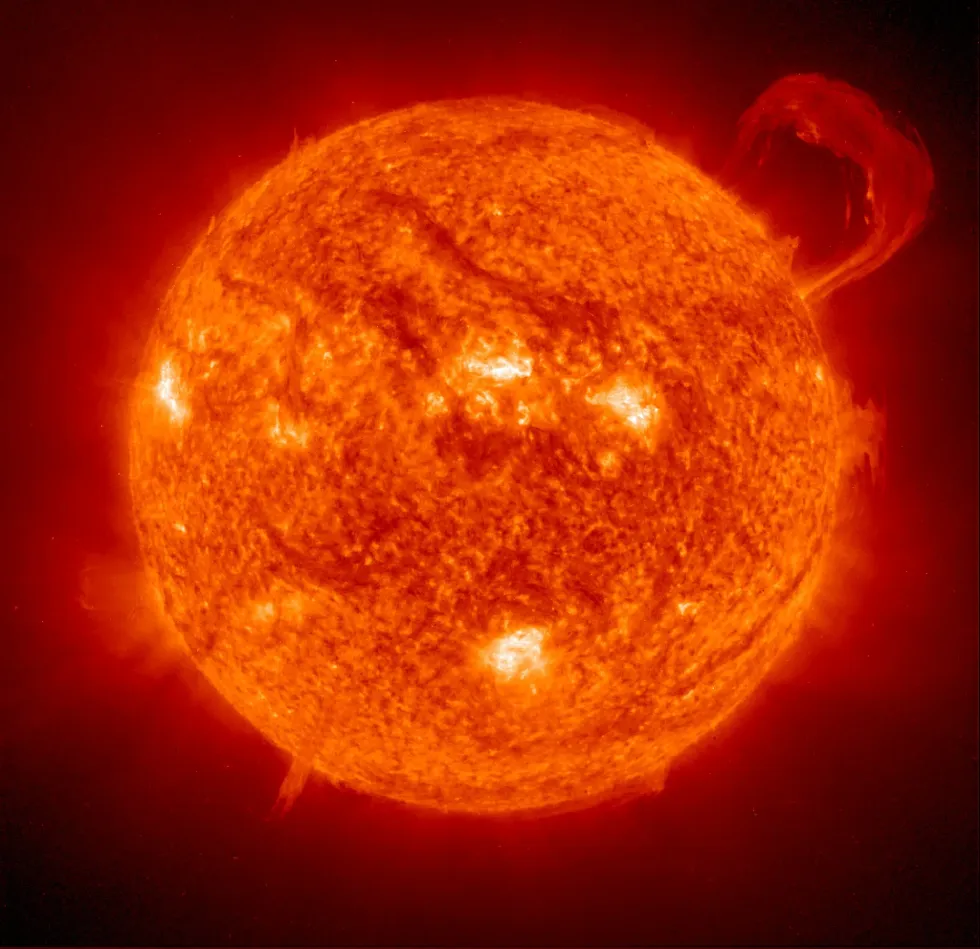
An X-class flare, the most powerful category of solar flare, triggered the coronal mass ejection that launched from the Sun on Sunday (stock pic)
| NASA”A clearer understanding of the sun’s internal music during these lulls could therefore improve forecasts of future solar storms - and that may help protect the technologies on which modern life depends".
The discovery comes promptly after research this week found Jupiter's frozen moons may have arrived in the solar system with the ingredients for life already inside them.
Scientists from the Southwest Research Institute, Aix-Marseille University, and the Institute for Advanced Studies have demonstrated carbon-based compounds containing oxygen and nitrogen - elements vital for living organisms - could have been woven into these celestial bodies from their earliest beginnings.
The study reveals that Europa, Ganymede, and Callisto likely inherited complex organic molecules at the very moment of their formation, some billions of years ago.