










Prehistoric figurines carved from animal bones have revealed what may be a lost chapter in human history dating back 40,000 years.
Scientists examining over 3,000 etchings across 260 ancient relics have identified what could be one of the earliest known systems of writing - which could upend our understanding of the written word.
A trove of artefacts were unearthed in caves within the Swabian Jura region of southwestern Germany, including a small mammoth figure from Vogelherd Cave.
The discovery predates the first Sumerian cuneiform writing from Mesopotamia by tens of thousands of years.
The objects include flutes, animal carvings and hybrid human-animal figurines.
All bear 22 recurring symbols, from V-shaped notches to lines, crosses and dots.
Researchers studied 260 objects spanning roughly 43,000 to 34,000 years ago, including ivory figurines, bone tools, flutes and pendants.
The carvings appear to form a structured system of symbols rather than random decoration.
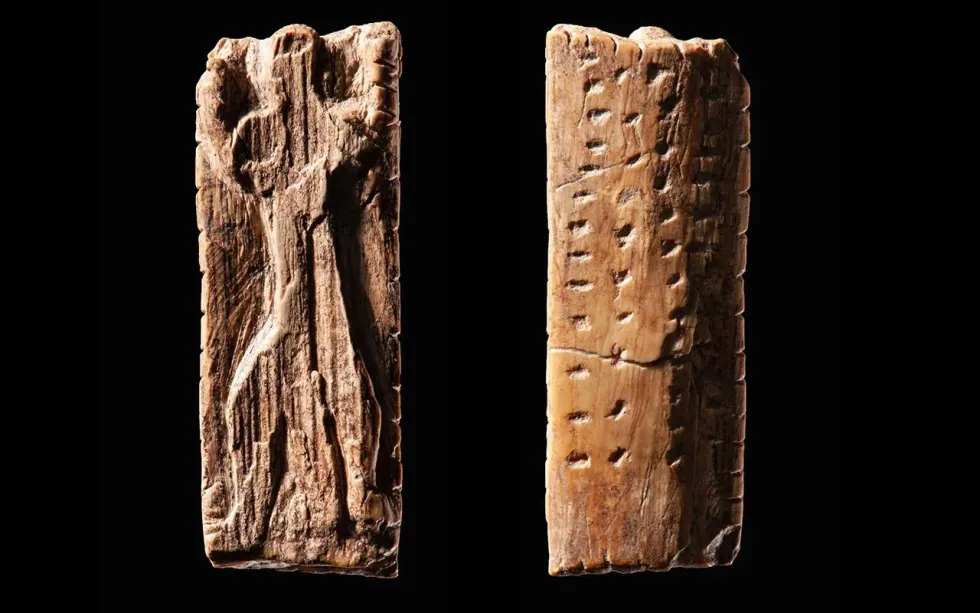
The carvings (pictured) appear to form a structured system of symbols rather than random decoration
|LANDESMUSEUM WURTTEMBERG
This suggests early forms of communication, and may have recorded calendars, rituals, tallies or cultural identity.
Figurines showed higher "information density," with more symbols deliberately engraved per surface area.
Tools, flutes and ornaments also carry symbols, though not as many as the figures, indicating a hierarchy based on an object's purpose.
"The artefacts date back tens of thousands of years before the first writing systems," said study co-author Ewa Dutkiewicz, an archaeologist at Berlin's Museum of Prehistory and Early History.
REMARKABLE DISCOVERIES - READ MORE:
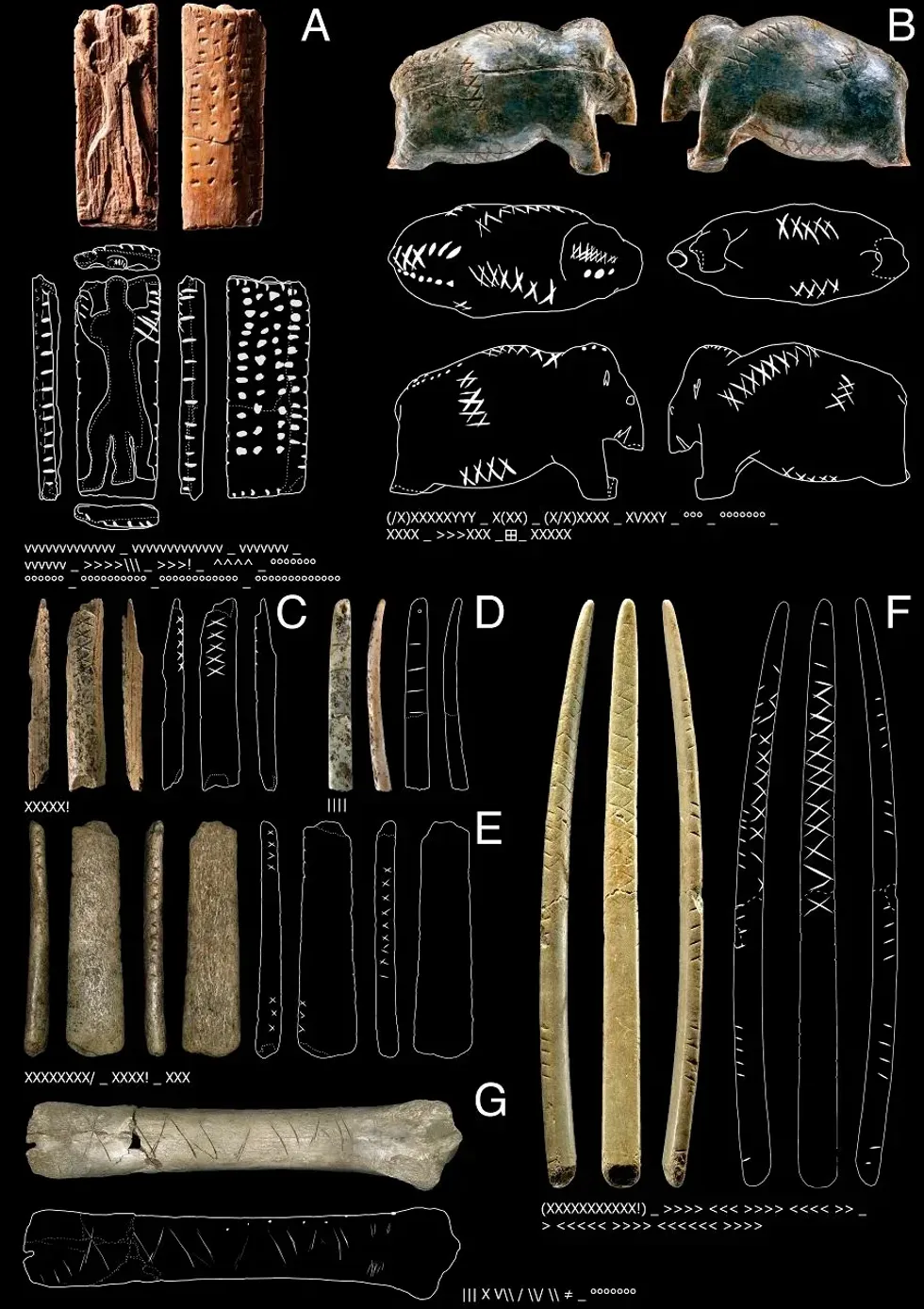
Researchers pinpointed a series of repeated symbols on the treasure-trove of artefacts
|UNIVERSITY OF TUBINGEN
The team stressed they were not attempting to decipher the signs' concrete meanings.
Professor Christian Bentz of Saarland University noted: "There are plenty of theories, but until now there has been very little empirical work on the basic, measurable characteristics of the signs."
"The signs on the archaeological objects are frequently repeated -- cross, cross, cross, line, line, line. This type of repetition is not a feature found in spoken language," Prof Bentz told Popular Science.
Statistical analysis revealed striking similarities between these ancient carvings and early cuneiform tablets.

Some of the prehistoric treasures were found in the ancient Vogelherd Cave
|WIKIMEDIA COMMONS
"Our findings also show that Palaeolithic hunter-gatherers developed a system of symbols that has an information density statistically comparable to the earliest proto-cuneiform tablets from ancient Mesopotamia, which came 40,000 years later," Bentz said.
And while the exact meanings of these symbols remain unknown, researchers have proposed several possibilities.
Some markings may reflect seasonal patterns or animal migration cycles.
Hybrid figures and recurring patterns could have held religious or cultural significance.
Regularly spaced notches may have served as counting systems or record-keeping tools.
Certain symbols appear consistently on human or feline figures rather than tools, suggesting early social conventions.
"Sign sequences in proto-cuneiform script are also repetitive, and the individual signs are repeated at a similar rate. In terms of complexity, the sign sequences are comparable," Prof Bentz explained.
"There are many sign sequences to be found on artefacts. We've only just scratched the surface," Dutkiewicz said.