











The Egyptian pyramids are thought to have been “built by advanced civilisation” thousands of years earlier than previously thought.
António Ambrósio, an independent researcher from the Autonomous University of Barcelona, has put forward his theory the three main pyramids of Giza are up to 12,000 years old, which predates the Egyptian era by a millennia.
If proven correct, this could rewrite human understanding of the pyramids - how they were built, but also who built them.
This revelation also points to the existence of an unknown “supercivilisation” that existed who were able to construct complex buildings, such as the pyramids and other historic monuments around the world.
TRENDING
Stories
Videos
Your Say
At the centre of Mr Ambrósio’s theory is, he and other researchers claim, proof that the Egyptians only copied the original three Pyramids in Giza after discovering them.
In the research paper, which is yet to be peer-reviewed, the author argues no royal mummies or burial artefacts have been discovered inside the Giza pyramids, despite the ancient Egyptians claiming they were the tombs of Khufu, Khafre and Menkaure.
The Giza pyramids, currently understood to have been built 4,600 years ago, display exceptional engineering skills. The structure aligns with star constellations, ultra-precise stone cuts and its base is almost perfectly level.
According to Mr Ambrósio, these engineering qualities are not reflected in any of the other smaller pyramids, which are understood to have been built by the Egyptians between 2,500 BC and 2,150 BC.
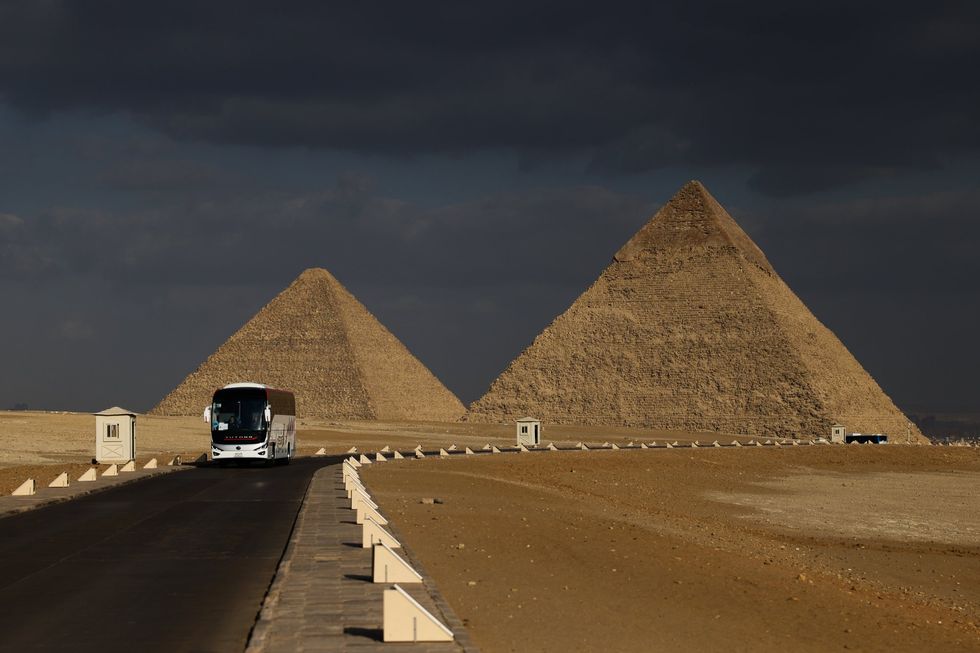
A researcher believes the Great Pyramids are 12,000 years old
|GETTY
The scholar also added the iconic statue, the Great Sphinx of Giza, shows signs of water erosion from heavy rain. However, it has not rained in Egypt between roughly 5,000 BC and 3,000 BC.
This suggests, says Mr Ambrósio, the entire site was already ancient and worn from the elements at the start of ancient Egyptian civilisation in 3,100 BC, reports the Daily Mail.
Mr Ambrósio wrote in his paper: “The pyramids of Giza were not built by the pharaohs of the Fourth Dynasty, but rather appropriated by them.
“Subsequent pyramids and earlier ones, according to the conventional timeline) would represent imperfect attempts to imitate preexisting structures.”
LATEST DEVELOPMENTS
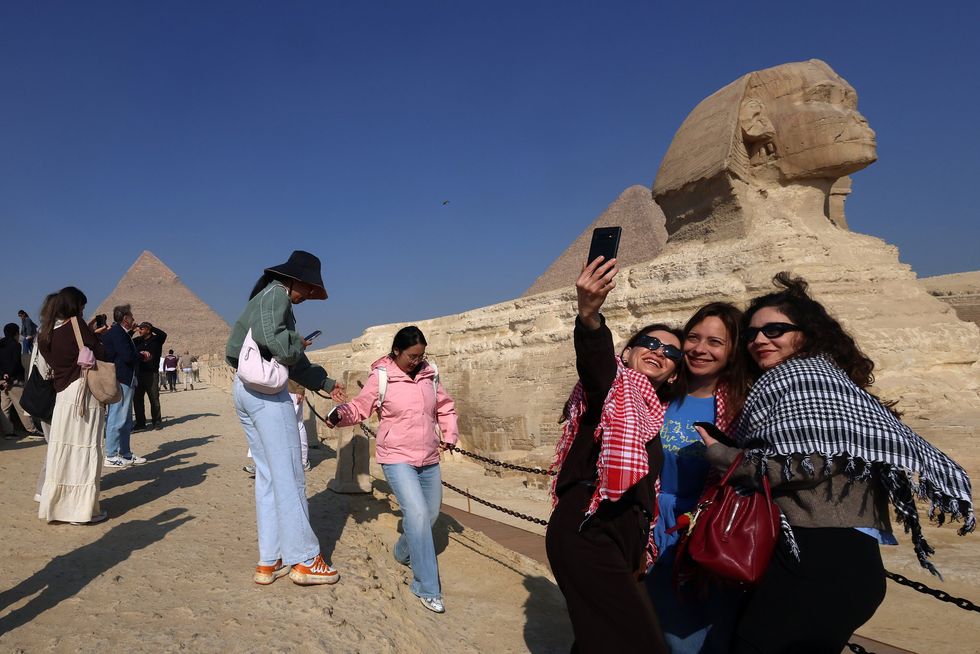
The Great Sphinx of Giza shows signs of water erosion from heavy rain which might suggest its much older than thought
|GETTY
To further his theory, the researcher claimed there are no definitive ancient writings which tie the Egyptians directly to the construction of the Giza pyramids.
One significant link is the Khufu cartouche, a red painted hieroglyph containing the name “Khufu” inside one of the hidden chambers in the Great Pyramid of Giza.
The pharaoh Khufu was the second ruler of the Fourth Dynasty of Egypt and is generally accepted as commissioning the Great Pyramid of Giza, but many aspects of his reign are poorly documented.
Many mainstream Egyptologists have determined the hieroglyph is genuine. Some doubt its legitimacy, with authors such as Scott Creighton and Zecharia Sitchin claiming the ancient writing was faked by Colonel Howard Vyse in 1837.
Mr Ambrósio wrote: “No mummy has ever been found in the pyramids of Giza.
“The discovery of a supposed sarcophagus of Khufu, found empty, does not prove that he built the pyramid - only that he claimed it.”
Much research around the ancient monuments concludes the knowledge and skills that were used to build the pyramids were lost during Egypt’s fifth and sixth dynasties.
However, Mr Ambrósio pointed out mega structures similar to the Great Pyramids have been discovered all around the world, which all point to an unknown civilisation that possessed advanced building techniques.
These include the ancient Incan stronghold of Sacsayhuamán in Peru and the vast stone platforms of Baalbek in Lebanon, both known for their enormous precisely cut blocks.
Mr Ambrósio suggested the pyramids may not have originated with the ancient Egyptians at all.
He wrote:“The pyramids of Giza may represent the legacy of an earlier, unknown civilisation.”
According to his theory, Egypt’s Fourth Dynasty inherited and adapted the structures rather than constructing them from scratch.
He said later dynasties attempted to recreate the techniques used, but were ultimately unable to match the original engineering.
The researcher also pointed to an ancient Egyptian concept known as Zep Tepi, meaning “the First Time”.
In Egyptian mythology, Zep Tepi described a primordial golden age when the world was formed, the gods emerged from chaos and ruled directly over humanity.
It was believed to be a period of perfect cosmic order before power passed to human kings.
Fringe historians, including Graham Hancock and Robert Schoch, have argued that Zep Tepi was not symbolic but a real historical era.
They claim it refers to a lost advanced civilisation that existed around 12,000 years ago, dating back to approximately 10,500 BC.
Our Standards: The GB News Editorial Charter
More From GB News