









Scientists have confirmed that a fossil unearthed in Scotland represents a completely new form of life.
The organism, known as Prototaxites, reached an impressive height of 26 feet during its heyday 370 million years ago.
Researchers from the University of Edinburgh and National Museums Scotland made the breakthrough.
The ancient specimen was initially believed to be a type of fungus due to its appearance resembling a large woody trunk without any leafy growth.
However, fresh analysis has revealed it belongs to neither a fungus, nor a plant.
Instead, it represents an evolutionary branch that no longer exists on Earth.
The organism displayed a unique combination of anatomical and chemical features that set it apart from all known life forms.
Sandy Hetherington, lead co-author and research associate at National Museums Scotland, said: "They are life, but not as we now know it, displaying anatomical and chemical characteristics distinct from fungal or plant life, and therefore belonging to an entirely extinct evolutionary branch of life."
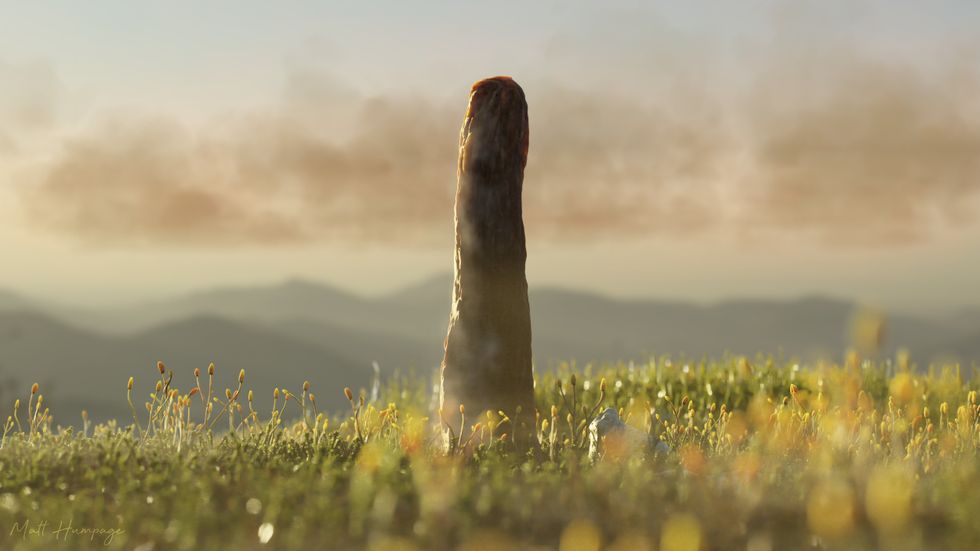
The organism, known as Prototaxites, reached an impressive height of 26 feet during its heyday 370 million years ago
|PA
Scientific investigation revealed that Prototaxites did not obtain energy through photosynthesis like plants do.
It also lacked the symbiotic relationships typical of lichens.
The organism appeared to be missing underground fungal root networks needed to sustain such a massive structure.
Researchers examined fossils from Rhynie chert, a sedimentary deposit located near Rhynie - about an hour's drive from Aberdeen - dating back 407 million years.
BREAKTHROUGHS BENEATH BRITAIN'S SOIL - READ MORE:
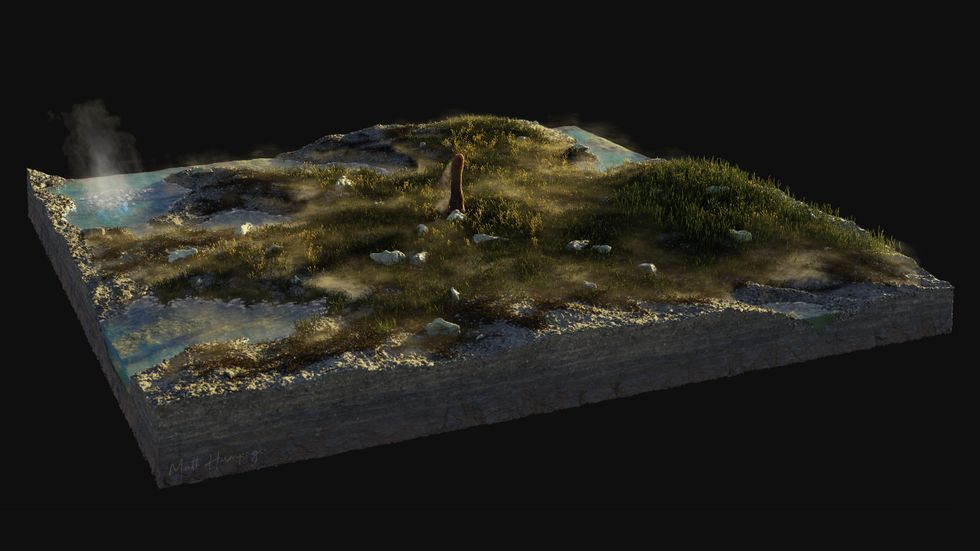
PICTURED: An artist's impression of how the life-form may have towered over prehistoric Scotland
|PA
Prototaxites specimens were first gathered in 1843, though it took another 14 years before Canadian scientist JW Dawson examined them.
Dawson mistakenly concluded the fossils were partially decayed giant conifers.
His assessment sparked a lengthy scientific dispute about where this mysterious organism belonged in the classification of living things.
The latest analysis determined that the specimens were chemically and structurally different from fungi that existed during the same period.
Researchers concluded it should be classified as an entirely extinct eukaryotic lineage - a different "kingdom".
Laura Cooper, the study's co-author and doctoral student from the University of Edinburgh's institute of molecular plant sciences, said: "Our study, combining analysing the chemistry and anatomy of this fossil, demonstrates that Prototaxites cannot be placed within the fungal group.
"As previous researchers have excluded Prototaxites from other groups of large complex life, we concluded that Prototaxites belonged to a separate and now entirely extinct lineage of complex life.
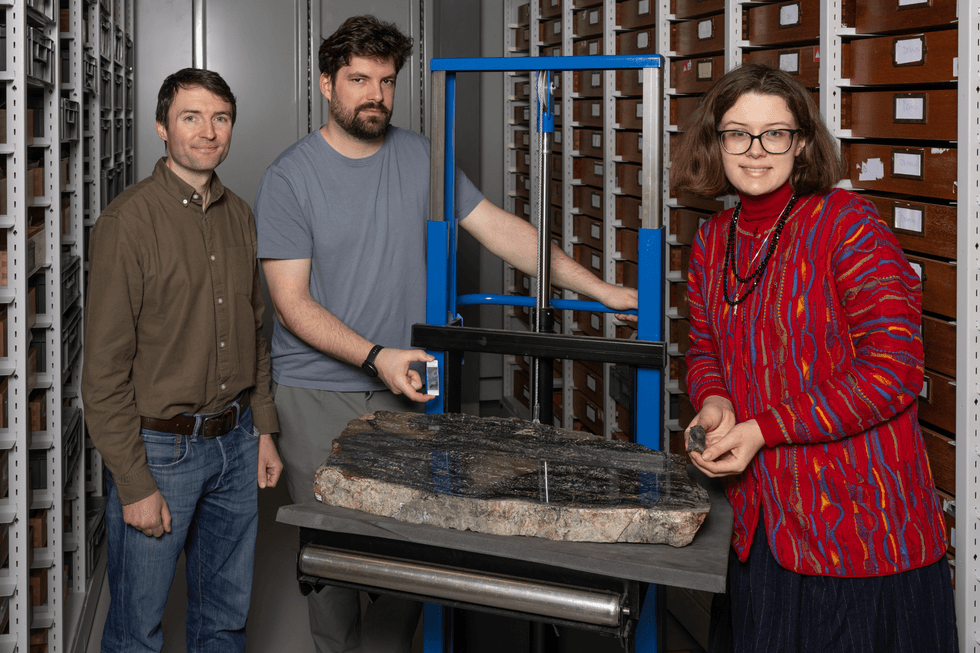
PICTURED: Researchers Sandy Hetherington, Corentin Loron and Laura Cooper (left to right) at the National Museums Collection Centre with sample fossils
|PA
"Prototaxites therefore represents an independent experiment that life made in building large, complex organisms, which we can only know about through exceptionally preserved fossils."
The organism existed between 420 and 370 million years ago, during the late Silurian to Late Devonian periods.
This era marked a transformative time when plants and animals began colonising land.
Prototaxites stood as Earth's first giant land-dwelling organism, towering over all other life forms of its age.
The findings have been published in the journal Science Advances.