










New data from Nasa's Cassini spacecraft has cast doubt on the longstanding theory that Titan, Saturn's largest moon, harbours a vast subsurface ocean.
The research, led by scientists at Nasa's Jet Propulsion Laboratory and published Wednesday in the journal Nature, proposes a markedly different internal structure for the moon.
Rather than a global liquid water ocean, the study suggests Titan's interior consists of deep strata of ice and slush, comparable to Earth's Arctic sea ice or aquifers.
Within these frozen layers, pockets of melted water may exist where microscopic organisms could potentially survive.
TRENDING
Stories
Videos
Your Say
The findings contradict assumptions which have persisted for more than a decade following Cassini's initial observations, and which were interpreted as evidence of a liquid ocean beneath Titan's hydrocarbon-rich surface.
The investigation, headed by JPL postdoctoral researcher Flavio Petricca, employed enhanced data processing methods to re-examine radio frequency communications from Cassini's 10 close flybys of the moon.
By reducing noise in the Doppler data, the team uncovered previously hidden signatures of energy dissipation within Titan's interior.
A critical discovery emerged regarding the moon's tidal flexing.
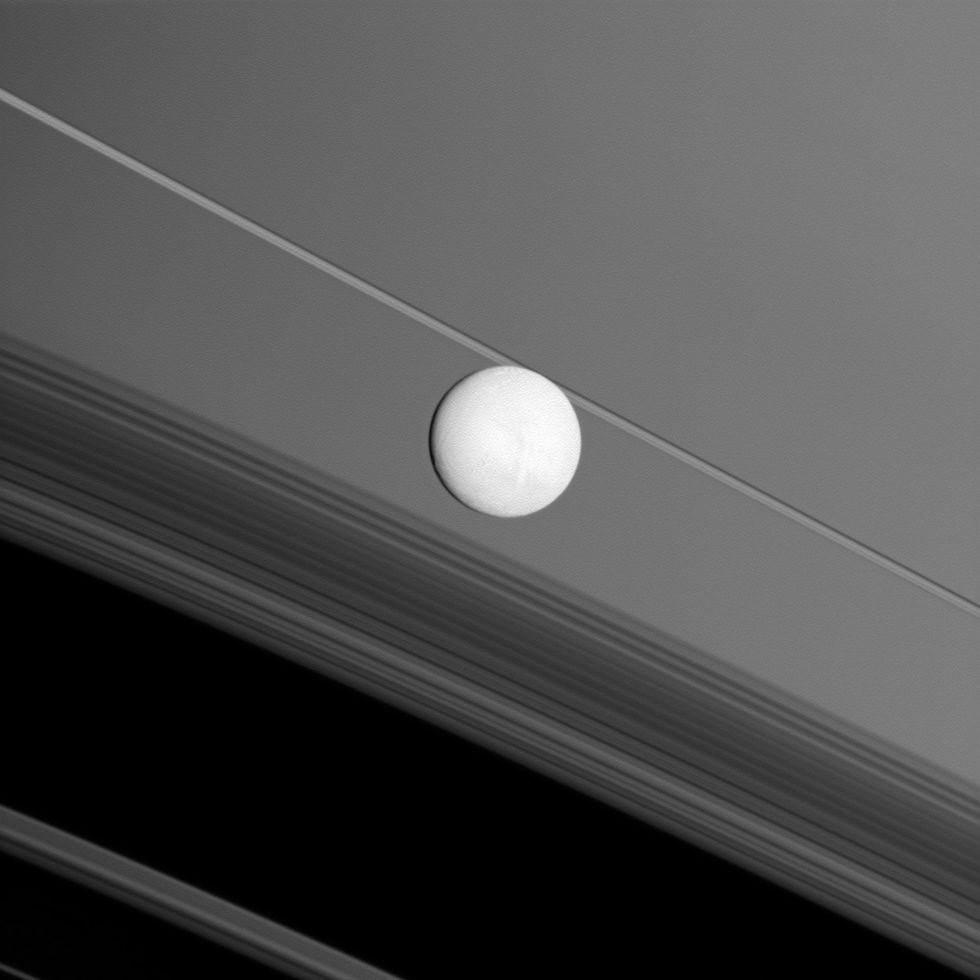
Titan may not have a vast underground ocean, a new study has suggested
|GETTY
Saturn's immense gravitational forces deform Titan's surface by as much as 10 metres when the moon approaches closest during its elliptical orbit.
The researchers measured a 15-hour interval between the peak gravitational pull and the corresponding rise of Titan's surface.
Were a liquid ocean present, Mr Petricca explained, the response would be instantaneous.
The substantial delay instead points to an interior composition of slushy ice interspersed with liquid water pockets.
LATEST DEVELOPMENTS:
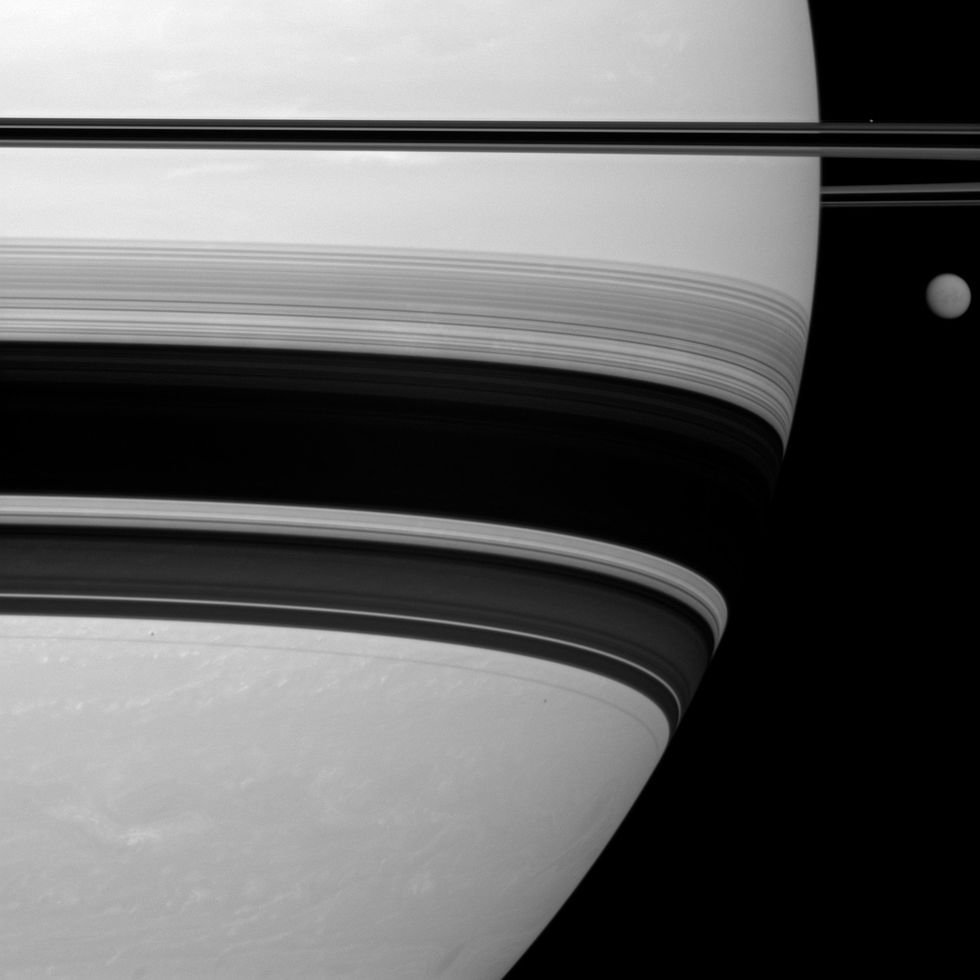
The study found a noticeable delay between the peak gravitational pull of Saturn and the rise of Titan's surface
|GETTY
Computer modelling of Titan's spatial orientation further supported this interpretation.
Computer models indicate Titan's ice, slush and water strata extend beyond 340 miles in depth.
The outermost frozen shell measures approximately 100 miles thick, beneath which lie slushy layers and water pools reaching down a further 250 miles.
These water pockets could reach temperatures of 20 degrees Celsius, the researchers suggest.
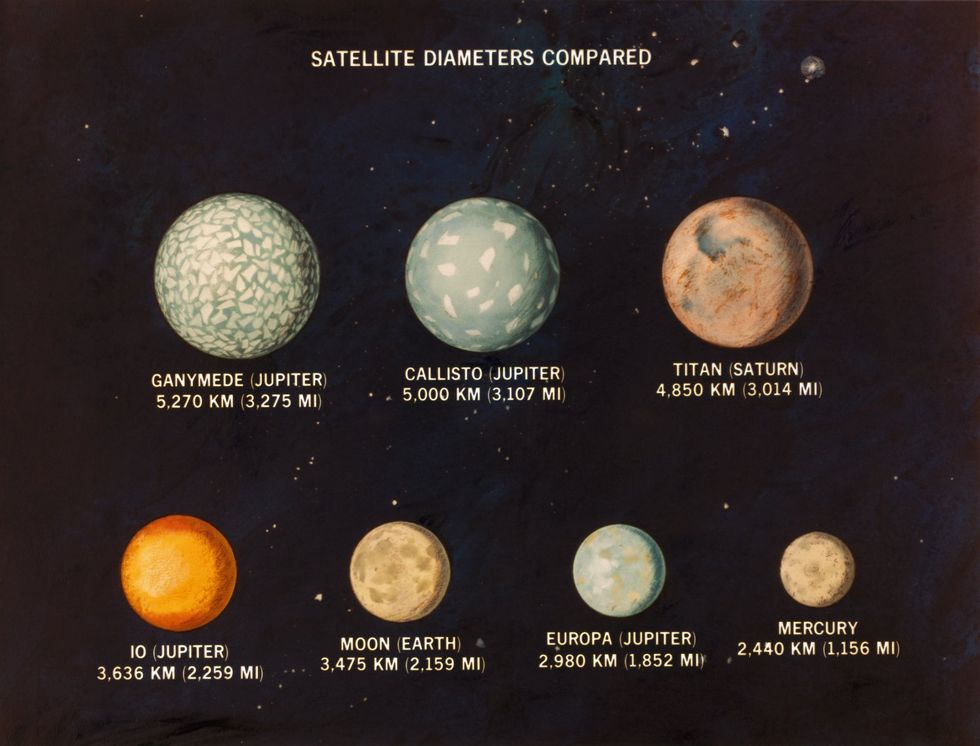
Comparison of Titan's size to Earth's Moon and other space objects
|GETTY
Mr Petricca noted liquid water may be cycling nutrients upward from the moon's rocky core through high-pressure ice layers towards the solid surface shell.Despite the absence of a global ocean, Baptiste Journaux of the University of Washington, a study co-author, maintained "there is strong justification for continued optimism regarding the potential for extraterrestrial life."Any organisms would likely be microscopic, he indicated, adding that "nature has repeatedly demonstrated far greater creativity than the most imaginative scientists."The concentrated nutrients in smaller water pools could potentially provide more favourable conditions for life than a diluted ocean would offer.
Not all scientists have embraced the new interpretation.
Luciano Iess of Sapienza University of Rome, whose earlier Cassini data analyses suggested the presence of a hidden ocean, disputed the conclusions.
Mr Iess acknowledged the findings as "certainly intriguing and will stimulate renewed discussion," but said in an email "at present, the available evidence looks certainly not sufficient to exclude Titan from the family of ocean worlds."
More conclusive answers may arrive with Nasa's Dragonfly mission, a helicopter-style craft scheduled for launch no earlier than 2028.
The rotorcraft will explore the moon's surface to investigate its habitability, with arrival expected in 2034.
Equipped with a seismometer, the mission could deliver crucial measurements of Titan's interior structure, subject to seismic activity occurring during its surface operations. Journaux serves on the Dragonfly team.
Our Standards: The GB News Editorial Charter