










Researchers have uncovered a previously unknown "supersonic state" lurking deep within our planet.
Scientists at China's Sichuan University have determined that Earth's innermost core does not behave as a conventional solid.
This unusual condition allows carbon atoms to move freely through a rigid iron structure, behaving much like a liquid passing through a crystalline framework.
The discovery means the planet's core can simultaneously function as a dense solid whilst retaining the flexibility of molten metal.
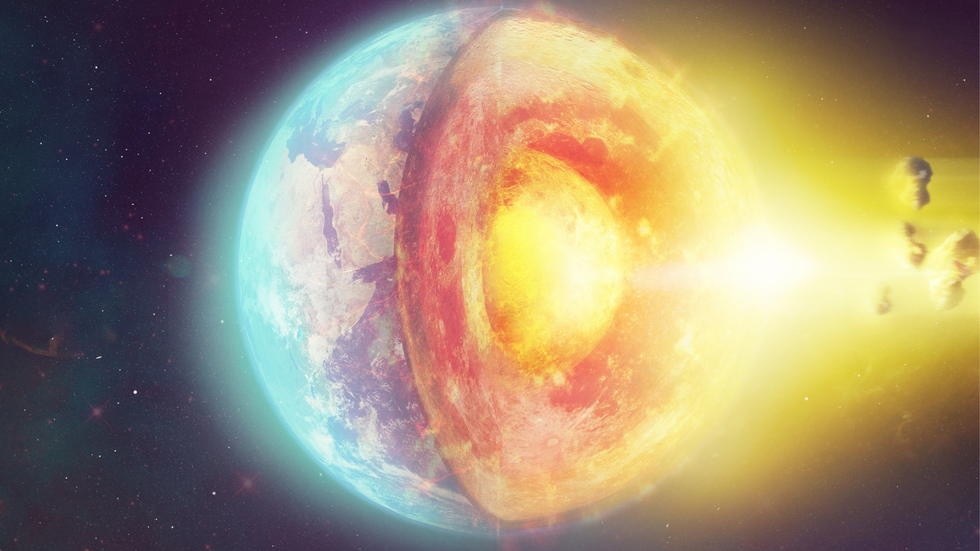
Sichuan University scientist determined that Earth's innermost core does not behave as a conventional solid
|GETTY
For years, geologists have struggled to explain how the inner core could exhibit such contradictory properties, appearing both rigid and remarkably pliable.
The inner core represents one of the most hostile environments anywhere in our solar system, a 102 quintillion-tonne sphere of iron alloy situated more than 3,000 miles beneath the Earth's surface.
At such depths, the material endures crushing forces exceeding 3.3 million atmospheres whilst being subjected to temperatures approaching those found on the sun's surface.
Despite evidence suggesting the core is solid, it displays characteristics more commonly associated with softened metals.
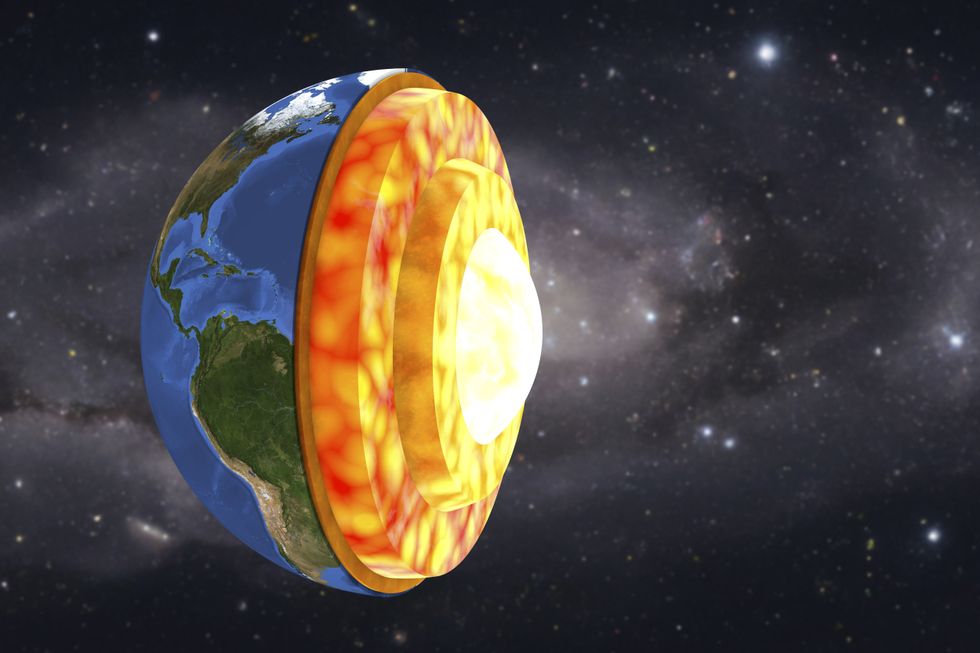
The inner core represents one of the most hostile environments anywhere in our solar system
|GETTY
Seismic waves travelling through this region slow considerably, similar to sound passing through water, and the material demonstrates a pliability more akin to butter than steel.
This paradox of a structure that is simultaneously solid yet malleable has confounded researchers for years.
To test whether this superionic phase could actually occur, the research team subjected iron-carbon samples to extreme shockwave experiments designed to replicate conditions found at the planet's centre.
The scientists accelerated the metal to speeds of 15,650 miles per hour, generating pressures of 1.38 million atmospheres and temperatures reaching approximately 2,300C.
SPACE - READ THE LATEST:
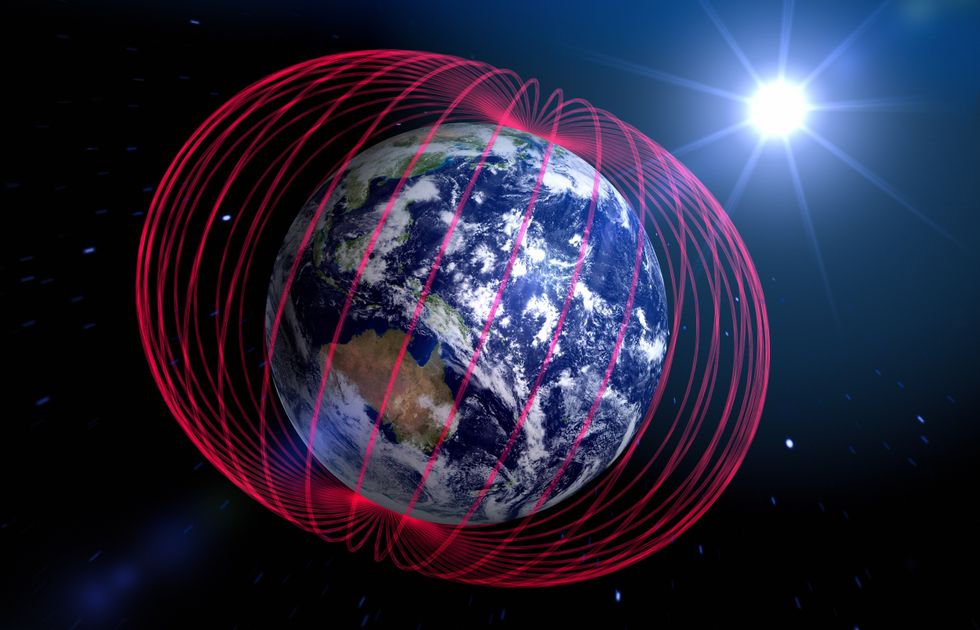
The findings carry significant implications for understanding how Earth generates its protective magnetic field
|GETTY
Analysis of the resulting shockwaves revealed that the iron-carbon samples became substantially more malleable as conditions approached those of the inner core.
Professor Youjun Zhang of Sichuan University explained the phenomenon: "In this state, carbon atoms become highly mobile, diffusing through the crystalline iron framework like children weaving through a square dance, while the iron itself remains solid and ordered."
Computer simulations had predicted this phase was possible back in 2022, but the extreme conditions required made experimental verification exceptionally challenging until now.
The findings carry significant implications for understanding how Earth generates its protective magnetic field.
Dr Yuqian Huang, a co-author of the study, said: "Atomic diffusion within the inner core represents a previously overlooked energy source for the geodynamo.
In addition to heat and compositional convection, the fluidlike motion of light elements may help power Earth's magnetic engine."
The research suggests geologists may need to fundamentally reconsider their understanding of the planet's deepest regions.
Professor Zhang added: "We're moving away from a static, rigid model of the inner core toward a dynamic one."
Beyond explaining why seismic waves behave unusually when passing through the core, the discovery could illuminate aspects of planetary evolution and help scientists interpret the magnetic fields of distant exoplanets.
Our Standards: The GB News Editorial Charter