









A Nasa Planetary Scientist has told GB News of his compelling discovery the biblical Star of Bethlehem was a comet witnessed by Chinese astronomers more than two millennia ago.
Speaking to host Jacob Rees-Mogg, Mark Matney lifted the lid on his analysis of ancient astronomical records from 5BC to develop his hypothesis.
Speaking to GB News, Mr Matney explained: "So what I've discovered is that a comet that was observed by the Chinese in 5 BC, I put together the information from their observation, to come up with an orbit that would take this particular comet very, very close to the Earth."
His calculations suggest the celestial object passed within approximately the distance of the moon from our planet.
TRENDING
Stories
Videos
Your Say
As the comet swept past Earth at this remarkably close range, Mr Matney's orbital calculations revealed it would have exhibited extraordinary behaviour from the perspective of observers on the ground.
The scientist drew a comparison with modern technology to illustrate his point, saying: "And as it passed the Earth, probably about the distance to the moon, a position on the rotating Earth would have seen the comet pause for a period of hours over location. We have the same thing now with the geosynchronous satellite, if you stand at the equator, there are there are geosynchronous satellites that stay over your head 24/7."
This phenomenon, according to Mr Matney's research, meant the comet could have remained apparently motionless above a specific location for an extended period, precisely matching the account described in the Gospel of Matthew.
The biblical narrative in Matthew describes how the Magi witnessed the star guiding them on their journey southward from Jerusalem to Bethlehem, appearing to halt above their destination.

NASA scientist Mark Matney has lifted the lid on the Star of Bethlehem that guided Three Wise Men 2,000 years ago
|GETTY / GB NEWS
Mr Matney explained: "And the orbit I came up with, the star would appear a little bit West of South as they were leaving on the morning of June 8 is where the orbit says. And as they walked from Jerusalem to Bethlehem, it would have maintained the same azimuth which is the East, West, North-South direction, so a little bit West of South."
As the travellers made their way along the route, the comet would have climbed progressively higher in the sky.
Upon reaching Bethlehem, the celestial object would have appeared almost directly overhead, seemingly pausing in position.
One aspect of Matney's theory challenges the familiar imagery found on Christmas cards, which typically depict the Magi travelling beneath a starlit night sky. The NASA scientist revealed that his orbital calculations placed the event during daylight hours, which initially troubled him.
However, the comet's extreme proximity to Earth would have made it extraordinarily luminous.
LATEST DEVELOPMENTS
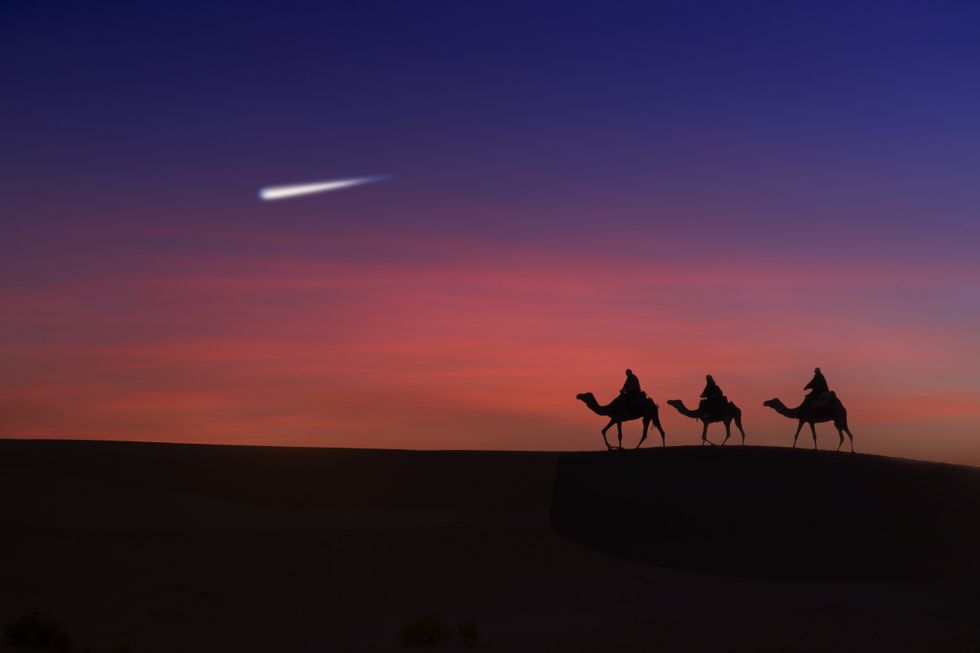 A Nasa astronomer has proposed a new theory behind the appearance of the Star of Bethlehem | GETTY
Mr Matney stated: "But this comet was so close to the Earth that it would have had the brightness of like a first quarter or full moon, so it would have been clearly visible in the daylight."
This detail actually aligns with historical travel practices, as the scientist pointed out that ancient travellers typically avoided journeying at night due to the absence of artificial lighting.
The walk from Jerusalem to Bethlehem takes roughly two to three hours, matching the window during which the comet exhibited its unusual stationary behaviour.
The comet's extended visibility supports Mr Matney's theory, with Chinese records documenting its presence in the constellation Capricorn for over 70 days.

The comet was an Oort cloud object with an orbital period spanning thousands or even tens of thousands of years
|GB NEWS
This prolonged appearance in a single constellation would have allowed the Magi ample time to undertake their lengthy journey from the East, which would have required many weeks of travel.
Mr Matney also explained the comet's apparent stillness using an analogy familiar to aviators, adding: "Pilots know this, if you see an object in the sky while you're flying a plane and it's not moving left, right or up down, it's actually on a collision course or nearly so with you."
The scientist believes the comet was an Oort cloud object with an orbital period spanning thousands or even tens of thousands of years.
His calculations indicate it was a sun-grazing comet, passing extremely close to the sun, where it most likely broke apart.
Our Standards: The GB News Editorial Charter