










Astronomers have been left stunned after spotting one of the universe's largest "spinning structures" lurking in the depths of the cosmos.
A team of scientists used some of the world’s most powerful telescopes to spot more than 280 galaxies aligned in a vast chain across the stars.
The galaxies sit scattered along a colossal filament made up of gas and dark matter, turning on its central axis in what has been likened to a "rolling pin" motion.
According to the researchers behind the discovery, the filament is spinning at speeds of more than 246,000 miles per hour - and could offer clues as to how the Milky Way was formed.

The filament is spinning at speeds of more than 246,000 miles per hour
|DESI
TRENDING
Stories
Videos
Your Say
Although it spans an astonishing 50 million lightyears long, researchers say the "razor-thin" structure is - just - 163,000 lightyears wide.
University of Oxford Professor Matt Jarvis, the study's co-author, told the Daily Mail: "The filament is long and thin.
"The narrowness of this filament means that a rolling pin of the same dimensions would only be a few millimetres thick.
"But the radius of the filament is about 10 billion times the distance between Earth and the Sun."
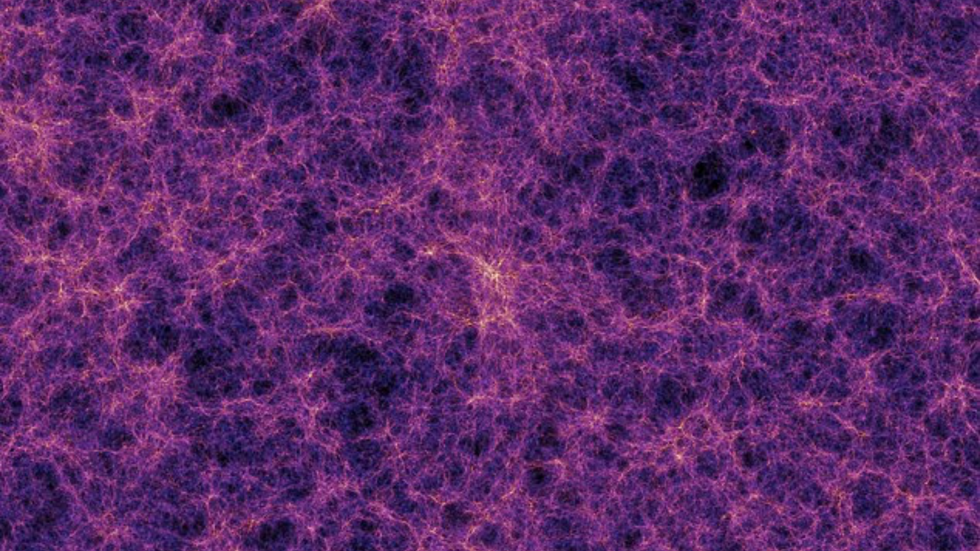
Although it spans an astonishing 50 million light-years, the "razor-thin" structure is just 163,000 light-years wide
|MAX PLANCK INSTITUTE
The study has been published in Monthly Notices of the Royal Astronomical Society.
Prof Jarvis and his colleagues have honed in on 14 galaxies in particular for the study.
While the team initially mapped the 280 galaxies in two dimensions, new observations have enabled them to track 14 of the galaxies in three dimensions.
This has allowed the researchers to pinpoint the rotation of the galaxies with greater precision.
SPACE - READ THE LATEST:
The study's co-lead author Dr Lyla Jung, also from Oxford, said: "You can liken it to the teacups ride at a theme park.
"Each galaxy is like a spinning teacup, but the whole platform - the cosmic filament - is rotating too."
Researchers also observed the galaxies spinning in the same direction - indicating that cosmic structures play a key role in influencing galaxy rotation.
Dr Jung explained: "What makes this structure exceptional is not just its size, but the combination of spin alignment and rotational motion.

The galaxies are spinning in the same direction - indicating that cosmic structures play a key role in influencing rotation
|GETTY
"This dual motion gives us rare insight into how galaxies gain their spin from the larger structures they live in."
Since the filament is brimming with hydrogen-rich galaxies, it is believed it is only in the infancy stage of its evolution.
Therefore, scientists are hopeful further study of the filament could help unlock clues as to how our own galaxy may have been formed.
Prof Jarvis said: "Understanding how structures form and evolve in the Universe allows us to piece together how galaxies like the Milky Way formed."
Our Standards: The GB News Editorial Charter