










Scientists have unveiled a newly identified dinosaur species from China that offers an extraordinary window into prehistoric biology through remarkably preserved 125-million-year-old skin.
The creature, named Haolong dongi, represents a juvenile iguanodontian whose fossilised remains retain skin tissue visible at the cellular level.
Discovered in north-eastern China, the specimen provides researchers with unprecedented detail about dinosaur appearance and anatomy.
"Finding skin preserved at the cellular level in a dinosaur is extraordinary," said Pascal Godefroit, senior author of the study and palaeontologist at the Institute of Natural Sciences.
TRENDING
Stories
Videos
Your Say
"It gives us a window into the biology of these animals at a level that we never thought possible."
The species was named to honour Dong Zhiming, a pioneering figure in Chinese palaeontology who died in 2024.
"This discovery shows that even well-studied groups like iguanodontian dinosaurs can still surprise us," said Huang Jiandong, director of the research department at Anhui Geological Museum and lead author of the paper published in Nature Ecology & Evolution.
"The complexity of dinosaur skin is far greater than we imagined."
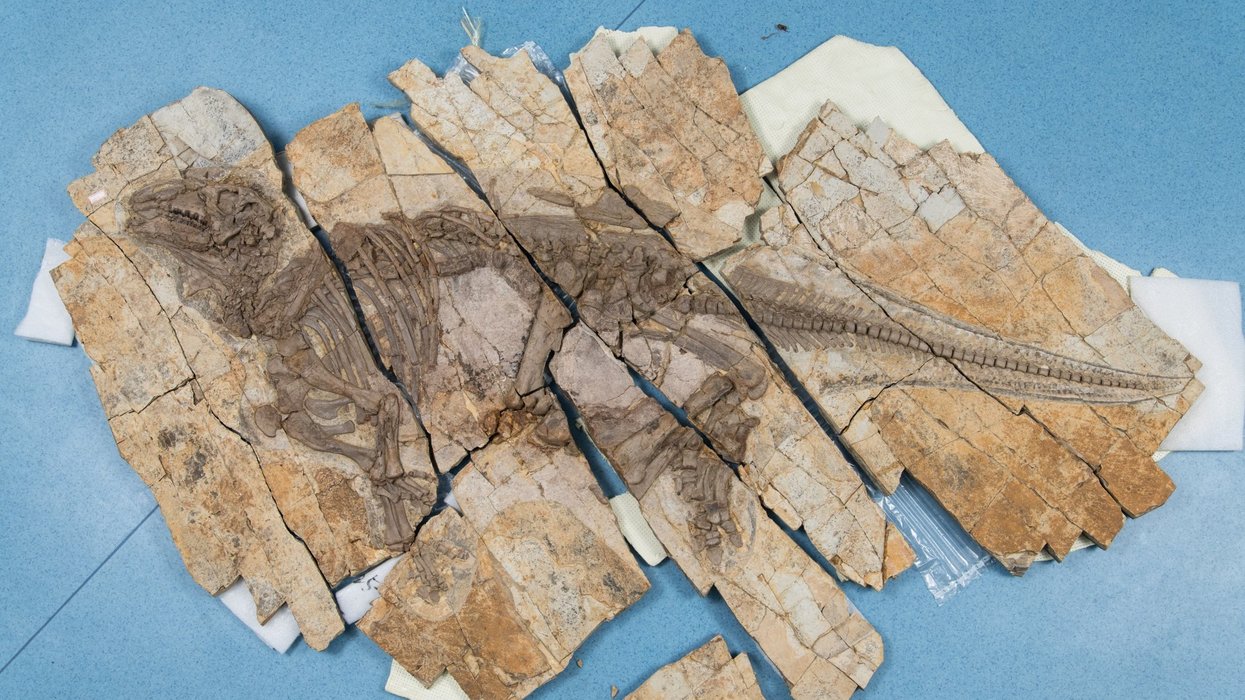
Scientists have unearthed a remarkably well-preserved fossil with dinosaur skin still attached
|THIERRY HUBIN / INSTITUTE OF NATURAL SCEINCES
The juvenile dinosaur, nicknamed the "spiny dragon", bore distinctive spikes of varying dimensions across its body.
These spines are features which have never previously been documented in any dinosaur species.
Large overlapping scales protected its tail, whilst the spikes ranged from tiny 2-3 millimetre protrusions to larger specimens reaching 44 millimetres in length.
Advanced imaging techniques and histological analysis revealed that these structures were cornified, composed of hardened keratin and preserved down to individual cell nuclei.
LATEST DEVELOPMENTS
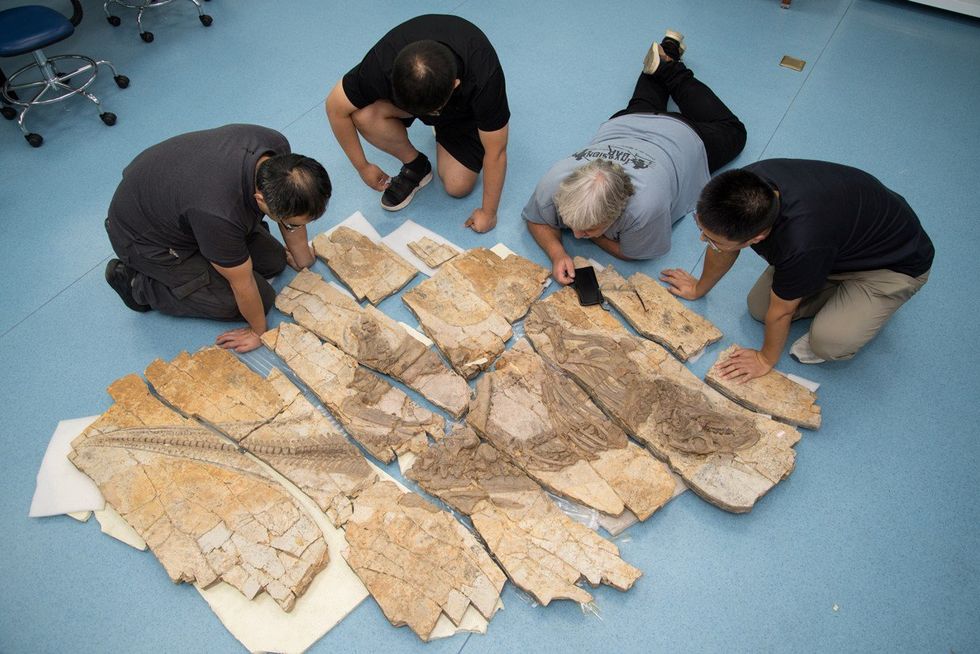
'It gives us a window into the biology of these animals at a level that we never thought possible,' researchers marvelled
|THIERRY HUBIN / INSTITUTE OF NATURAL SCEINCES
The hollow, near-cylindrical spikes differ markedly from both protofeathers found on other dinosaurs and the scaly spines seen in modern lizards, suggesting they evolved independently.
Scientists believe the spikes likely served as a defence mechanism against predators, making the young herbivore difficult for smaller meat-eating dinosaurs to swallow – functioning similarly to a porcupine's quills.
The creature inhabited an environment populated by small carnivorous dinosaurs, where such protection could prove crucial for survival.
Researchers suggest the structures may have offered additional benefits beyond deterrence, potentially helping regulate body temperature in the region's climate..
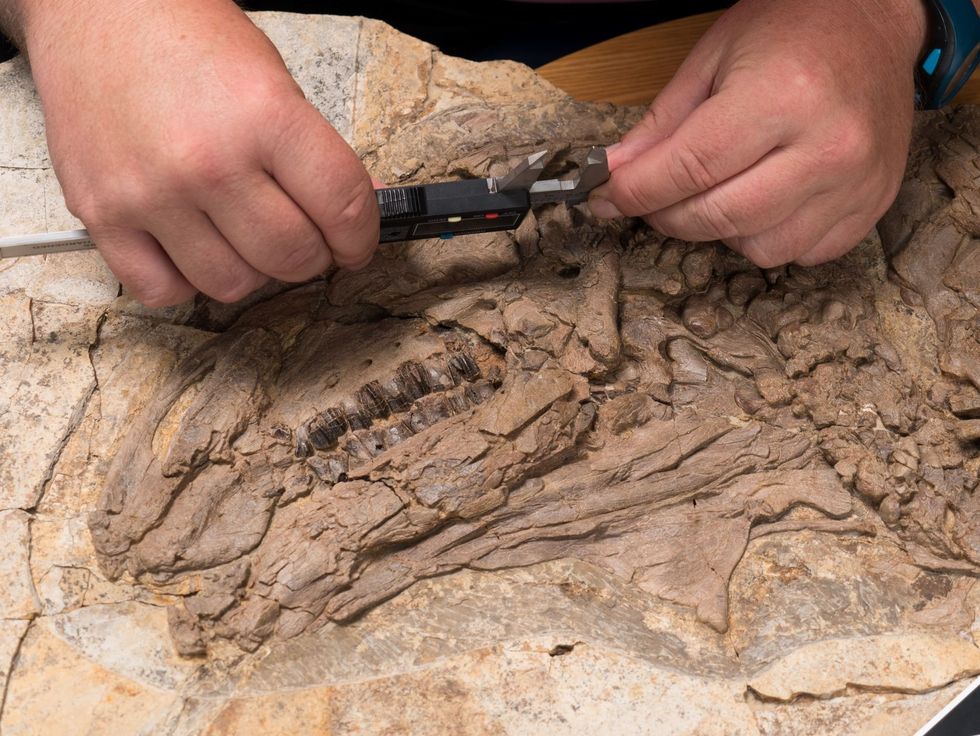
'Finding skin preserved at the cellular level in a dinosaur is extraordinary'
|THIERRY HUBIN / INSTITUTE OF NATURAL SCEINCES
The spikes might also have functioned as sensory tools, enabling the animal to detect vibrations in its surroundings much as snakes use bristles today.
Larger spikes could additionally have warned off rivals or attracted potential mates.
Haolong dongi occupies an early position in the evolutionary lineage that eventually gave rise to hadrosaurs, the distinctive duck-billed dinosaurs
Our Standards: The GB News Editorial Charter