




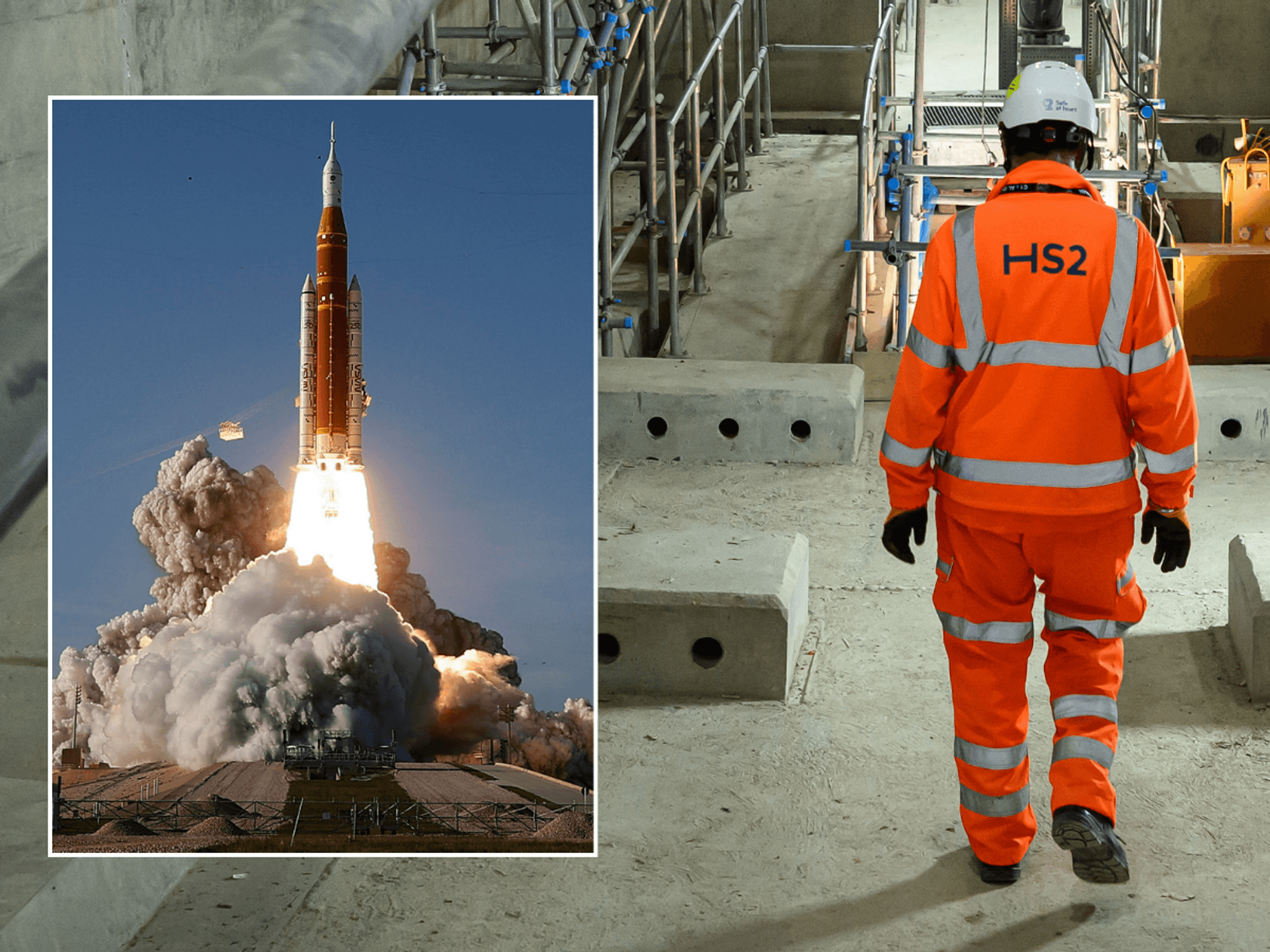







Nasa has declared it's "back in the business" of sending mankind to the Moon after the historic launch of the Artemis II rocket.
Four astronauts blasted off from Florida on Wednesday night for the high‑stakes 10-day trip around the Moon that marks the United States' boldest step yet toward returning humans to the lunar surface this decade.
"After a brief 54-year intermission, Nasa is back in the business of sending astronauts to the Moon," the agency's chief Jared Isaacman said.
Mr Isaacman confirmed the crew was "safe, secure and in great spirits" as they raced towards Earth's natural satellite.
The mission commander is Reid Wiseman, a veteran Nasa astronaut who will lead the crew through their ten-day journey around the Moon and back.
Victor Glover serves as a pilot, while Christina Koch serves as a mission specialist for the American space agency.
Joining them is Jeremy Hansen, a Canadian Space Agency astronaut and colonel who becomes the first non-American to venture beyond low Earth orbit.
"We're going for all humanity," Col Hansen said ahead of lift-off.
In his address to the nation, US President Donald Trump congratulated "our brave astronauts".
"God bless those four," he added.
Their journey to Earth’s natural satellite is now underway - and the whole world is watching.
Ben Leo moved to tears as he shares historic moment with his son in Florida

Ben was on the ground in Cape Canaveral - alongside some 400,000 others - to witness the Nasa mission set off
|GB NEWS
GB News presenter Ben Leo was visibly emotional as he watched Artemis II blast off alongside his son, Jude.
Ben was on the ground in Cape Canaveral - alongside some 400,000 others - to witness the Nasa mission set off on its journey to the Moon.
As the rocket soared into the sky, the Late Show Live host was moved to tears - while Jude cheered as he sat in his father's arms.
"It was like a rolling stream of thunder which gripped your body," he later said of the sheer sound of the take-off.
Donald Trump congratulates Nasa on success of Artemis II
Donald Trump has congratulated Nasa and the "brave astronauts" of Artemis II.
He said it was "amazing" what the mission will accomplish with its goal to send humans a distance "which has never been done before".
"God bless those four unbelievable astronauts," the President concluded.
Nasa 'back in the business of launching rockets', says administrator
Jared Isaacman has said Nasa is "back in the businesses of launching rockets" and will "bring the world with us".
Responding to a question about why there was an over 50 year gap between Artemis II and last crewed Moon mission, he admitted there were historical financial constraints.
He also said competition played a large role in the decision to orbit the Moon, and said there "certainly" was international competition now.
As a former commercial astronaut himself, he earlier said it was "far less stressful to be strapped in" to a rocket than coordinating the Artemis II mission.
Jared Isaacman says Nasa Artemis II crew is 'safe secure and in great spirits'
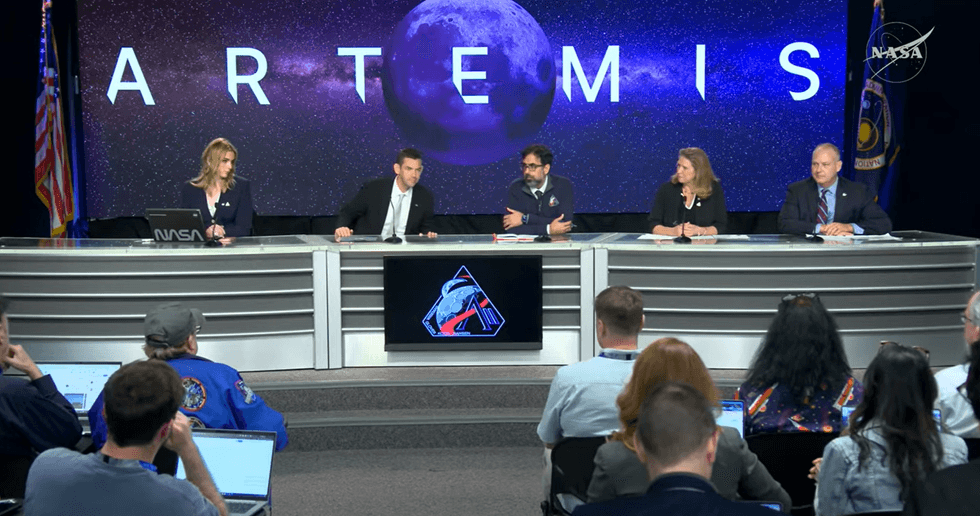
Nasa is currently hosting a press conference, with administrator Jared Isaacman saying the crew was in 'good spirits'
|NASA
Jared Isaacman has said the crew is "safe secure and in great spirits" as they embark to the Moon.
But Nasa officials have said they are "still looking into" what caused the communications issue earlier.
They said the problem occurred during the handover between teams.
One Nasa official said they have snacks ready to eat, but will likely not be hungry on flight day one and two.
Postlaunch press conference
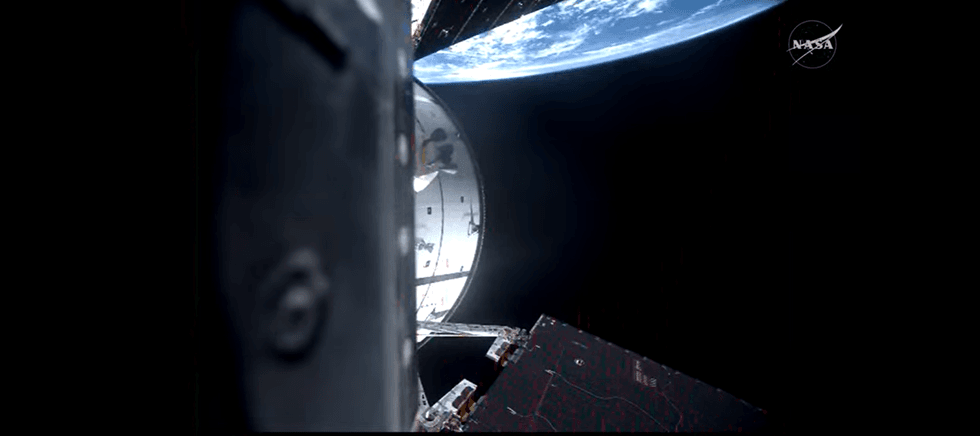
Nasa is about to brief the press on Artemis II.
Jared Isaacman, the 15th administrator of NASA, will give opening remarks on the rocket's launch.
GB News will keep you updated.
Nasa set to give update on mission
Nasa will have a press briefing at 8.05pm ET to give an update on the mission.
The Artemis II mission launched about one hour ago.
The solar wings are successfully deployed to power Orion's electric functions and Christina Koch is working to turn on Orion's services, such as waste management.
The apogee raise burn to increase the altitude of the orbit is set to occur during the press briefing.
The Artemis II launch - as it happened

Crowds gathered in Cape Canaveral to watch the Artemis II mission
|REUTERS
Crowds gathered in Cape Canaveral to watch the Artemis II mission
The Artemis II launch - as it happened
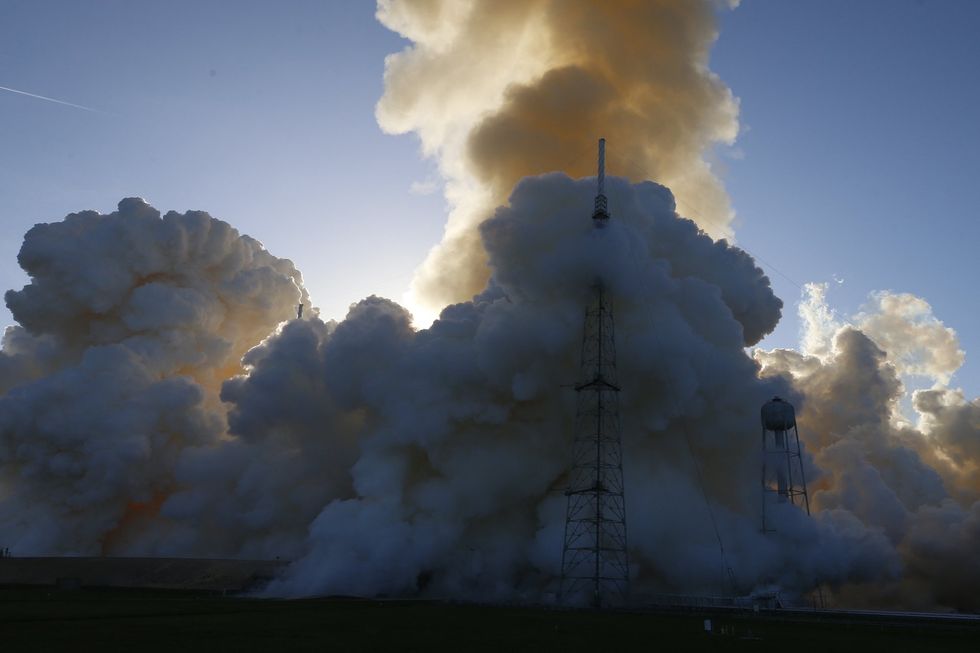
Smoke shrouds the tower of Nasa's Artemis II mission to fly by the moon
|REUTERS
Smoke shrouds the tower of Nasa's Artemis II mission to fly by the moon
The Artemis II launch - as it happened

People watching the launch of Artemis II on a screen at News Corp plaza in Manhattan, New York City, US
|REUTERS
People watching the launch of Artemis II on a screen at News Corp plaza in Manhattan, New York City, US
The Artemis II launch - as it happened
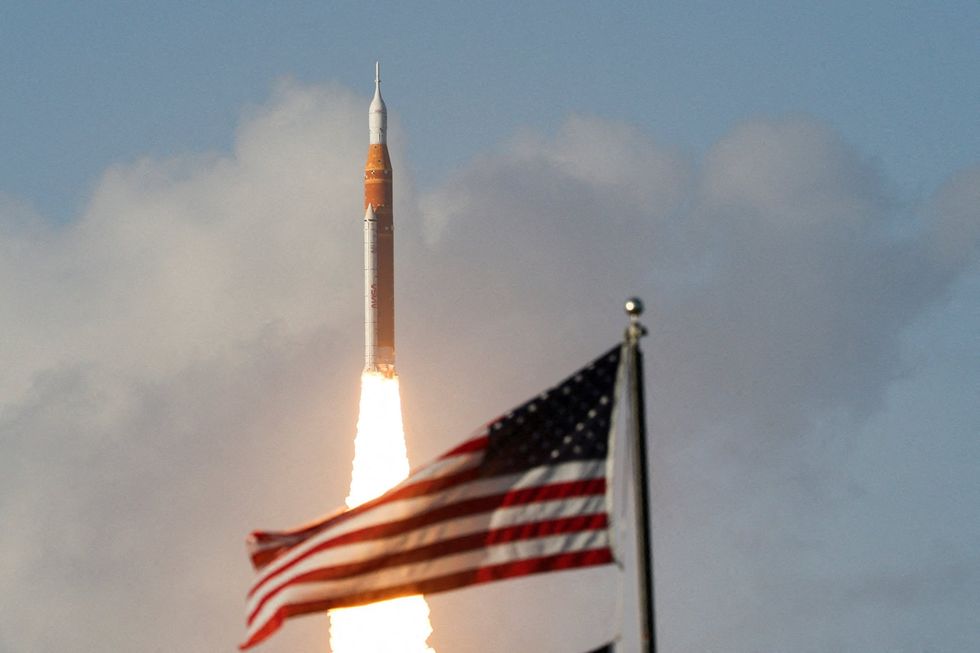
Nasa's Artemis II mission to fly by the moon, comprising of the Space Launch System (SLS) rocket with the Orion crew capsule, lifts off from the Kennedy Space Center in Cape Canaveral, Florida, US
|REUTERS
Nasa's Artemis II mission to fly by the moon, comprising of the Space Launch System (SLS) rocket with the Orion crew capsule, lifts off from the Kennedy Space Center in Cape Canaveral, Florida, US
Nasa has cut Artemis II's official broadcast
Nasa has now cut the Nasa+ broadcast of Artemis II, with everything successful so far.
The mission's next major milestones are the perigee raise maneuver and apogee raise burn.
These two steps increase the lowest and highest points of the Orion capsule's orbit to prepare for operation in deep space.
For those who wish to follow along, Nasa will continue to provide updates via its live blog, alongside a 24/7 livestream of mission control.
Commander Reid Wiseman remarks on view
Space commander Reid Wiseman has said: "Great view. We have got a great Moonrise."
A naval aviator and test pilot, he is overlooking the deployment and latching of the solar arrays.
At age 50, he is the oldest person to leave low Earth orbit.
Solar array wings are open
The Artemis II has opened its solar array wings, which will provide continuous electrical power.
A critical milestone, they will power life-support systems, avionic, communications, and onboard operations.
The solar array wings have 150,000 solar cells to convert sunlight to electricity.
Main engine cutoff is complete as next major milestone is approaching
The astronauts, now within low Earth orbit, are able to to lift their visors, as the radiation risk is much lower.
Main Engine Cutoff, also known as Meco, when the boosters detach, is a big moment in any space mission.
More than 700,000 gallons of fuel are burned through in this step of the mission.
The top portion of the rocket, the Interim Cryogenic Propulsion Stage (ICPS) will propel the Orion capsule - where the four man crew is seated - to escape velocity speed.
Next up, solar array wings will be deployed from the Orion capsule, to provide electrical power for the rest of the mission.
Artemis II has entered low Earth orbit
Core stage separation has occurred on Artemis II.
Artemis II is over 100 miles from Earth.
They have now entered low-Earth orbit.
Artemis II approaching the boundary of space
Artemis II is approaching the boundary of space at 10,000 miles per hour.
The rocket removed its abort "jettison" system, which allowed the astronauts to escape if there is an emergency.
Houston - home to the Johnson Space Center - has picked up mission command.
Artemis II is now supersonic
Artemis II's is now supersonic.
The ship is flying within Earth's atmosphere.
The next step will be first stage rocket separation.
Artemis II has blasted off from Earth as historic mission is underway
The first crewed mission in 50 years, the history making Artemis II has lifted off.
The four astronauts will ride the most powerful rocket in Nasa's history.
The Earth has shaken and they are now bound for the Moon.
‘Godspeed, Artemis II’ - Read the message sent to astronauts as historic launch just moments away
The Artemis II is ready to go, with the ground rumbling and those on the Space Coast excited to witness history.
Three of the astronatus have shared a pre-launch message.
"We are going for our families," said pilot Victor Glover.
"We are going for our teammates," said mission specialist Christina Koch.
"We are going for all humanity," said mission specialist Jeremy Hansen.
It is two minutes from launch as the Launch Abort System has been activated.
Crew access arm retracted as timer to launch ticks down
The crew access arm, where astronauts board the rocket, has been retracted.
With the arm retracted, astronauts can not walk off Artemis II if there is an emergency.
We are approximately six minutes from launch, with all signs looking good to go.
Final 10-minute countdown now underway after Nasa gives greenlight
Final checks are complete and we are ready to go.
The final terminal 10-minute countdown is now underway.
"We are go for all humanity," Nasa has said as there are no further technical issues.
Artemis II, the first crewed Moon mission in 50 years, will launch in 10 minutes.
Nasa confirms battery issue will NOT affect launch in late breakthrough
Nasa has said the battery issue will not affect the launch, just minutes before the window opens.
The space agency said the fault lies with one of two batteries on the Launch Abort System, which it said was out of range.
It was reported there was a "higher temperature than would be expected" on the battery.
But the technical problem is "believed to be an instrumentation issue" which will not affect the launch.
Critical failure resolved before battery issue discovered
Moments before a second issue was discovered, cheers rang out at the Florida launch site as the Nasa announced the historic mission was now "go for launch" following the resolution of a major failure.
This critical safety feature, at the heart of the fault, is designed to destroy the vehicle mid-flight if it deviates from its intended path, ensuring that any potential debris does not pose a risk to Earth.
The problem appeared to stem from a communications fault between ground control and the system, preventing teams from properly testing the hardware ahead of launch.
Hatch sealed as Artemis II 'ready for launch'
Nasa have confirmed the hatch of the Orion Artemis II spacecraft has now been sealed.
"The Artemis II astronauts are now strapped into their seats and ready for launch," the space agency announced.
PICTURED: Nasa engineers making final preparations as major issue fixed
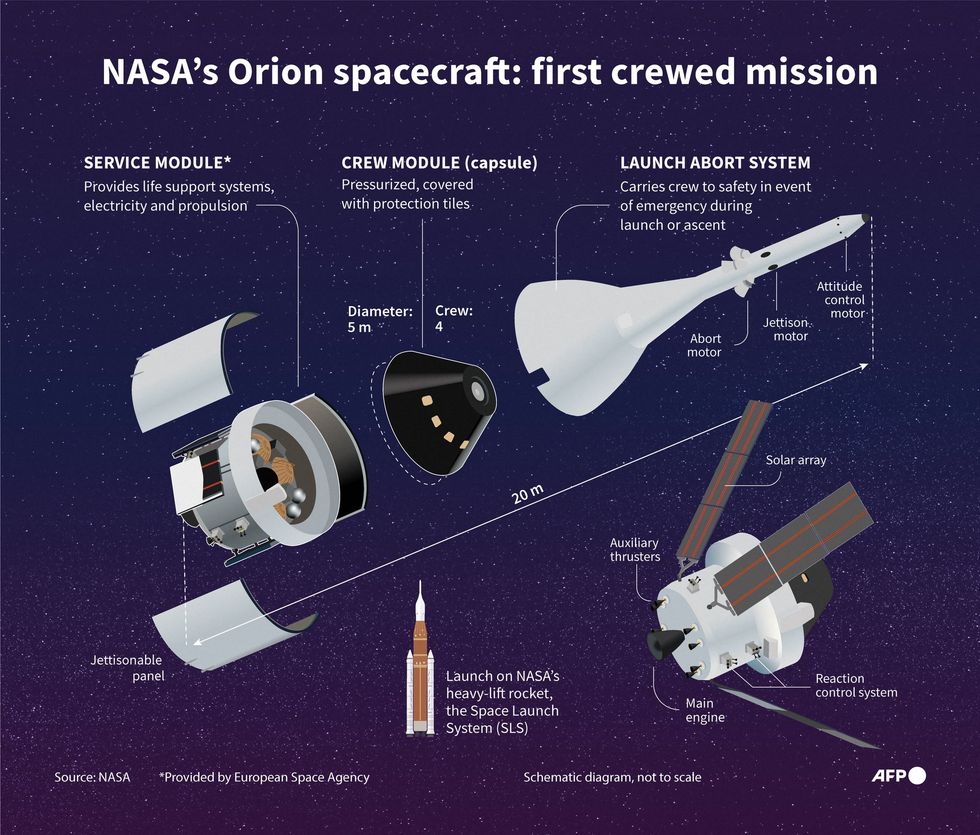
In detail: The Orion spacecraft taking astronauts to the Moon
The Orion spacecraft atop the Artemis rocket
|GETTY
The Orion spacecraft will be home to four astronauts for the next 10 days.
Nasa chief set sights on future Mars mission and talks alien life
The newly appointed Nasa administrator, Jared Isaacman, has spoken about the possibility of alien life in the solar system as the organisation prepares to launch its first moon mission in 50 years.
“If we can get to Mars and bring samples back, I put it at a better 90 per cent chance that we could prove there was some microbial life on Mars,” he told conservative commentator Benny Johnson.
“I would say there could be life everywhere. It doesn't mean it looks like us. It doesn't mean it has the tentacles you have in movies,” he added.
Nasa is planning a groundbreaking nuclear-powered mission to Mars, dubbed Space Reactor-1 (SR-1) Freedom, set to launch by the end of 2028.
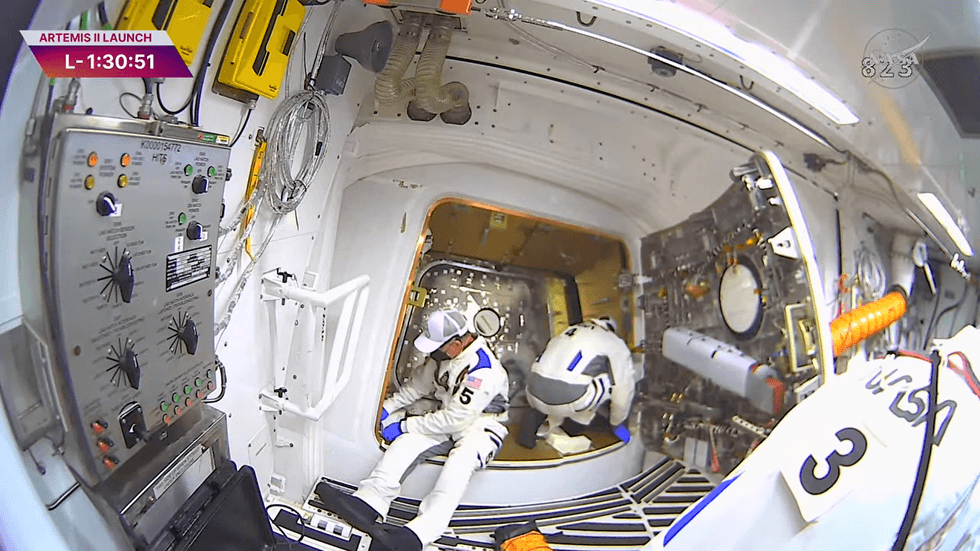
PICTURED: Inside the Artemis module cockpit
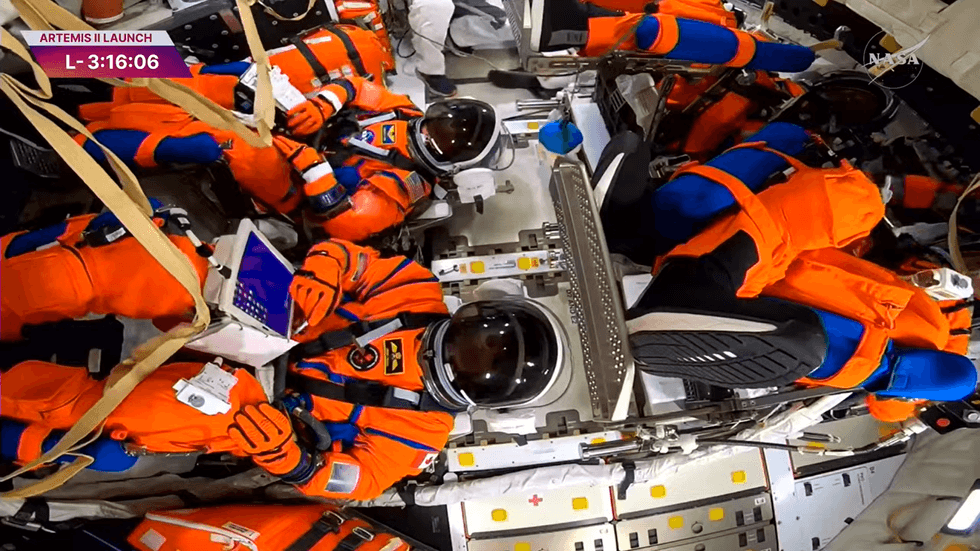
Inside the Artemis II module
|NASA
Nasa has shared footage of the tiny Orion module cockpit that will be home to the four Artemis astronauts for the next ten days.
Astroauts reveal the treasured items they are taking to lunar orbit
The astronauts of Nasa's Artemis program have shared the meaningful personal items they plan to carry with them on their upcoming journey around the Moon.
Pilot Victor Glover, who is deeply religious and teaches Sunday school, will be bringing a Bible on board.
Meanwhile, Jeremy Hansen of the Canadian Space Agency has chosen four small moon-shaped pendants. He originally bought them for his wife and children, but has now gathered them back so they can accompany him on the landmark mission.
Mission commander Reid Wiseman is opting for simplicity, packing just a notebook and pencil so he can jot down reflections as he takes in views of both the Moon and Earth.
For mission specialist Christina Koch, the most meaningful items are handwritten messages from family members—tokens she says will feel especially significant when she is far from home.
MAPPED: The Artemis II mission
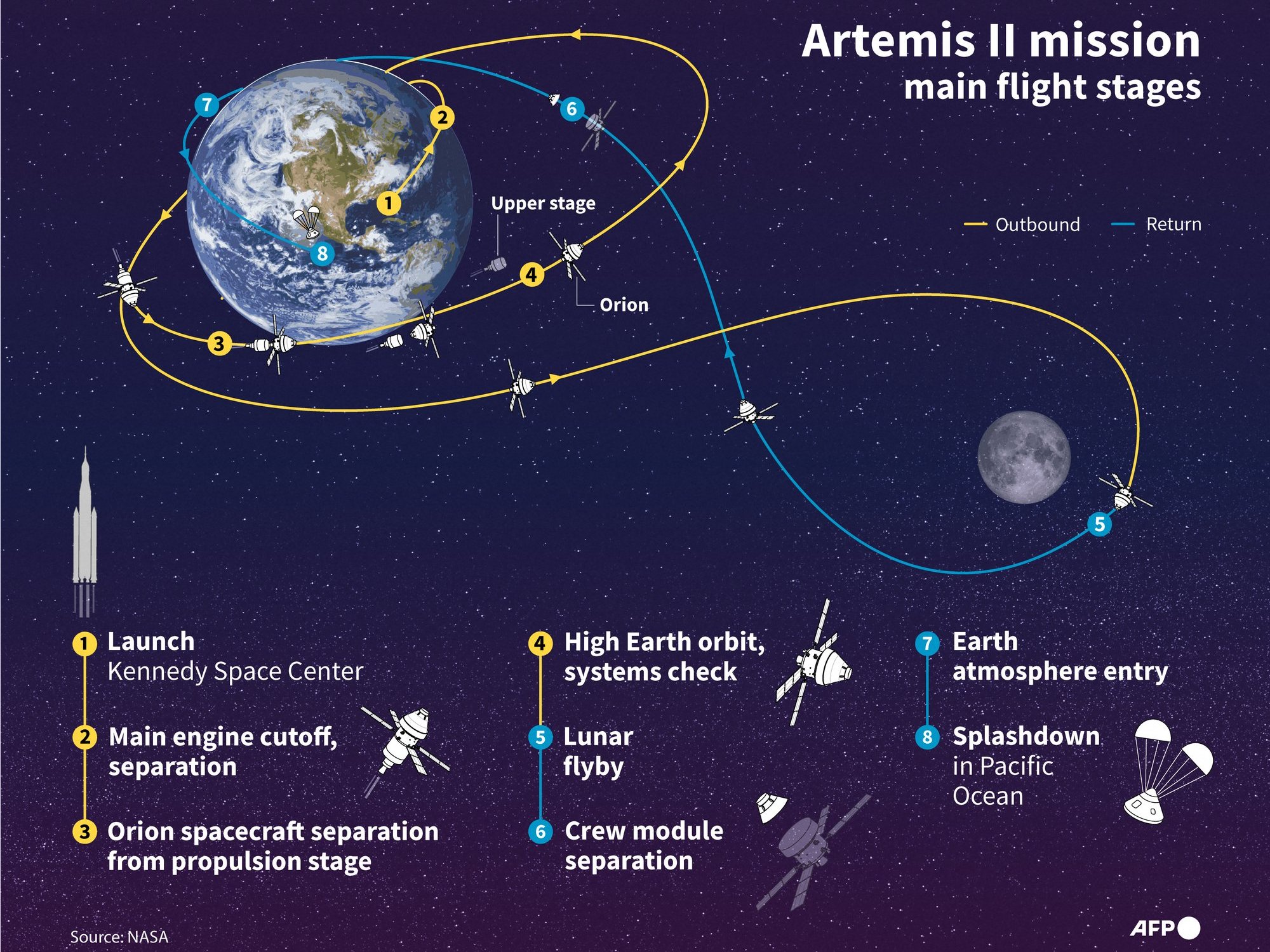
The route the mission will take
|GETTY
The King's message to Nasa astronauts
King Charles has sent a personal letter to Canadian Space Agency astronaut Colonel Jeremy Hansen.
The monarch acknowledged the growing importance of responsible stewardship as space exploration and the commercial space sector continue to expand rapidly.
In his message to the crew, the King said: "As you embark on this momentous endeavour, I send you and your fellow crew members my heartfelt good wishes.
“May the stars align in your favour, and may your safe return inspire countless others to uphold the values of sustainability, cooperation and wonder that the Astra Carta inspires."
The British engineers helping take Artemis II to the moon
Dozens of science and technology firms based in the United Kingdom are making significant contributions to Nasa's first crewed Moon mission in more than half a century in a triumph for British engineering.
In January 2025, Thales Alenia Space signed a £750million contract with the European Space Agency (ESA) to contribute towards the Artemis programme.
Its scientists, based in Harwell, Oxfordshire, are designing the propulsion solution for the Lunar Gateway — more commonly known as "Gateway".
Another firm helping with the Artimus programme is John Crane, whose core engineering is based at its headquarters in Slough, Berkshire.
Jeroen Huizinga, the company's Senior Director for Auxiliary Products and New Energy Solutions, highlighted his team's work on filtration sieves, which are designed to keep propellant tanks required for manoeuvring Orion free of gas bubbles.
Welcome to the GB News Artemis II live blog
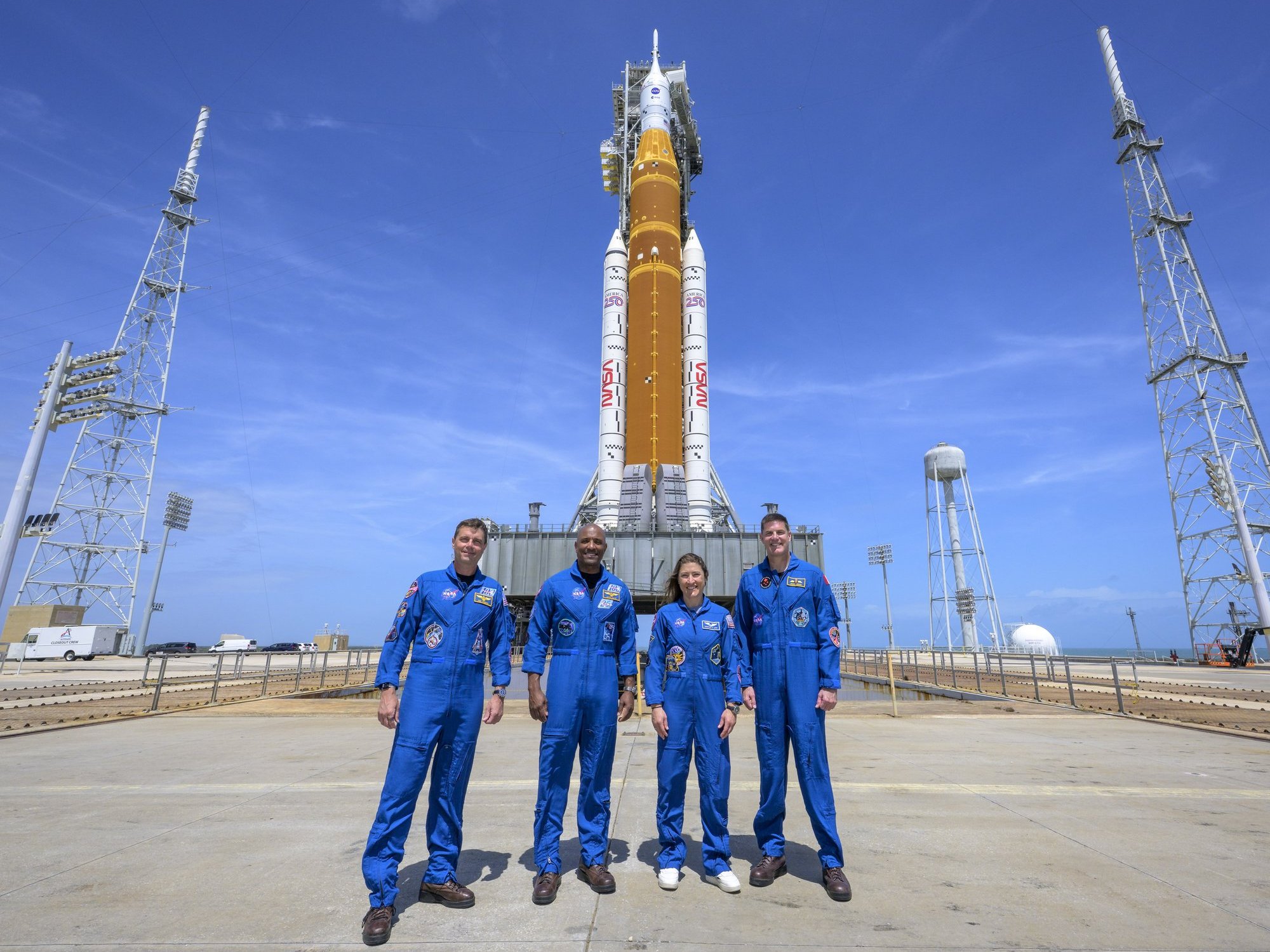
The four astronauts of the Artemis II mission
|GETTY
Good evening and welcome to the GB News Artemis II launch live blog.
Join us throughout the night as we cover the launch of humanity's first crewed voyage to the Moon since Apollo 17 touched down on the Moon's surface in December 1972.
The Orion capsule will carry four astronauts roughly 4,700 miles past the Moon's far side, setting a new record for human spaceflight distance.
Nasa chief flight director Emily Nelson said: "The opportunity is immense for us to finally get the opportunity to send our crew farther than anyone's gone before."
Although the crew will not set foot on the lunar surface, their primary task is to rigorously evaluate Orion's life support, propulsion, power, and navigation systems during the deep-space portion of the flight.
Our Standards: The GB News Editorial Charter
More From GB News