









A groundbreaking genetic investigation has uncovered evidence that whole families were put to death as offerings to local rulers in the ancient Silla kingdom, located in present-day South Korea, roughly 1,500 years ago.
The research, published last Wednesday in Science Advances, examined remains from the Imdang-Joyeong burial site in Gyeongsan, situated in the southeastern Korean Peninsula.
An international team of scientists studied 78 skeletons from tombs dating to the fourth through sixth centuries - a period known as the Three Kingdoms era.
Their findings also exposed a complex kinship structure centred on women and their descendants, challenging assumptions about ancient Korean social organisation.
TRENDING
Stories
Videos
Your Say
Historical accounts indicate that Silla society practised "sunjang", a ritual in which servants known as "retainers" were killed and interred alongside elite members of society.
The ancient Korean practice of human sacrifice saw servants, retainers, or family members buried alive or killed to accompany deceased royalty and elites in the afterlife.
DNA analysis of the 78 individuals revealed 11 pairs sharing first-degree relationships, such as parents and children or siblings, alongside 23 pairs connected as second-degree relatives, including grandparents with grandchildren or aunts with nieces.
These genetic connections suggest the Silla people deliberately buried close family members together.
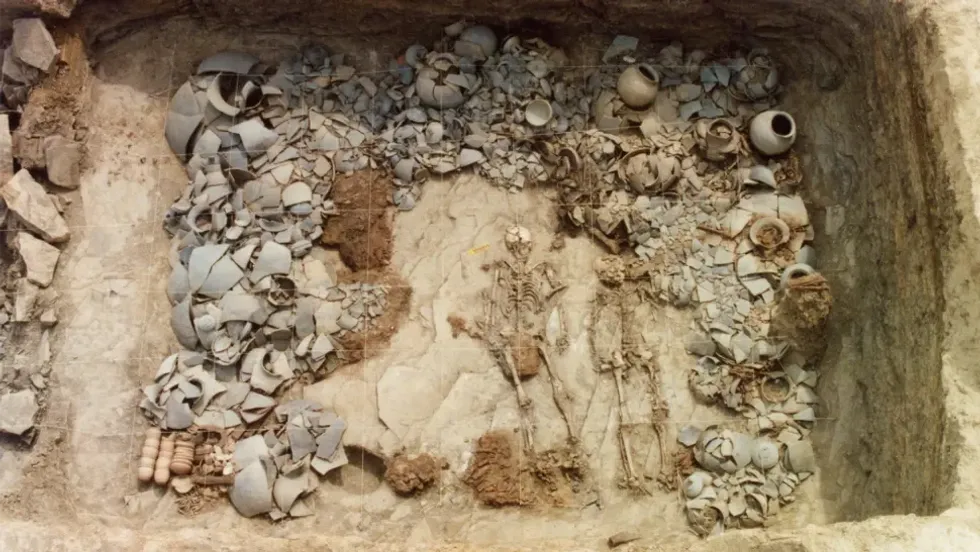
Excavation of tombs in the Joyeong burial complex in Gyeongsan, South Korea
|GYEONGSAN CITY
The researchers successfully reconstructed 13 family trees from the genomic data, uncovering an extensive network of relatives that stretched across two burial locations, and spanned more than a century.
The kinship network was distinctly organised around maternal lineages, setting Silla apart from male-centred systems observed in other parts of ancient Korea and Europe.
Evidence of consanguineous marriage emerged among five individuals from both royal and non-royal backgrounds, with at least one case involving first cousins.
While elite "tomb owners" received individual burials, sacrificed retainers were sometimes interred together in groups.
LATEST ARCHAEOLOGY BREAKTHROUGHS
Researchers identified three instances where parents and their offspring were sacrificed and placed in the same grave, confirming historical records that sunjang affected entire households.
"Genetic relatedness among sacrificial individuals over generations may suggest the presence of families that served as sacrificial individuals for the grave owner class for consecutive generations," the researchers wrote.
Jack Davey, director of the Early Korean Studies Center in Cambridge, Massachusetts, who was not involved in the research, described the study as "an important contribution to Korean archaeology".
He noted that skeletal preservation from the Three Kingdoms period is rare.
He said: "If correct, the presence of what seems to have been a sacrificial caste in this regional polity outside of the Silla core has profound implications for how we understand Silla society."
The practice of sunjang on entire families raises questions about institutionalised violence, slavery and social mobility in this 1,500-year-old kingdom.
"This study could serve as a model for future work on other sites that have yielded skeletal material," Mr Davey added.