










A schoolgirl has potentially found a 500,000-year-old mammoth bone on a beach in a stunning archaeology discovery.
Nina Evans, seven, was hunting for shark teeth on a Suffolk beach has stumbled across what experts believe could be a prehistoric bone up to half a million years old, potentially from a woolly mammoth.
The schoolgirl from Ipswich, made the discovery on Easter Saturday while searching through rocks on Felixstowe beach with her father David, 41, and her nine-year-old brother Ivan.
After spotting the chunk of bone among the rocks, the family photographed it and ran it through an AI app, which suggested it may have belonged to a mammoth.
TRENDING
Stories
Videos
Your Say
Professor Ben Garrod, an evolutionary biologist from the University of East Anglia, subsequently examined the find and said while a mammoth was one possibility, it could also have come from a range of other large prehistoric mammals.
He told the BBC the bone was from something larger than a cow, with candidates including an Irish elk, aurochs, wild horse or even a rhinoceros.
He said: "So far as I can say, it is old, sub-fossilised, and probably Pleistocene - it's a massive ballpark, but most likely somewhere between 100,000 and half a million years old."
Regardless of its origins, the academic described Nina's discovery "a lovely find and a real piece of prehistory".
He added whatever creature the bone belonged to, it would have roamed a landscape almost unrecognisable from Suffolk today.
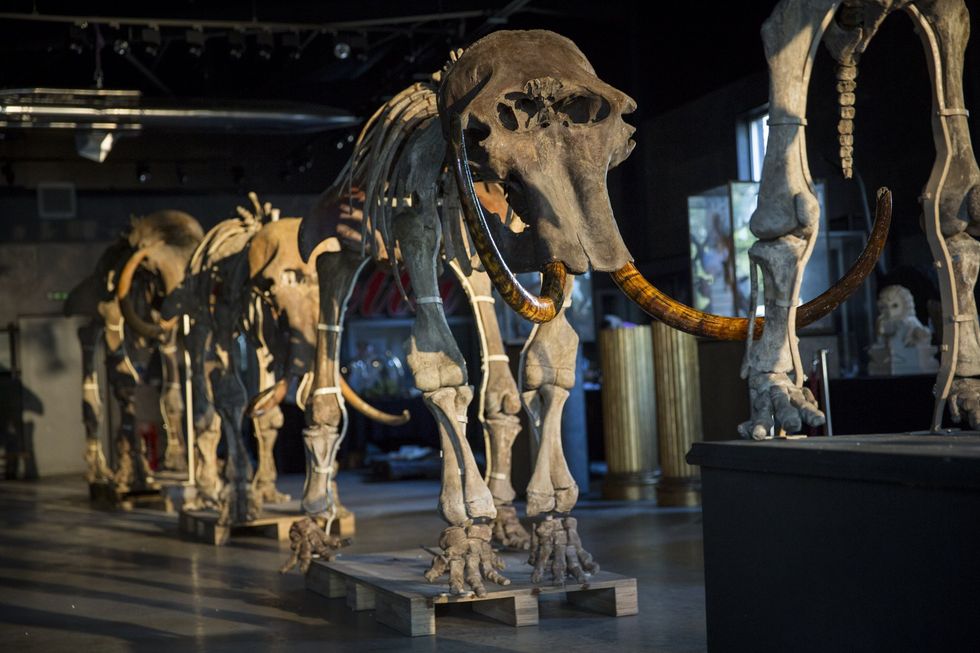
The fossilised bone is thought to be either a mammoth, an Irish elk, aurochs, wild horse or even a rhinoceros
|GETTY
He said: "When it was walking around Suffolk, it could have walked all the way to mainland Europe, as the North Sea wasn't there then."
Ipswich Museums said the bone could be from a rib, although a horn could not be ruled out either.
Mr Evans said he regularly takes his children to beaches along the Suffolk coastline to see what they can find, but a prehistoric mammal bone was the last thing either of them had expected to turn up.
He said: "She asked me what type of stone it was, and I thought it might be a bit of wood, but then it became clear that it was a bone, so we were quite excited."
LATEST DEVELOPMENTS
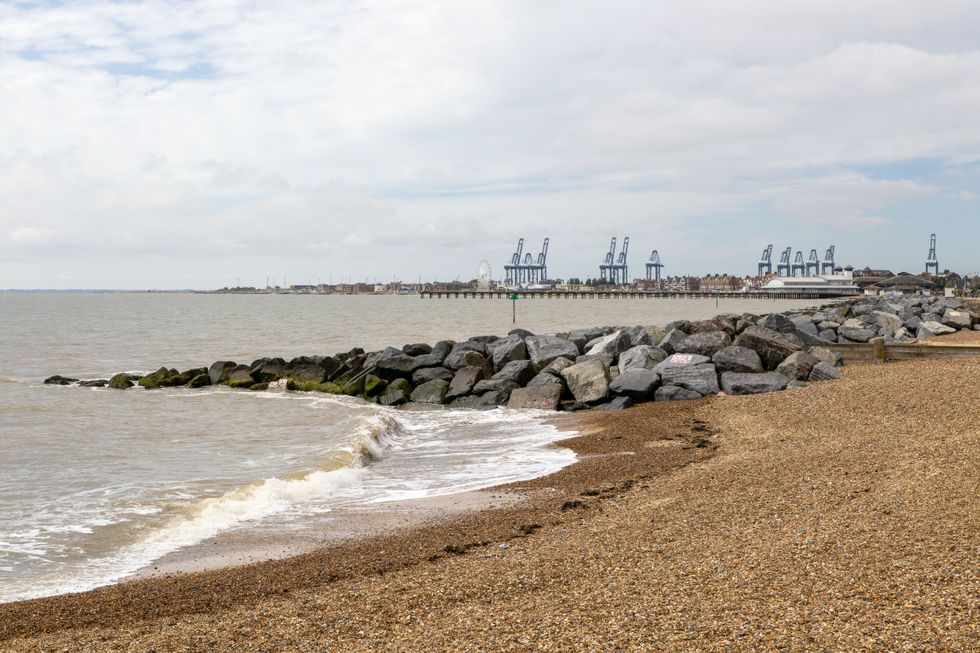
Felixstowe Beach in Suffolk where the schoolgirl found the prehistoric bone
|GETTY
Nina has since placed her find in a special box in her bedroom safe and, according to her father, is characteristically understated about the whole thing.
Suffolk is well established as one of Britain's richest locations for Pleistocene-era fossils, including those belonging to woolly mammoths, making the county a regular destination for fossil hunters of all ages.
The idea that such a creature once walked the same ground is less far-fetched than it might seem. Woolly mammoths roamed what is now the British Isles for hundreds of thousands of years before their extinction.
The woolly mammoth evolved around 2.5 million years ago as the Earth's poles began to freeze over and the Ice Age took hold, with ice sheets spreading across much of the Northern Hemisphere and permafrost reaching as far south as London.
Rather than being wiped out by the cold, mammoths adapted to it, developing a double layer of fur, with the shaggy outer coat growing up to 20 inches long, small heat-retaining ears, and a deep layer of subcutaneous fat to insulate against temperatures as low as minus 50 degrees Celsius.
Roughly the size of a modern African elephant and standing around 13 feet tall, they used their enormous curved tusks, some as long as a canoe, to clear snow, and their trunks to forage for grasses and shrubs beneath.
They were also remarkable travellers, with some individuals covering distances equivalent to circumnavigating the globe twice during their lifetimes.
Their heyday came around 20,000 years ago, but within 10,000 years the population had reduced to small isolated communities on islands off the coasts of Siberia and Alaska.
The last mammoths died out around 2000 BC. This is the same era in which the Pyramids at Giza were being built.
The cause of their extinction has been debated, but scientists now broadly agree that the speed of climate change at the end of the last Ice Age was the decisive factor, destroying the grassland habitats on which the mammoths depended.
Professor Eske Willerslev from Cambridge University's Department of Zoology said it was not merely the change in climate but the pace of it that proved fatal, with trees and wetland plants rapidly replacing the open grasslands the mammoths relied upon for food.
Humans did hunt mammoths, using their bones to build shelters, carve tools and even musical instruments, but scientists believe the scale of hunting alone is insufficient to drive them to extinction.
Our Standards: The GB News Editorial Charter