










Nasa has officially confirmed the discovery of MoM-z14, the most distant galaxy humanity has ever observed, following peer-reviewed research published in the Open Journal of Astrophysics.
The remarkable celestial object was photographed by the James Webb Space Telescope in April 2024, with scientists initially announcing their findings last year.
The space agency declared that this extraordinary image extends the "boundaries of the observable universe" closer to the Big Bang than ever before achieved.
Rohan Naidu, the study's lead author from the Massachusetts Institute of Technology, expressed both wonder and intrigue at the findings.
"With Webb, we are able to see farther than humans ever have before," he said.
"And it looks nothing like what we predicted, which is both challenging and exciting."
Observing galaxies at such staggering distances effectively functions as a form of cosmic time travel, owing to the finite speed at which light traverses space.
Whilst illumination from our Moon reaches Earth in just over a second, and sunlight takes approximately eight minutes to arrive, scaling this principle to astronomical proportions allows scientists to peer into the universe's earliest epochs.
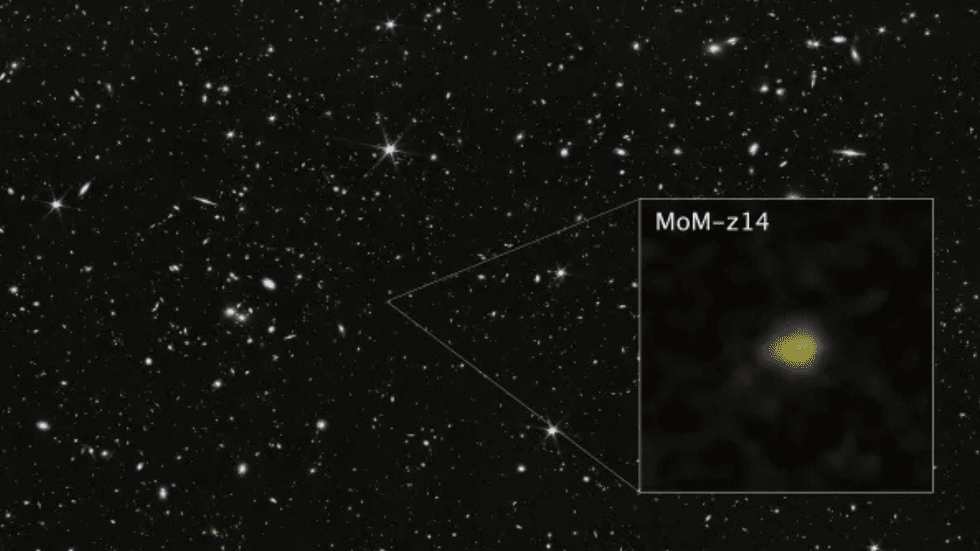
Nasa has officially confirmed the discovery of MoM-z14, the most distant galaxy humanity has ever observed
|NASA
MoM-z14 exists at such an immense distance that its light has journeyed for roughly 13.5 billion years to reach Webb's instruments.
This means astronomers are witnessing the galaxy as it appeared merely 280 million years following the Big Bang, which occurred 13.8 billion years ago.
Nasa confirmed the galaxy's age using Webb's Near-Infrared Spectrograph, which measured a cosmological redshift of 14.44, indicating its light has been stretched across expanding space throughout nearly the entire history of the cosmos.
The research revealed that MoM-z14 belongs to a collection of unexpectedly luminous galaxies from the early cosmos, possessing remarkably elevated nitrogen concentrations.
SPACE - READ THE LATEST:
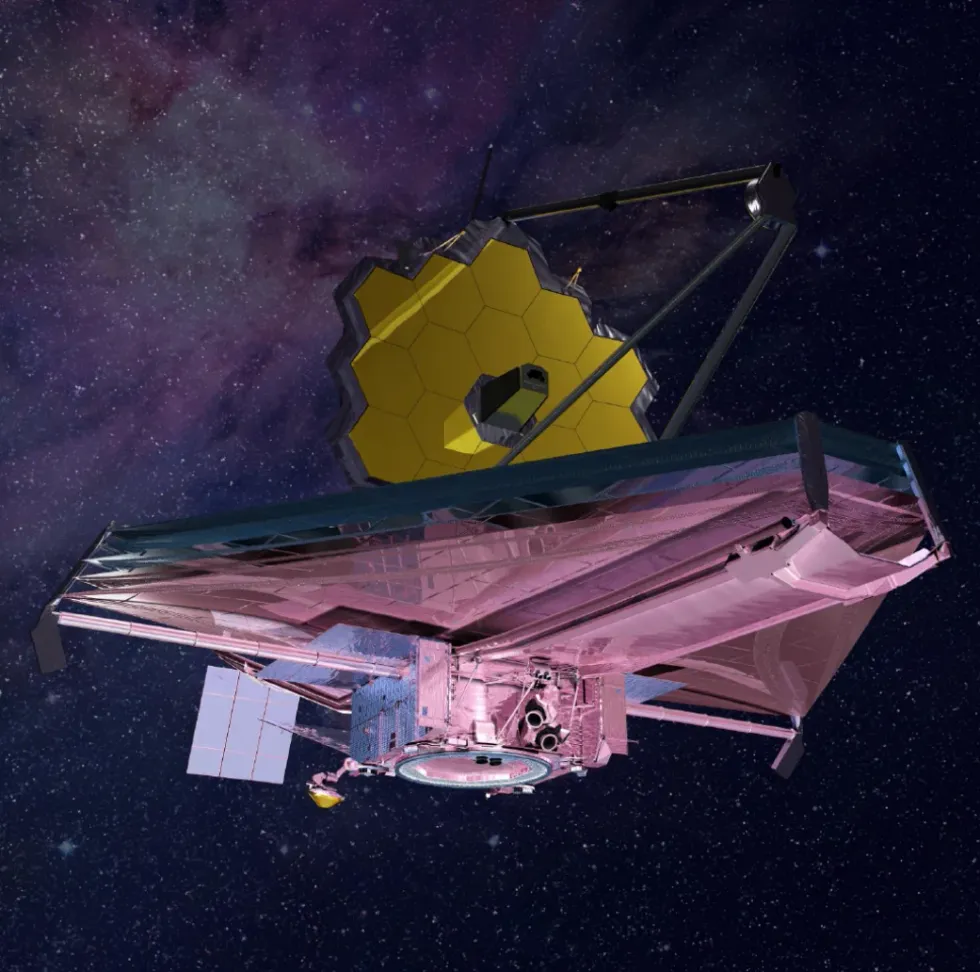
The remarkable celestial object was photographed by the James Webb Space Telescope
| NASAThis discovery presents a significant puzzle for astrophysicists, as conventional understanding suggests insufficient time existed for successive stellar generations to manufacture such quantities of nitrogen within 280 million years of the universe's birth.
Scientists now theorise that the dense conditions of the primordial universe gave rise to supermassive stars capable of generating far greater nitrogen quantities than their modern counterparts.
"We can take a page from archaeology and look at these ancient stars in our own galaxy like fossils from the early universe," Mr Naidu explained.
"It turns out we are seeing some of the same features, like this unusual nitrogen enrichment."
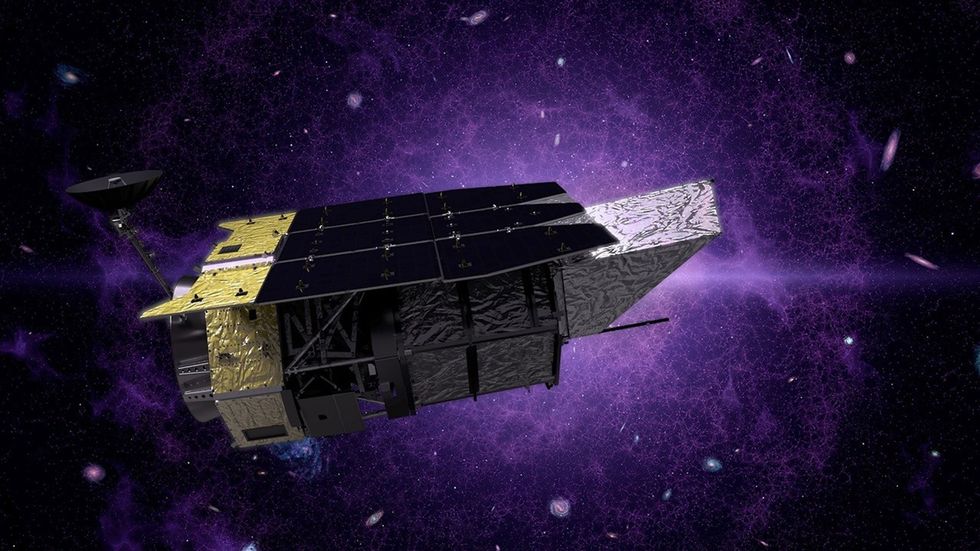
Nasa intends to probe even deeper using the forthcoming Nancy Grace Roman Space Telescope
|NASA
Nasa intends to probe even deeper into cosmic history using Webb alongside the forthcoming Nancy Grace Roman Space Telescope, anticipated to launch as early as late 2026.
Yijia Li, a research team member from Pennsylvania State University, emphasised the necessity for additional data to comprehend these ancient cosmic phenomena.
"To figure out what is going on in the early universe, we really need more information," she said.
"More detailed observations with Webb, and more galaxies to see where the common features are, which Roman will be able to provide."
Ms Li added: "It's an incredibly exciting time, with Webb revealing the early universe like never before and showing us how much there still is to discover."
Our Standards:
The GB News Editorial Charter