










Archaeologists in the United States believe they have uncovered evidence of an ancient civilisation older than the pyramids of Egypt.
A prehistoric canoe that predates the Great Pyramid of Giza by approximately 700 years has been discovered in Lake Mendota, Wisconsin.
Egypt's famous pyramid is at least 4,500 years old - while the vessel is believed to be around 5,200 years old.
Researchers from the Wisconsin Historical Society made the find during ongoing excavations of the lake.
Six previously unknown canoes were unearthed in the latest dig.
The discovery points to an advanced civilisation thriving in North America at the same time ancient Egyptians were building their monuments.
Since 2021, a total of 16 ancient dugout boats have been located in the lake.
Each vessel was carved from a single tree trunk using fire and basic implements such as stones and shells.
Radiocarbon dating revealed the canoes were constructed between 3000 BC and 1300 AD.
The boats were discovered 30 feet beneath the surface, clustered near natural paths.

The canoes were discovered 30 feet beneath the surface, clustered near natural paths
|WISCONSIN HISTORICAL SOCIETY
This suggests the lake served as a busy trading and shipping hub for generations.
Only two of the 16 vessels have been removed from the water so far.
These are nearing the end of a preservation process lasting several years, including a 14-foot boat approximately 3,000 years old.
Most of the ancient dugout canoes were fashioned from hardy hardwoods, particularly red and white oak.
The oldest vessel, dating to the Egyptian era, was carved from red oak.
ARCHAEOLOGY - READ MORE:

Only two of the 16 vessels have been removed from the water so far
|WISCONSIN HISTORICAL SOCIETY
This choice puzzled experts because red oak typically absorbs water through its open pores, making boats heavier and less buoyant.
Researchers believe the builders may have selected stressed or damaged trees, or deliberately wounded growing trees.
This would have caused the wood to form natural blockages called tyloses, sealing it against water and rot.
The canoes were also found with rocks carefully positioned on top.
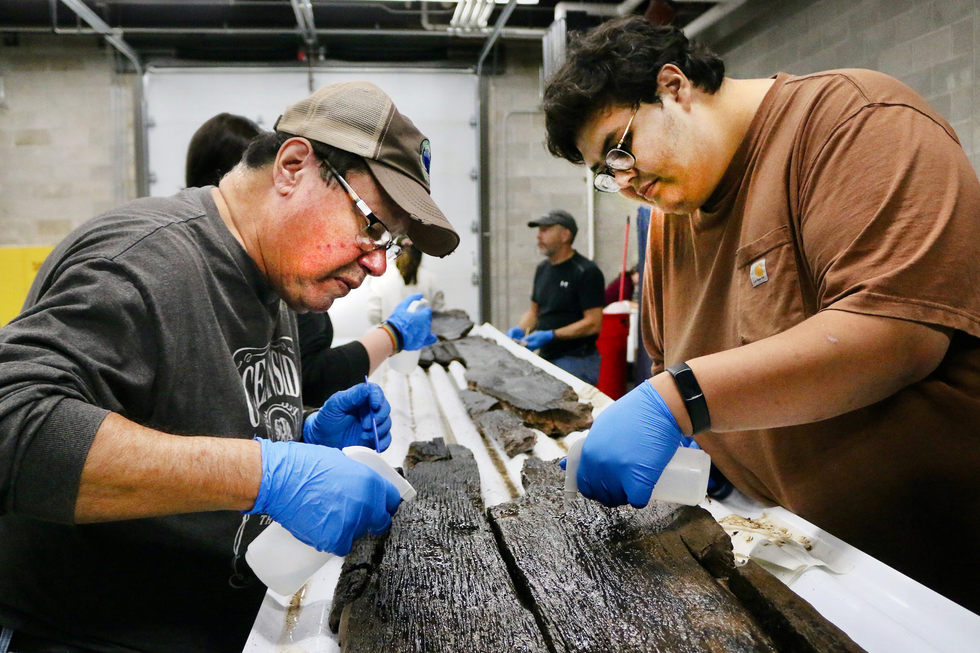
PICTURED: Members of the Wisconsin Historical Society work on segments of one of the ancient canoes
|WISCONSIN HISTORICAL SOCIETY
Experts believe this was done to prevent the vessels from warping during winter.
The discovery holds deep significance for the Ho-Chunk people, whose ancestors inhabited the region for millennia.
While the Paleo-Indian people first arrived around 12,000 years ago, the Ho-Chunk tribe migrated to the area no earlier than 800AD.
The find has been earmarked as a way for the Ho-Chunk to strengthen their cultural and spiritual ties to the local waters and lands.
And the nearby Lake Wingra, likely accessible by canoe to this ancient community, is also deeply significant to the tribe.
Dr Amy Rosebrough, State Archaeologist for WHS, said: "One of its springs, with its white clay bottom, is viewed as a portal to the spirit world. For generations, the Ho-Chunk have honored this place through ceremonies of remembrance."