










Scientists have revealed that ancient bones unearthed deep in a quarry date back approximately 773,000 years - and could be a fabled "missing link".
The ancient remains were found at Grotte a Hominides, a cave in Casablanca, Morocco.
Moroccan and French researchers believe they represent the last common ancestor of modern humans, Neanderthals and Denisovans.
The collection of bones includes a nearly intact adult jawbone, half of another adult jaw, a child's jawbone, several vertebrae and individual teeth.
These were different from fossils at nearby Jebel Irhoud, which at 300,000 years old are the earliest known remains of Homo sapiens - us.
Morocco's bones also bear a striking resemblance to Homo antecessor, a species first identified in Spain in the 1990s.
Homo antecessor displays both primitive and modern facial characteristics.
The Spanish fossils extended the known timeline of humans in Western Europe by hundreds of thousands of years.
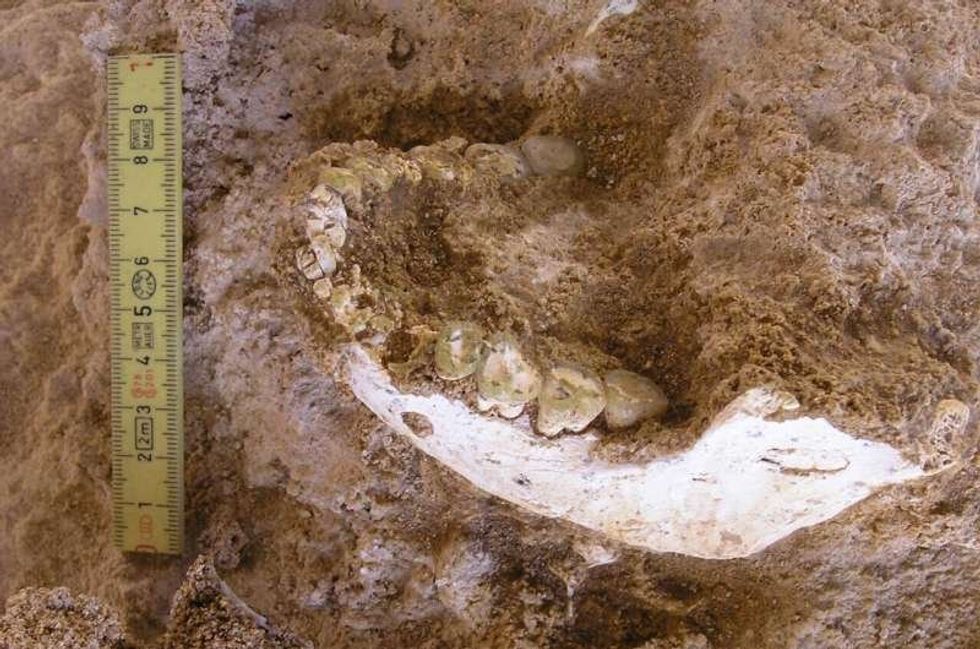
Researchers think the jawbones could represent the last common ancestor of modern humans, Neanderthals and Denisovans
|PROGRAM PREHISTOIRE DE CASABLANCA
They challenged a theory that Homo sapiens began in Africa then replaced other hominins as they migrated to the rest of the world.
Instead, they back the idea that early hominins migrated out of Africa before evolving into distinct groups across Asia and Europe.
The Moroccan specimens show a blend of traits, suggesting a "missing link" of African and Eurasian lineages lived on both sides of the Mediterranean.
Dr Jean-Jacques Hublin, an anthropologist at the Max Planck Institute for Evolutionary Anthropology and lead author, argued this evidence supports a deep African origin for Homo sapiens - and shuts down claims humanity started in Eurasia.
He and his colleagues believe the findings prove hominins are the best candidates yet for the "root of the tree" which led to our species.
Though finding out exactly how old the bones were was challenging, researchers eventually made a breakthrough.
LATEST SCIENCE HEADLINES FROM GB NEWS:
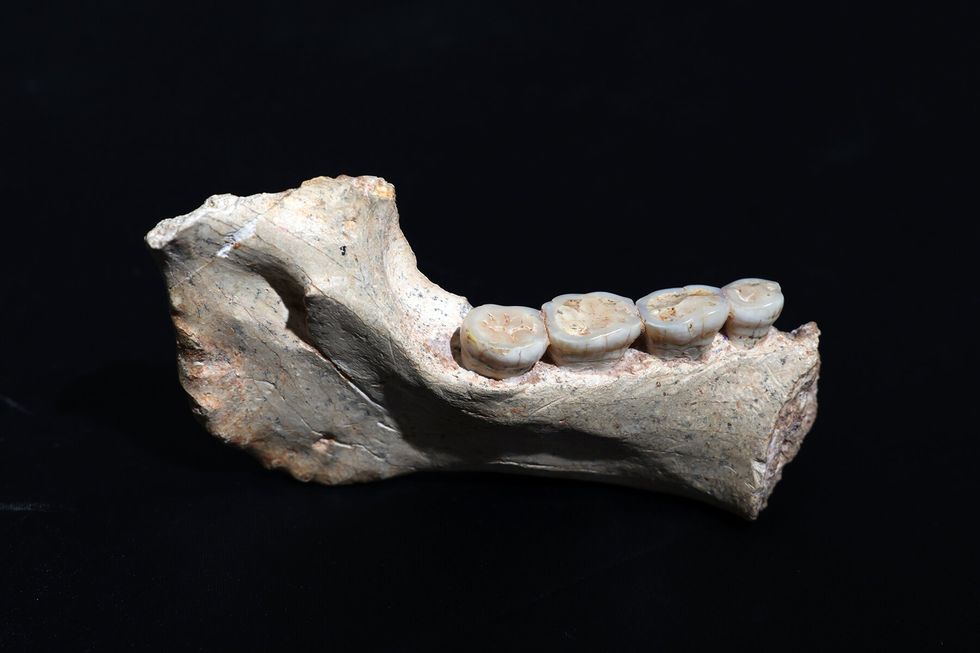
PICTURED: A 773,000-year-old jawbone from the cave in Morocco
|PROGRAM PREHISTOIRE DE CASABLANCA
"Fortunately, the deposits at the site proved to be exceptionally well suited to recording past variations of the Earth's magnetic field," Dr Hublin said.
Earth's magnetic field reverses periodically, and scientists were able to show that the layer of rock where the jawbones were found lined up with the most recent major flip.
But Dr Hublin was cautious about definitively identifying the Moroccan fossils.
"Human evolution is largely a history of extinctions," he said. "It is difficult to say whether the small Grotte a Hominides population left any descendants, but it provides a good picture of what the last common ancestor may have been like."
And Scott A Williams, a paleoanthropologist at New York University, said the research demonstrated that travel between north Africa and southern Europe took place throughout the Middle Pleistocene, an ice age which lasted from roughly 774,000 to 129,000 years ago.
Researchers believe the cave may once have served as a lair for ancient meat-eating animals.
The site provides a glimpse into an ancient coastal environment where the Atlantic met a landscape of dunes, rocky outcrops and marine platforms.
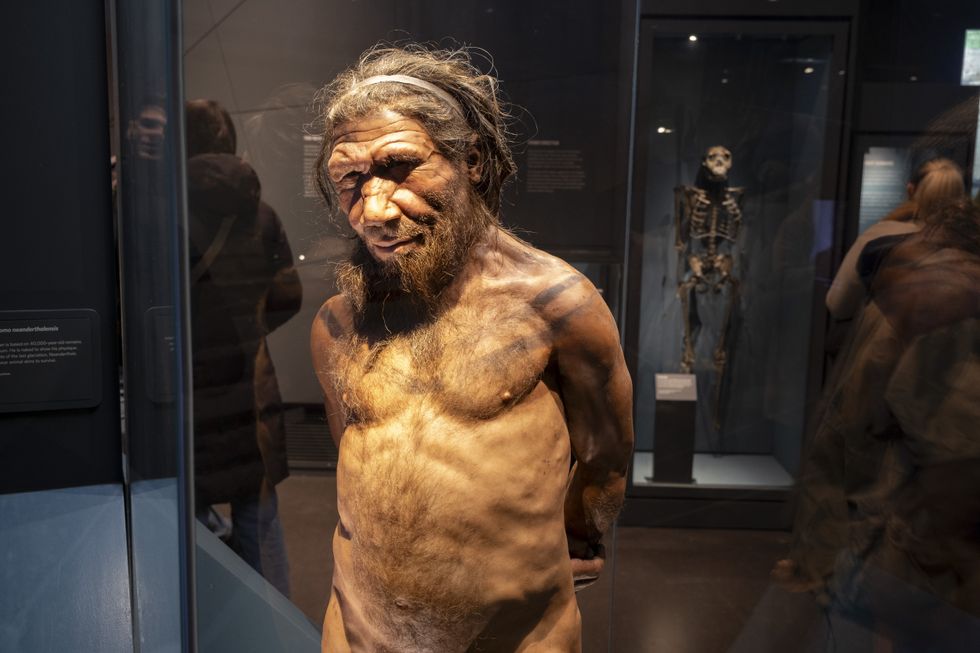
PICTURED: A Neanderthal man at the human evolution exhibit at the Natural History Museum. Researchers believe their findings may be the last common ancestor of modern humans and Neanderthals
|GETTY
Wetlands and swamps once thrived in this region, teeming with wildlife.
Panthers roamed the grasslands while hippos, crocodiles, hyenas and jackals inhabited the muddy banks.
Evidence from nearby Rhinos Cave, a slightly younger site, shows "intense butchering activity", suggesting those hominins dominated their environment as top predators.
But sometimes, the tables turned.
"The occurrence at the Grotte a Hominides of a hominin femur bearing gnawing marks from a large carnivore - probably a hyena, after death - demonstrates that hominins were also, at times, consumed as prey," Dr Hublin added.
The findings appear in the journal Nature.