










If you've been treated for certain heart conditions, the wearable already strapped to your wrist could offer better diagnosis and reduce the risk of unexpected hospitalisation compared to regular check-ups at your local NHS hospital, a landmark study revealed.
Given the ludicrous success of Apple's tech-laden timepiece — the Apple Watch lineup has outsold the entire Swiss watch industry, according to some estimates — these findings could have widespread implications for heart health in the UK and could provide a new tool to reduce pressure on the NHS.
For those who live far away from their nearest hospital, this could let patients manage their condition from the comfort of their own home without compromising on the level of care, since researchers found that Apple Watch "detected atrial fibrillation earlier and more frequently than those receiving standard care".
The study, published in the Journal of American Cardiology at the end of last month, was put together by researchers at St Bartholomew’s Hospital in London, led by Dr Nikhil Ahluwalia.
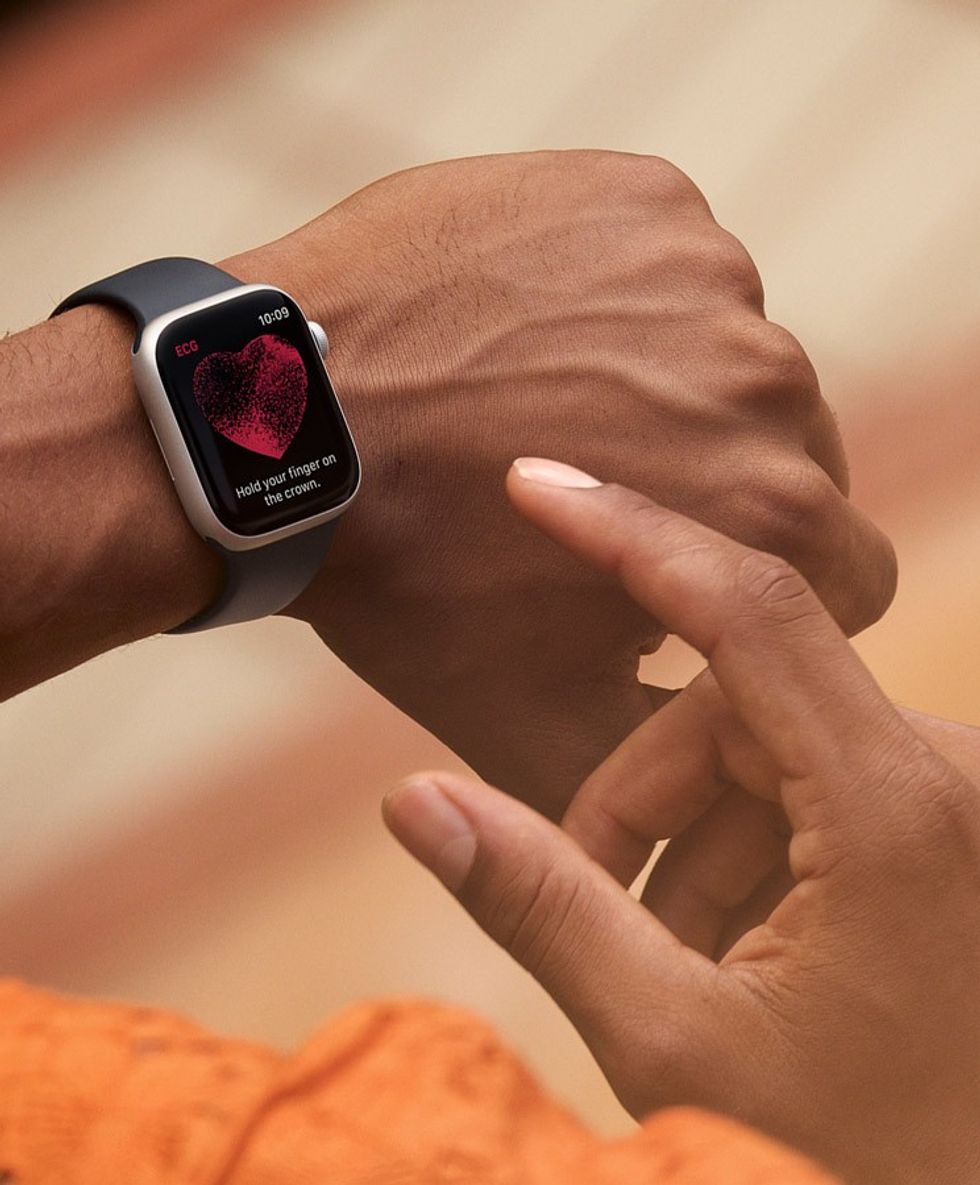
Some Apple Watch models can perform an ECG (electrocardiogram) that uses built-in electrodes to read and record the electrical heart signals straight from your fingertip and wrist. You can share a PDF of your ECG reading with your doctor
|APPLE PRESS OFFICE
He wanted to look into whether off-the-shelf smartwatches and wearables could transform how patients are monitored after treatment for Atrial Fibrillation, sometimes referred to as AF or AFib. Dr Ahluwalia is part of Apple's Investigator Support Program, which provides Apple devices for health researchers to use in studies.
Atrial Fibrillation costs the NHS more than £2 billion every year, so Dr Ahluwalia wanted to see whether everyday gadgets – like the Apple Watch – could compete with the standard NHS treatment route, which includes an ECG exam in a hospital.
Patients chosen to take part in the study, the first randomised trial of its kind, used an Apple Watch as a clinical tool after catheter ablation – a common treatment for AF. Instead of relying on occasional hospital ECGs, patients were able to record a clinical-grade ECG at home whenever they experienced symptoms.
Introduced with the Apple Watch Series 4 in late 2018, the dedicated ECG app lets you record an electrocardiogram from anywhere in 30-seconds. To do this, you'll need to rest your arm and place a fingertip on the Digital Crown.
@gbnews Dr. Nikhil Ahluwalia discusses the Apple Watch's groundbreaking health potential #tech #health #applewatch
Behind the scenes, this wristworn computer is reading data from two electrodes (the heart-rate sensor on the back of the Apple Watch that rests against your wrist and the Digital Crown) to measure the tiny voltage difference across your chest — essentially a single-lead ECG waveform. After 30-seconds, the trace is digitised, filtered, and analysed by Apple’s algorithm to classify sinus rhythm, atrial fibrillation (AFib) or “inconclusive.”
You can share a PDF of your ECG reading with your doctor via the Health app preinstalled on your iPhone.
According to Dr Nikhil Ahluwalia's study, patients who relied on an Apple Watch detected Atrial Fibrillation earlier and more frequently than those who received a standard care plan.
Crucially, despite identifying more rhythm abnormalities, these patients were less likely to be admitted to hospital unexpectedly — suggesting that real-time feedback helped reduce anxiety and avoid unnecessary emergency visits.
LATEST DEVELOPMENTS
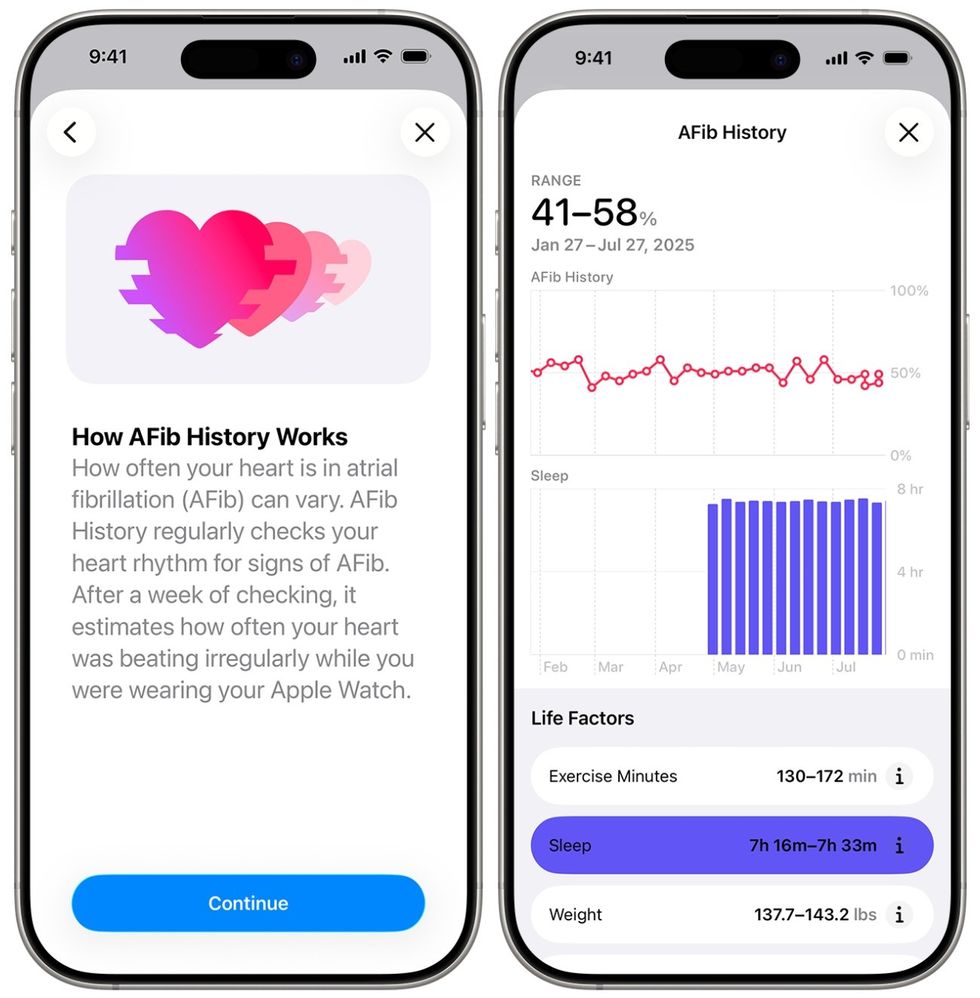
Apple keeps a comprehensive history of all Atrial Fibrillation recordings in the Health app. This data can be exported as a PDF to confidentially share with a chosen healthcare provider
|APPLE PRESS OFFICE
Atrial Fibrillation impacts millions of people worldwide and is linked to roughly 1 in 4 strokes. It is estimated that 30% of people living with the condition in the UK are undiagnosed, roughly 270,000 and 500,000 individuals, meaning they will not be receiving treatment to manage their elevated risk of a stroke.
Some studies have linked Atrial Fibrillation to an increased risk of dementia. The results of this study show that consumer electronics, like the Apple Watch, could reduce pressure on the health service as patients with these devices were shown to be less likely to be admitted to hospital unexpectedly.
"The cost of one of these devices is similar to a one off assessment in a hospital. There is definitely a case for this to be rolled out on the NHS," Dr Nikhil Ahluwalia told the Daily Mail. "We have shown that by giving patients the power to monitor their condition at home, we are able to reduce the number of times they make unplanned visits hospital but also catch recurring symptoms quicker."
Apple’s Vice President of Health Dr Sumbul Desai about a new feature allowing AirPods to be used as hearing aids
It comes as recent analysis by the British Heart Foundation reveals there has been a rise in the rate and number of deaths in working-age adults aged 20-64 from cardiovascular disease in the UK.
The rate rose to 55 deaths per 100,000 in 2023 from 49 per 100,000 in 2019 – that's the first sustained increase in at least a generation. Deaths in working-age adults rose by 18 per cent, from 18,693 in 2019, to 21,975 in 2023, averaging 420 a week.
More From GB News