








Researchers have developed a method to "hear" collisions between black holes using a new technique.
Scientists call the method astrophysical calibration, and it mirrors the sort of pitch-correction software often found in music studios.
It allows them to accurately capture signals from massive cosmic events even when one detector is not functioning optimally.
The process works by merging data from multiple detectors alongside precise calculations based on gravitational laws.
Experts compared it to how Autotune corrects a vocalist's pitch when they sing off-key.
The international Ligo, Virgo and Kagra (LVK) gravitational wave observatory collaboration employed this approach to calibrate their highly sensitive equipment.
Dr Christopher Berry, of the University of Glasgow's Institute for Gravitational Research, is an author of the paper and part of the LVK collaboration.
He said: "Gravitational waves are ripples in spacetime that stretch and squeeze space.
"They are tiny by the time that they reach the Earth, millions of years after the events that first created them.
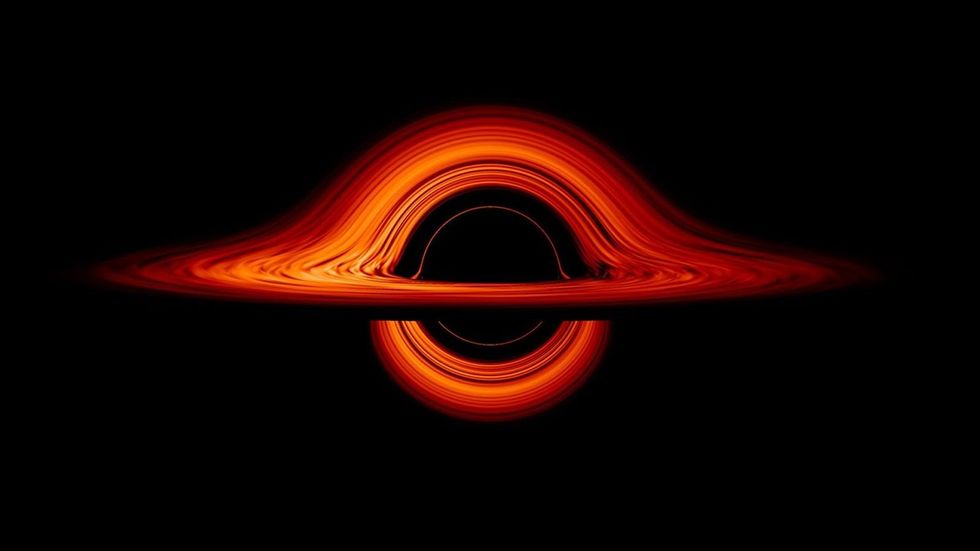
Researchers have developed a method to hear collisions between black holes
|NASA
"They are not something which we can hear, but our detectors can output the signals as waveforms that we can increase in pitch to listen to, with each signal producing their own distinctive chirp.
"Those chirps encode a wealth of information we can analyse to learn about their sources: their masses, spins, distance, and location."
The gravitational wave signals used to develop this calibration technique are among the loudest the collaboration has ever recorded.
On 25 September 2024, detectors captured a signal called GW240925, created when two black holes merged over a billion light-years from Earth.
SPACE BREAKTHROUGHS - READ MORE:
Those black holes were between seven and nine times the mass of our sun.
The second signal, GW250207, arrived in February 2025 and became the second-loudest detection in the collaboration's history.
Nearly 200 signals have been recorded since the first detection in 2015.
This event involved two black holes roughly 30 to 35 times our Sun's mass, located approximately 600 million lightyears away.
The research paper demonstrates how scientists transformed a challenge into an opportunity when the Ligo Hanford detector was underperforming.
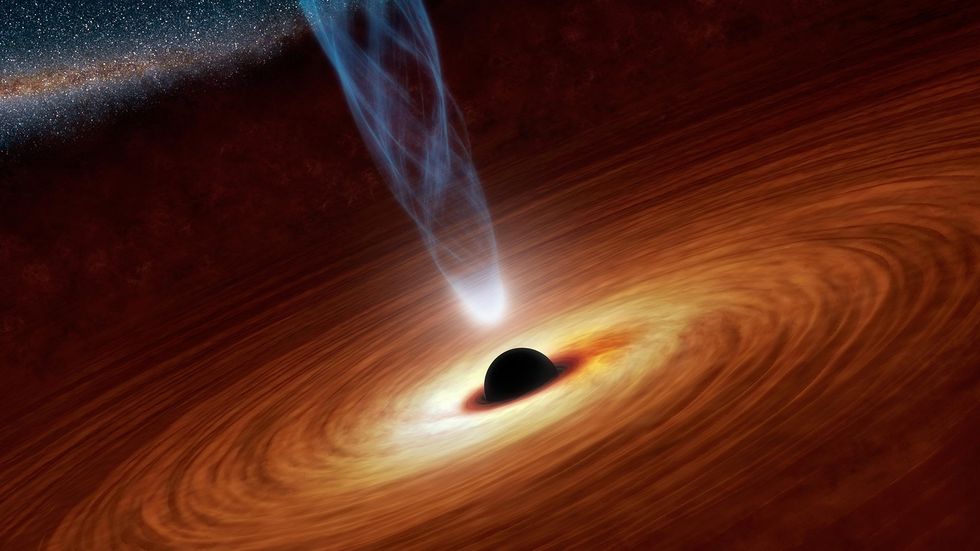
The new method lets scientists accurately capture signals from massive cosmic events like black holes
|NASA
Dr Daniel Williams from the University of Glasgow's Institute for Gravitational Research, said: "These discoveries demonstrate that, over our decade of work since the first detection, we have developed a comprehensive understanding of our entire analysis pipeline, from the signals themselves to the detector behaviour.
"In the rare instance that something goes wrong with one detector, we now have robust back-up methods to compensate and leverage data from the other detectors to give us the best-quality results."
Professor Stephen Fairhurst, of Cardiff University and a spokesman for the Ligo Scientific Collaboration, said: "It's remarkable that these massive cosmic events can not only be measured by our instruments, but actually used to check our measurements."
He added: "We're moving from the era of first discoveries to the era of precision gravitational wave astronomy. We can be confident that our next observing runs will continue to build our rapidly-growing catalogue of gravitational-wave discoveries, and expand our understanding of the universe."