










Humans could reach a new star system over four light-years away in just two decades, a bombshell study has revealed.
Alpha Centauri, humanity's closest neighbouring star system, is separated from Earth by tens of trillions of miles of empty space.
Using current rocket technology, reaching this destination would require an almost incomprehensible journey lasting hundreds or potentially thousands of years.
Such timescales would necessitate constructing generation ships designed to sustain human life across multiple lifetimes.
TRENDING
Stories
Videos
Your Say
However, researchers may have identified a method to dramatically shorten this cosmic voyage.
A team from Texas A&M University has published findings in the journal Newton outlining a promising new approach to spacecraft propulsion.
Their technique employs lasers to propel and navigate objects remotely, requiring no physical contact whatsoever.
The scientists assert that this technology could eventually accelerate entire spacecraft to velocities that would reduce the Alpha Centauri transit time to roughly two decades.
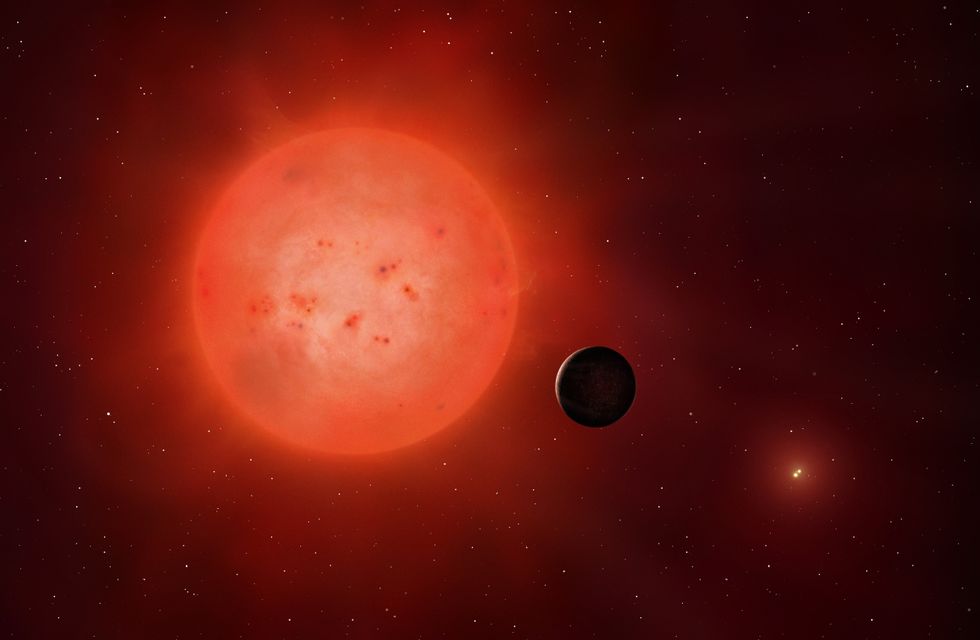
Alpha Centauri, humanity's closest neighbouring star system, is separated from Earth by tens of trillions of miles of empty space
|GETTY
While 20 years remains a substantial duration, it represents a transformative improvement compared to millennia-long expeditions requiring self-sustaining vessels.
For their experiments, the Texas A&M team created microscopic devices termed "metajets" measuring smaller than a human hair's width.
These tiny structures respond to laser illumination by moving through space.
Each metajet incorporates what scientists call "metasurfaces" – elaborate microscopic patterns etched into the devices that alter light's behaviour in a manner comparable to a lens.
LATEST DEVELOPMENTS
These intricate surface designs enable something the researchers describe as a world first: complete three-dimensional manoeuvrability when struck by laser beams.
"When illuminated by a normally incident beam, these free-standing devices simultaneously translate laterally and lift vertically, enabling 3D motion not accessible with conventional optical manipulation methods," the research paper stated.
This capability to move both sideways and upwards simultaneously distinguishes the technology from previous optical manipulation techniques, which could not achieve such comprehensive directional control.
Shoufeng Lan, a Texas A&M assistant professor and the study's corresponding author, likened the underlying principle to ping pong balls rebounding off a surface. Light reflecting from any surface transfers momentum to that object.
Though the force generated by shining light on something appears minimal, the microgravity conditions of space allow even modest cumulative effects to become meaningful.
Solar sail experiments have previously demonstrated that sunlight alone can generate sufficient thrust to propel specially designed spacecraft.
Earlier this month, European Space Agency scientists proposed using lasers to guide solar sails and adjust satellite positioning through graphene aerogels, an exceptionally lightweight porous material.
The Texas A&M team maintains their concept can expand well beyond microscopic demonstrations.
The Texas A&M team maintains their concept can expand well beyond microscopic demonstrations
|GETTY
Since the propulsive force depends on the intensity of the light source rather than the object's dimensions, sufficiently powerful lasers could theoretically push much larger structures.
Their paper suggests applications ranging from tiny microrobots to full-scale interstellar light sails for deep space exploration.
Nevertheless, significant questions about practical feasibility persist. The researchers conducted their experiments in a fluid environment to counteract gravitational effects.
They now seek external funding to evaluate the technology under actual microgravity conditions in space.