










A mysterious shockwave has been discovered around a dead star for the first time in history.
With images taken by Muse, an instrument on ESO's Very Large Telescope, the dead star RXJ0528+2838 can be seen with shockwaves around it.
A star dies when the core runs out of nuclear fuel, destabilising the outward pressure to balance its inward gravity.
As for a white dwarf, as RXJ0528+2838 is, it describes the core left behind after a star has died.
It no longer generates energy or heat, but continues to shine from residual heat and will slowly cool over billions of years.
A white dwarf is usually a similar size to Earth.
Dead stars don't have the internal mechanisms to generate large-scale shock waves because they have exhausted their nuclear fuel. The only shockwaves typically occur during a supernova.
But, scientists have found that, as the dead star RXJ0528+2838 moves through space, it creates a so-called bow shock as the surrounding material is pushed away.
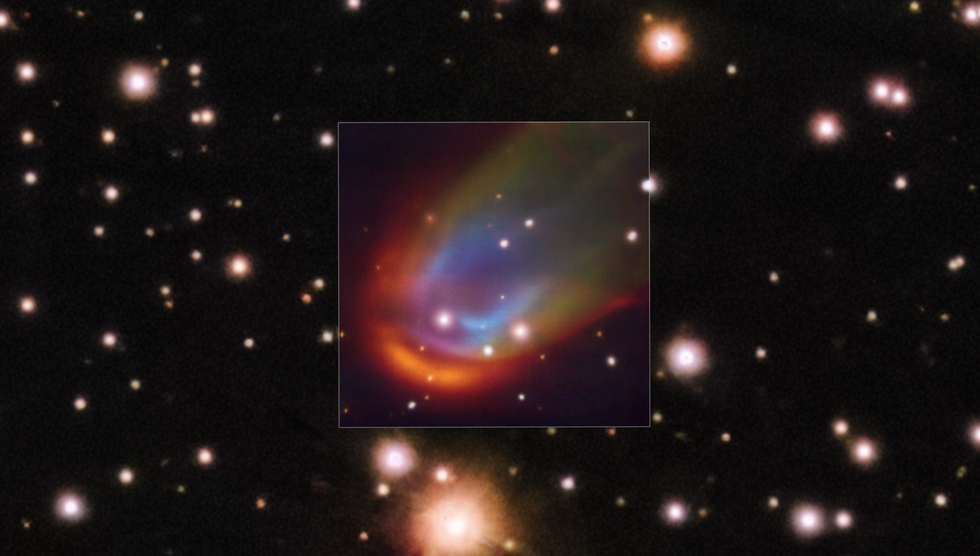
VLT image of a dead star creating a shock wave as it moves through space
|ESO/K Ilkiewicz and S. Scaringi et al
A bow shock refers to a curved shockwave that forms in front of an object that is travelling at supersonic speed through a gas, plasma, or liquid.
This particular bow shock was captured in 2024.
Structures like this one are typically caused by a strong outflow from the star.
However, in the case of RXJ0528+2838, no known mechanism could be causing the outflow.
LATEST DEVELOPMENTS
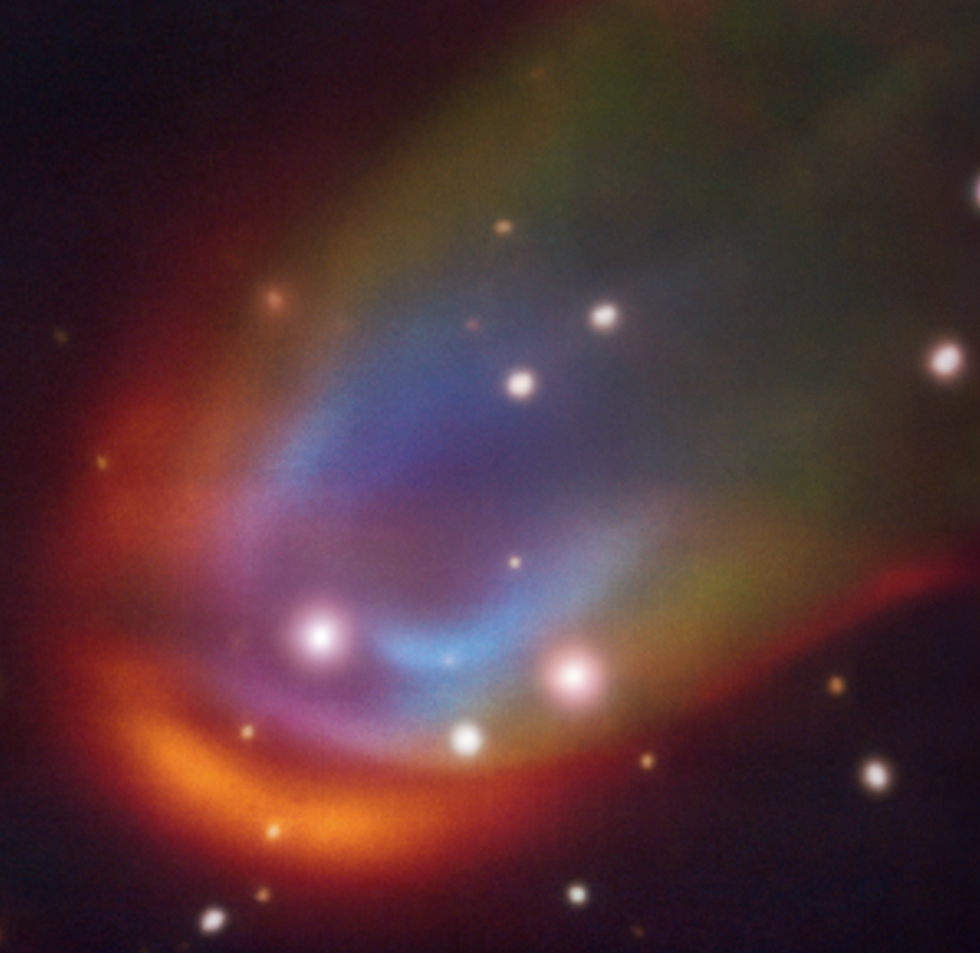
VLT image of a dead star creating a shock wave as it moves through space
|ESO/K. Ilkiewicz and S. Scaringi et al
When a star moves through space, it can push away nearby material, creating a bow shock, which in the image is glowing in red, green and blue.
For RXJ0528+2838, the red, green and blue glows represent hydrogen, nitrogen and oxygen.
These shocks are usually produced by a strong outflow expelled from the star.
However, in the case of RXJ0528+2838, astronomers discovered that the shock wave cannot be explained by any known mechanism.
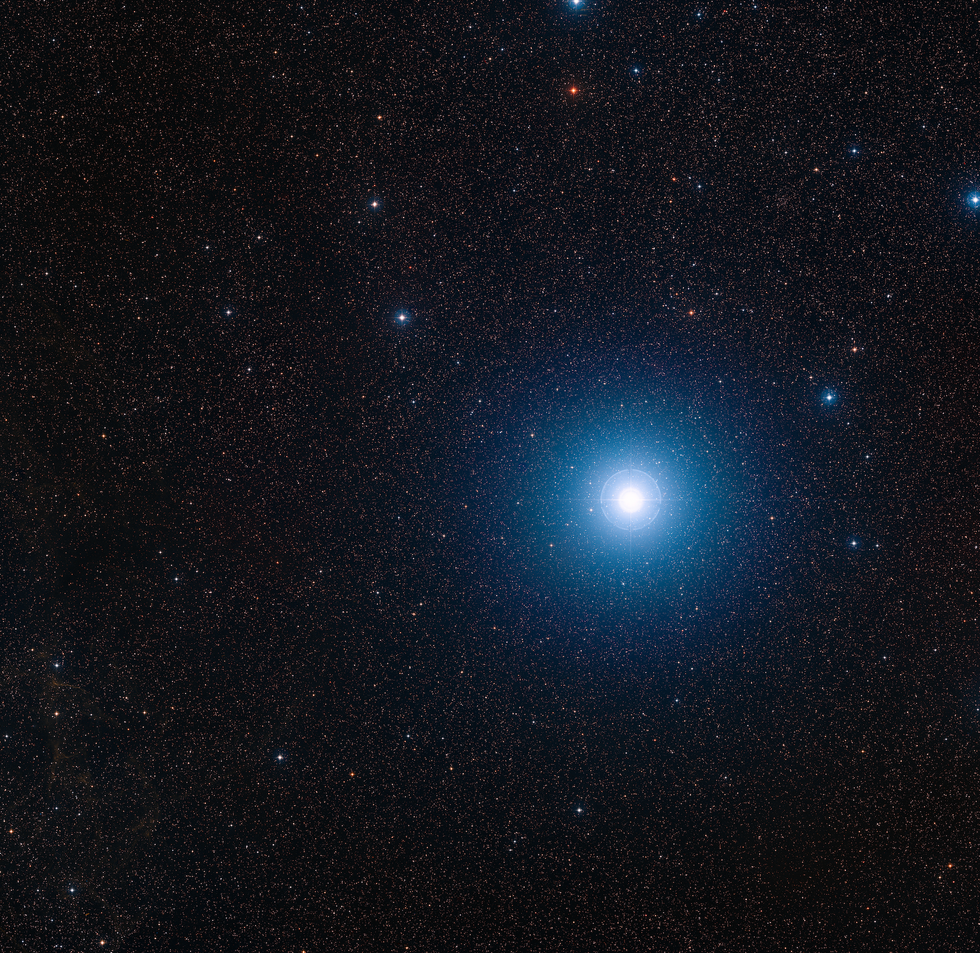
Wide-field view (PanSTARRS) of the area of the sky around the star RXJ0528+2838
|PanSTARRS
Some hidden energy source, perhaps magnetic fields, could be the answer to this mystery.
Photos have also been taken from the PanSTARRS survey and the Digitised Sky Survey (DSS), both showing the region of the sky around the dead star.
Other footage shows a wide view of the night sky in visible light, transitioning into an image from the Digitised Sky Survey (DSS) and then the PanSTARRS survey, also in visible light.
Our Standards: The GB News Editorial Charter