










The Hubble Space Telescope has captured a remarkable cosmic event for only the second time in history.
Two asteroids were snapped smashing into each other around a star beyond our solar system.
The collision occurred in the vicinity of Fomalhaut, a relatively young star situated just 25 light-years from Earth.
Scientists estimate the two rocky bodies were each approximately 60 kilometres in diameter before they violently collided, reducing themselves to an expanding cloud of dust.
"This is certainly the first time I've ever seen a point of light appear out of nowhere in an exoplanetary system," said astronomer Paul Kalas of the University of California, Berkeley.
Fomalhaut, at merely 440 million years old, remains encircled by a disc of debris from its formation, making it an ideal location for studying the processes that precede planetary development.
This was not the first time astronomers had witnessed such destruction around Fomalhaut.
In 2004, researchers detected a bright object orbiting the star that appeared to be a planet, which they subsequently named Dagon.
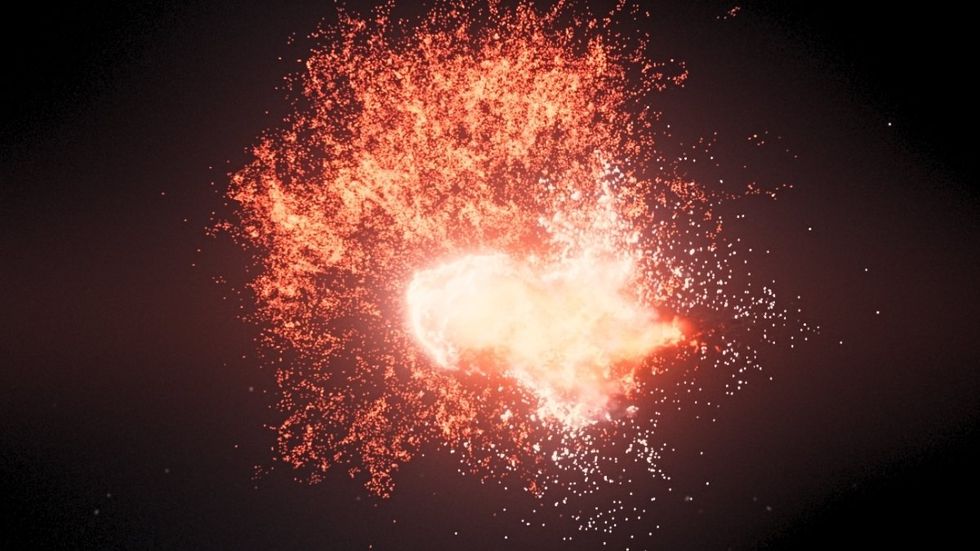
An artist's impression of two asteroids colliding at Fomalhaut
|NASA
Direct imaging conducted in 2012 seemed to confirm the existence of this gas giant.
However, when scientists returned to observe it in 2014, the supposed planet had entirely disappeared.
The explanation proved far more dramatic than a simple observational error.
Astronomers determined that Dagon had never been a planet at all, but rather a brilliant dust cloud produced when two asteroids had crashed into one another.
LATEST DEVELOPMENTS
The newly discovered collision has been designated Fomalhaut cs2, whilst the original 2004 event has been reclassified as Fomalhaut cs1.
The frequency of these collisions has astonished researchers.
Previous theoretical models suggested such events should occur once every 100,000 years or longer, yet astronomers have now documented two within just two decades.
"If you had a movie of the last 3,000 years, and it was sped up so that every year was a fraction of a second, imagine how many flashes you'd see over that time. Fomalhaut's planetary system would be sparkling with these collisions," Kalas said.
The second observation has enabled scientists to calculate crucial statistics about the system.
According to astronomer Mark Wyatt of the University of Cambridge, researchers can now estimate both the dimensions of the colliding objects and their abundance.
"We infer that there are 300 million such objects orbiting in the Fomalhaut system," Wyatt explained.
The emerging picture around Fomalhaut points to an exceptionally active environment that may offer crucial insights into how planets initially form.
The star's surroundings serve as a natural laboratory for investigating how these small rocky bodies behave during impacts, revealing information about their composition and origins.
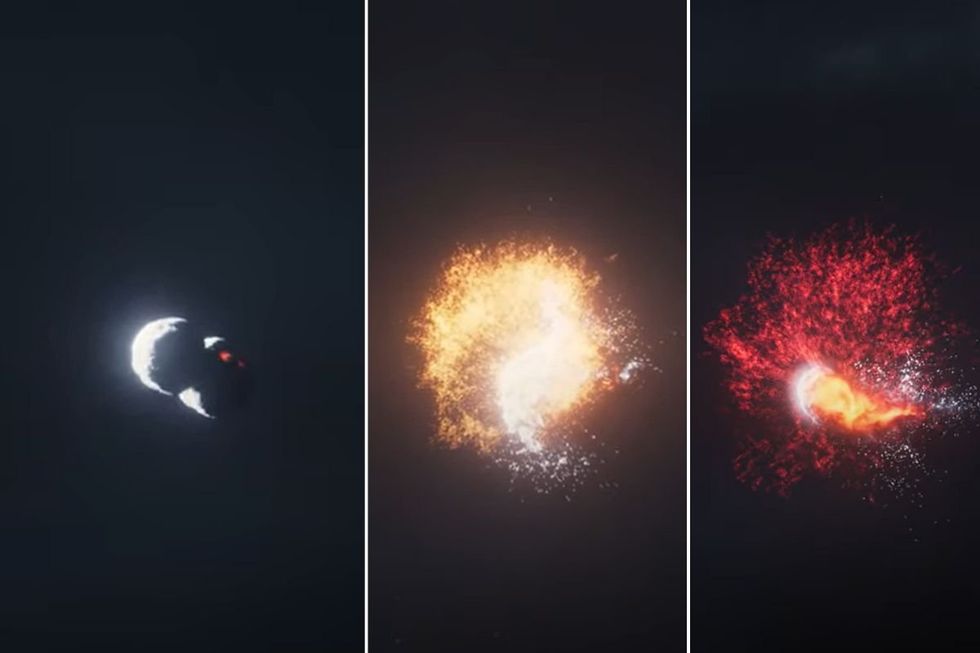
A time lapse of the collision in an artist's impression
|NASA/ESA
"The system is a natural laboratory to probe how planetesimals behave when undergoing collisions, which in turn tells us about what they are made of and how they formed," Wyatt said.
Recent observations have also revealed concentric gaps within the debris disc, suggesting something may be clearing material from these regions, potentially a developing planet sweeping through its orbital path.
Scientists intend to continue monitoring the new dust cloud using both Hubble and the James Webb Space Telescope to track changes in its shape, brightness and trajectory over the coming years.