







Researchers at King's College London have found that a peculiar form of dark matter could be behind three baffling signals emanating from the Milky Way's core.
The team's findings, published in The Astrophysical Journal Letters, suggest "excited dark matter" might finally explain phenomena that have puzzled astronomers for years.
Lead author Dr Shyam Balaji said: "When we look at well-known astrophysical events, like star explosions, they haven't been able to provide a full explanation for mysteries like the specific energy and shape we've observed coming from the centre of the Milky Way.
"Now, we've shown how one excited dark matter model could account for at least two possibly even three of these kind of unexplained signals at once."
TRENDING
Stories
Videos
Your Say
Dr Balaji explained: "Excited dark matter is a scenario where dark matter particles can briefly jump into a slightly higher-energy state when they collide with each other.
"When they fall back to their normal state, they release that extra energy by producing an electron and its antimatter partner, a positron."
These positrons create signals detectable by deep-space telescopes, including the European Space Agency's INTEGRAL mission, which orbits at roughly 37,000 miles above Earth.
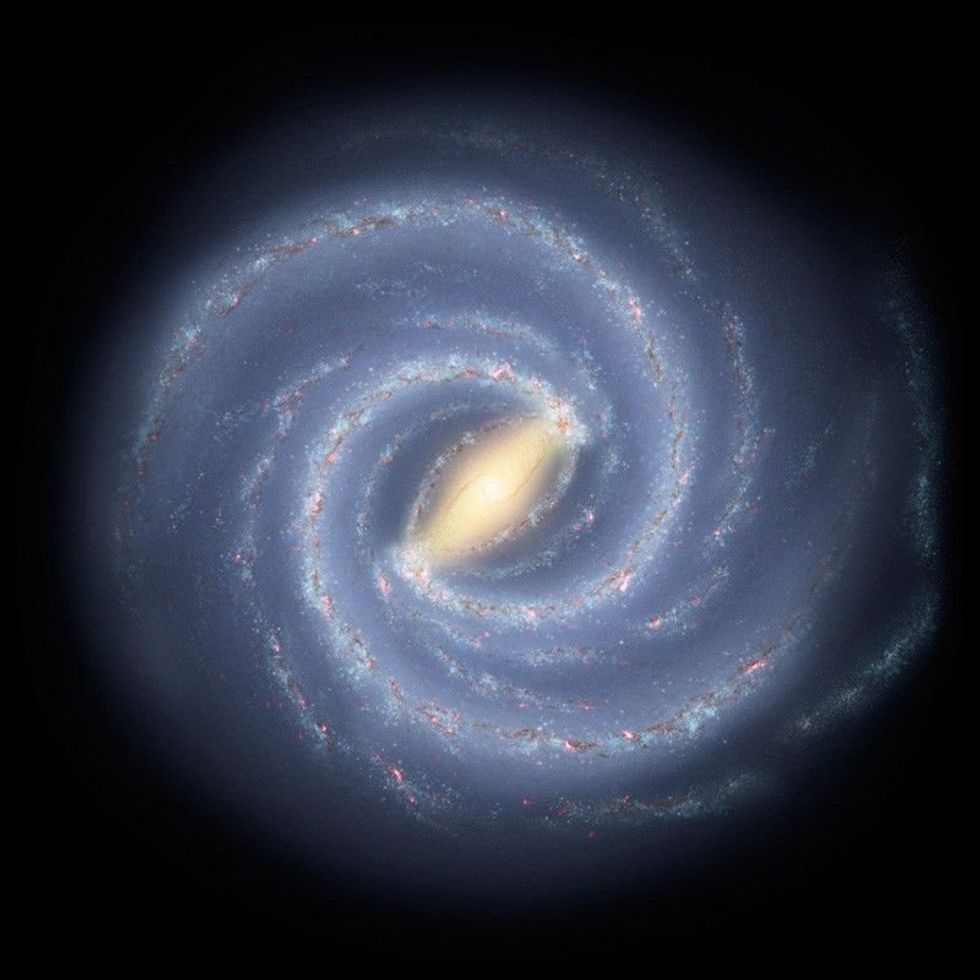 Lead author of the Institute of Astrophysics, Valentina Crespi, said: 'This is a pivotal point' | NASA
The scientists identified three distinct signals their model could account for. First, there is a sharp spike in gamma-ray radiation at a precise wavelength called the 511keV emission line – something that does not fit with how ordinary matter behaves.
Then there is the 2 MeV gamma-ray continuum, a form of extremely high-energy light streaming from the galactic centre.
Dr Balaji noted: "The signal requires positrons with very specific energies of only a few million electron volts. Most conventional astrophysical sources, such as supernovae or cosmic rays, tend to produce particles that are either much more energetic or distributed across the galaxy in the wrong way."
Finally, the model might explain unusually high ionisation levels in gas clouds within the Central Molecular Zone, located 28,000 light-years away.
LATEST DEVELOPMENTS

Researchers at King's College London have found that a peculiar form of dark matter
| PAThis crowded region holds nearly 80 per cent of the galaxy's dense gas, yet cosmic rays have not adequately explained why it appears so heavily ionised.
Co-author Damon Cleaver, a PhD student at King's College London, said: "If one mechanism could account for several long-standing unexplained observations in space, it gives a much clearer direction for future research.
"Within the next generation of space missions, we may finally be able to test the theory of whether dark matter is behind some of the Milky Way's most persistent mysteries and learn more about the mysterious substance itself in the process."
Our Standards: The GB News Editorial Charter