







Nasa has unveiled what stands as one of the most comprehensive maps ever produced of a mysterious substance holding the universe together.,
The remarkable images, captured by the James Webb Space Telescope. indicate that that dark matter functions as a concealed scaffold upon which galaxies throughout the cosmos are constructed.
Researchers from Durham University suggest the findings could prove instrumental in deciphering how our own Milky Way galaxy came into existence, along with Earth itself.
The scientific team characterises dark matter as the essential "glue" binding the universe together, though its invisible nature has long frustrated attempts to comprehend its precise properties and function.
Professor Richard Massey, a co-author of the study, offered a striking illustration of dark matter's ubiquity: "Wherever you find normal matter in the Universe today, you also find dark matter."
He noted that billions of these particles traverse the human body each second, passing through entirely unnoticed and causing no harm whatsoever.
Yet the collective gravitational force of the vast dark matter cloud enveloping our galaxy proves absolutely essential.
"The whole swirling cloud of dark matter around the Milky Way has enough gravity to hold our entire galaxy together," Prof Massey explained.
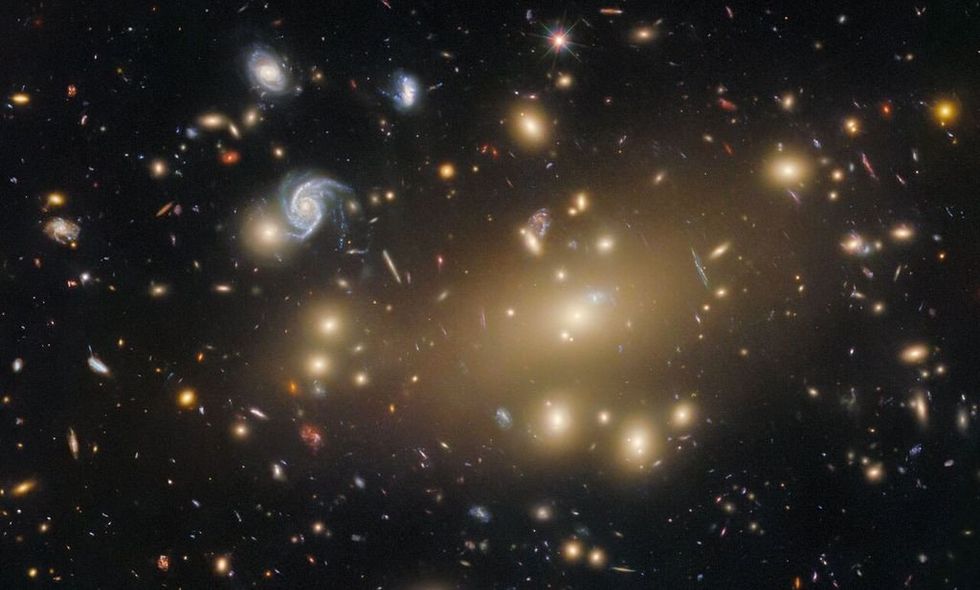
Dark matter functions as a concealed scaffold upon which galaxies were constructed
|NASA
"Without dark matter, the Milky Way would spin itself apart."
Scientific understanding suggests that in the universe's earliest moments, both dark matter and ordinary matter existed in a sparse, scattered state.
Dark matter began clustering together before its gravitational pull drew in normal matter, establishing the dense regions where stellar and galactic formation could commence.
This process proved fundamental not merely to creating the cosmic structures we observe today, but to enabling the very conditions necessary for planetary development.
SPACE - READ THE LATEST:
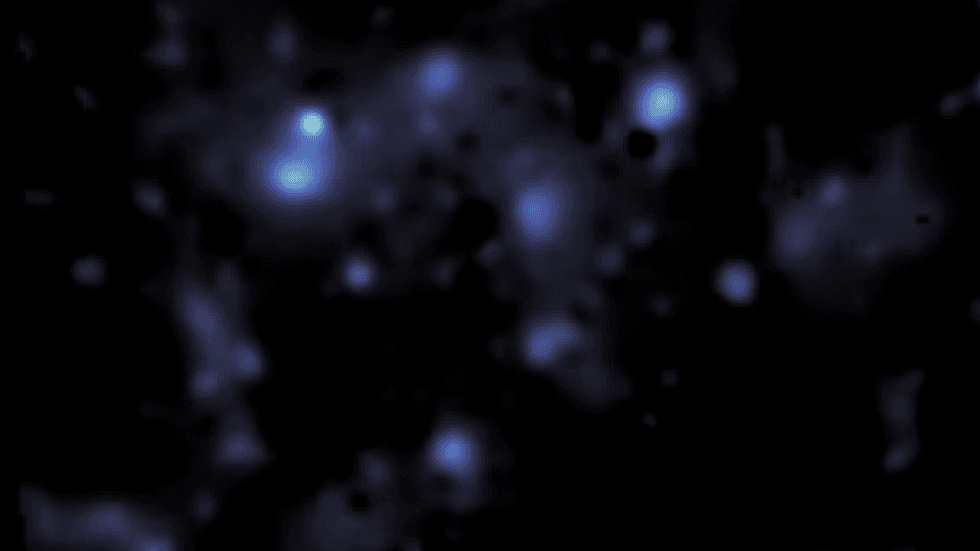
The map encompasses a region of sky approximately 2.5 times the size of a full moon
|GETTY
Dr Gavin Leroy, a co-author of the research, said: "By revealing dark matter with unprecedented precision, our map shows how an invisible component of the Universe has structured visible matter to the point of enabling the emergence of galaxies, stars, and ultimately life itself."
The map encompasses a region of sky approximately 2.5 times the size of a full moon, situated within the constellation Sextans.
It captures nearly 800,000 galaxies, representing roughly ten times the number that Webb's predecessor, the Hubble telescope, could observe.
Dr Diana Scognamiglio from Nasa's Jet Propulsion Laboratory highlighted the achievement: "This is the largest dark matter map we've made with Webb, and it's twice as sharp as any dark matter map made by other observatories."
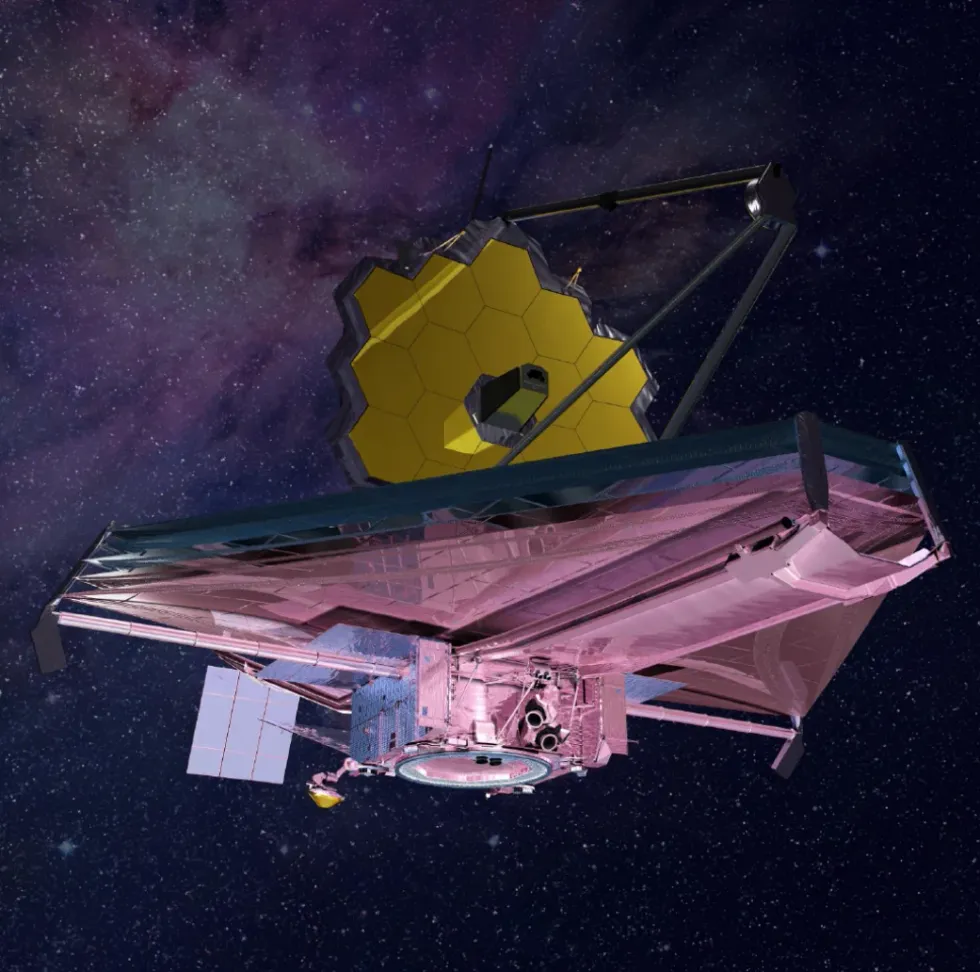
The James Webb Space Telescope took the stunning new images
| NASAShe added: "Previously, we were looking at a blurry picture of dark matter. Now we're seeing the invisible scaffolding of the Universe in stunning detail."
The research team intends to extend their mapping across the entire universe, utilising the European Space Agency's Euclid telescope alongside Nasa's forthcoming Nancy Grace Roman Space Telescope.
Dark matter was first proposed in 1933 by Swiss astrophysicist Fritz Zwicky, after he found galaxies in the Coma cluster were moving too fast to be bound by their visible mass alone.
In the 1970s, astronomer Vera Rubin and Kent Ford produced compelling evidence for dark matter, showing stars at the edges of galaxies rotate as fast as those near the centre.
Our Standards: The GB News Editorial Charter