










A prominent University College London space scientist has declared she is confident humanity will discover alien life within the next 50 years.
Dame Maggie Aderin-Pocock, who works in the Department of Physics and Astronomy at UCL, anticipates a "positive detection" of life beyond Earth by 2075.
The prediction comes as she prepares to deliver this year's Royal Institution Christmas lectures, Britain's most prestigious public science talks, which will broadcast later this month and tackle the major unanswered questions in space science.
Her confidence stems from what she describes as a "numbers game" - the Drake equation.

Dame Maggie Aderin-Pocock anticipates a 'positive detection' of life beyond Earth by 2075.
|PA
"In the whole of the universe there are approximately 200 billion galaxies," Dame Maggie told the Daily Mail.
"And so although certain conditions were in place for life to start here on Earth, and this is the only example we have of life, I'm absolutely convinced that there's life out there, because with so many stars, so many planets, why would it just occur here?"
The Milky Way alone contains approximately 300 billion stars, each comparable to our own sun, with planets now being detected in orbit around them.
Dame Maggie pointed to "tantalising glimpses" of potential life already emerging from these distant worlds, particularly exoplanet K218b, located 124 light years from Earth.
Dame Maggie pointed to 'tantalising glimpses' of potential life already emerging from distant worlds
|GETTY
Scientists identified molecules in the planet's atmosphere earlier this year that can only persist if some form of life exists there.
Experts have described this as the most encouraging evidence yet of life beyond our solar system, suggesting the world may be ocean-covered and potentially teeming with organisms.
Closer to home, Nasa announced in September what it considers the clearest indication of life ever discovered on Mars - unusual markings on mudstones in an ancient riverbed containing minerals potentially linked to Martian life.
Despite the popular image of extra-terrestrials as little green men arriving in spacecraft, Dame Maggie expects reality to be far less dramatic.
SPACE - READ THE LATEST:
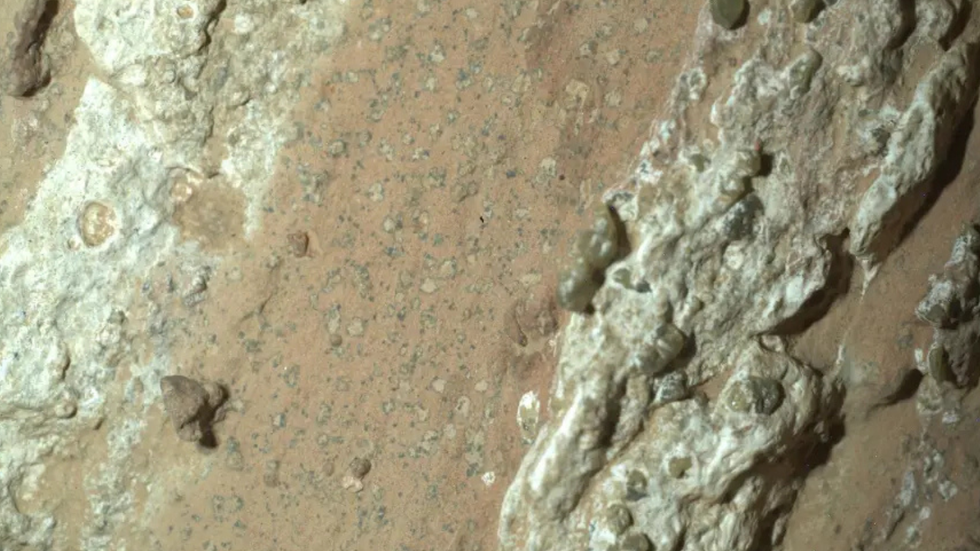
Nasa announced in September it had discovered unusual markings on mudstones potentially linked to Martian life
| NASA"Grey sludge is probably the most likely thing we're going to find," she said.
However, she has not ruled out discovering something considerably more advanced.
"We might find something that does evolve and that can communicate and of course, their technology might be far superior to ours," she added.
The space scientist even entertains a whimsical notion about our cosmic neighbours.
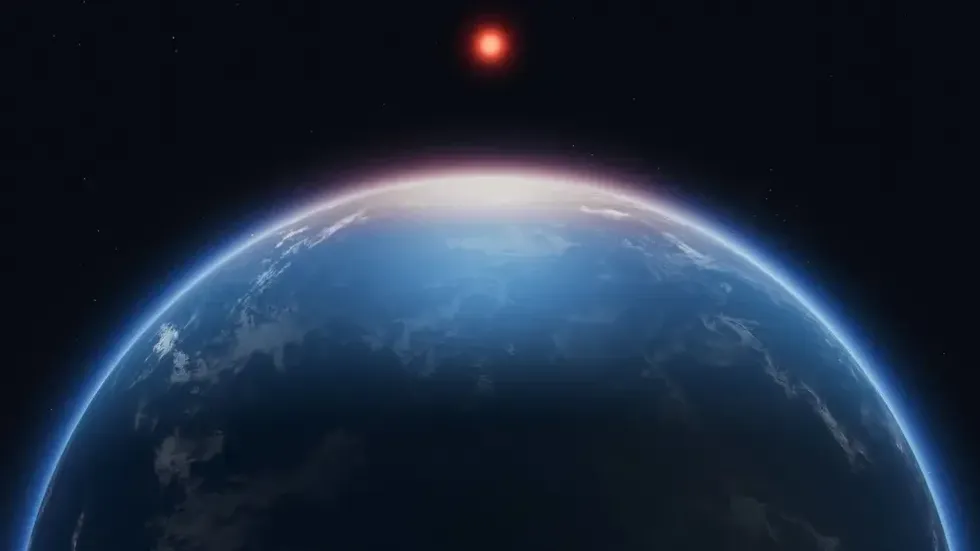
Exoplanet K218b is located 124 light years from Earth
|CAMBRIDGE UNIVERSITY
"I love the idea of aliens on the other side of the moon looking back at us, hoping we'll 'grow up' soon."
While primitive organisms remain the most probable discovery, the possibility of encountering intelligent beings with capabilities exceeding our own remains tantalisingly open.
Dame Maggie stressed that any discovery of alien life would require extreme caution in its handling.
"If there is any form of life, we need to make sure it is totally isolated," she said. "It cannot come into contact with any sort of human presence."
Facilities are currently being developed to analyse such samples safely on Earth, given the impracticality of transporting all necessary scientific equipment to distant planets.
As for her own ambitions, the scientist has unconventional retirement plans: "Some people retire and potter around their garden, and my retirement plan is to potter around Mars."
Looking ahead, Dame Maggie envisions humanity expanding beyond Earth as a spacefaring civilisation.
"I think space might be a way that we unite," she concluded.
Our Standards: The GB News Editorial Charter