










Researchers examining one of Christianity's most venerated relics claim to have found an "impossible reflection" hidden inside it.
Mexico's Tilma of Guadalupe, an image of the Virgin Mary, has at least 13 miniature human figures concealed within her eye, investigators said.
The reflections on the relic are invisible to the naked eye and can only be detected through digital enlargement.
Researchers say these figures appear to depict witnesses who were present when the cactus-fibre cloak was first unveiled in 1531.
"The image of Our Lady of Guadalupe has been the subject of numerous technical studies since 1751," researchers said.
"None of the results offered any sound scientific explanation, which up to this very day defies science and all human reasoning."
The cloak belonged to Juan Diego, an Indigenous convert who reported encountering the Virgin Mary near Mexico City in 1531.
Church tradition holds that the image materialised on the garment when Juan Diego presented it to Juan de Zumarraga.
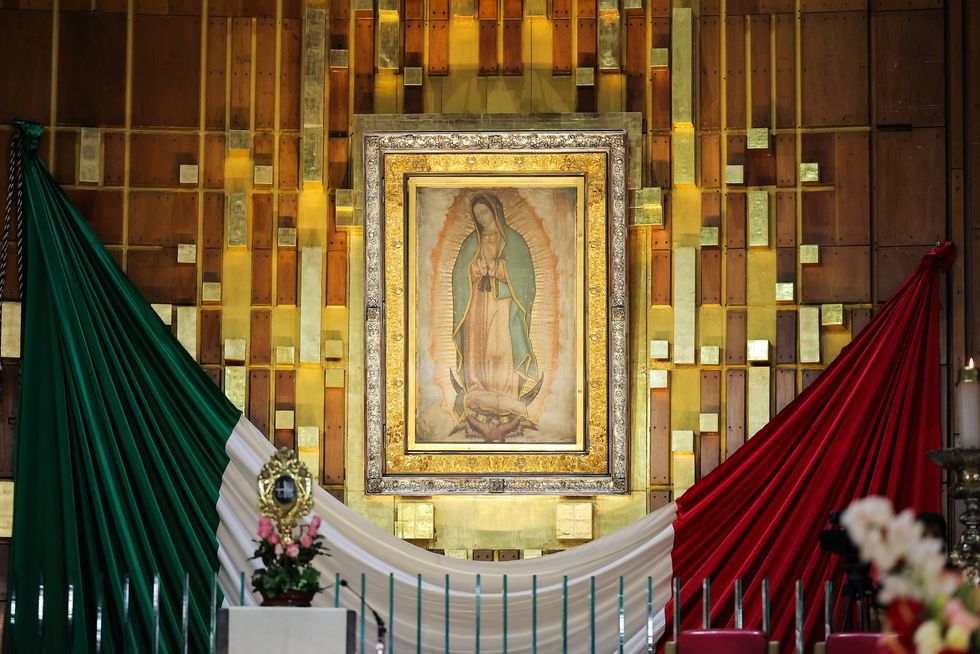
Mexico's Tilma of Guadalupe, an image of the Virgin Mary, has at least 13 miniature human figures concealed within her eye, investigators said
|GETTY
Those who witnessed the moment were reportedly astonished by what they saw.
The tilma has since become one of the most revered religious artefacts in the Americas.
Measuring approximately five feet tall by three feet wide, the cloth comprises two pieces joined by a central seam running through the image.
The findings have been compiled in a report titled "Miraculous Image of Our Lady of Guadalupe," published by St Michael the Archangel Catholic Church in Texas.
BIBLICAL BREAKTHROUGHS - READ MORE:
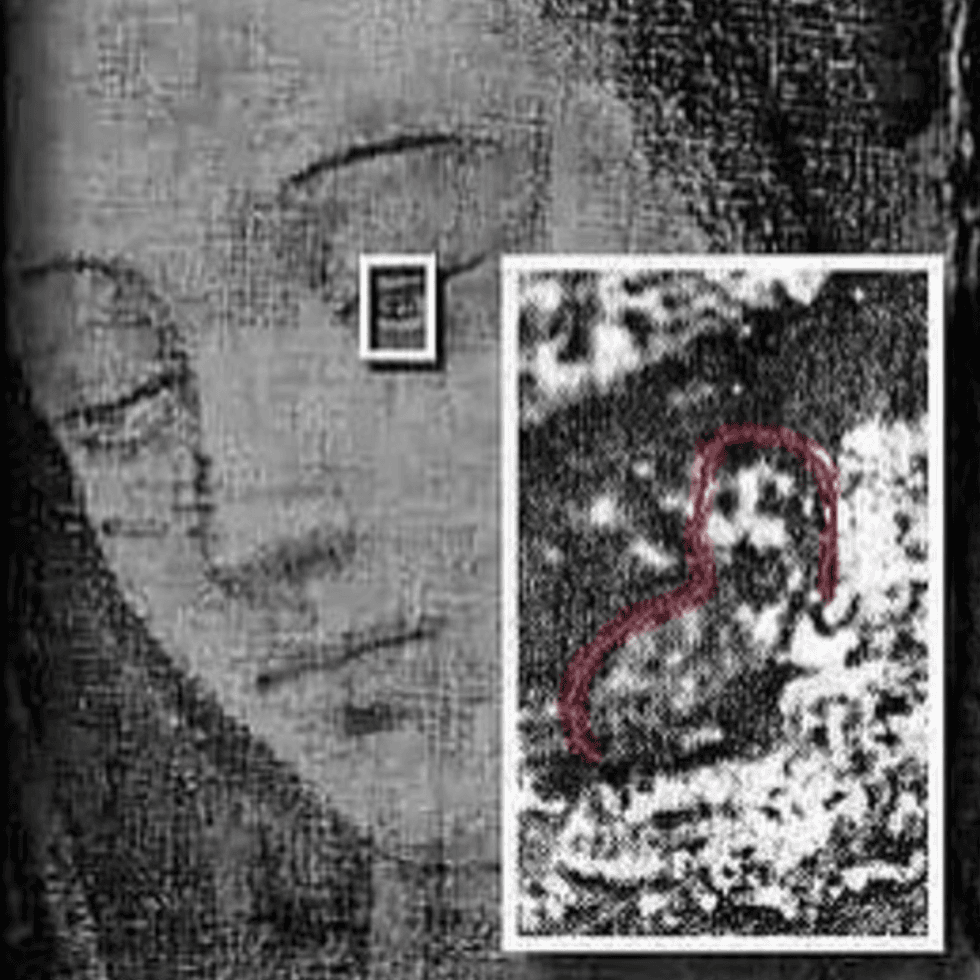
Church analysis claimed to have seen at least 13 microscopic figures hidden inside Mary's eye
|ST MICHAEL THE ARCHANGEL CATHOLIC CHURCH
High-resolution scans processed by investigators revealed that portions of the face, hands, robe and mantle seem to have been created in a single application, with no preliminary sketches, corrections or visible brushwork.
In 1936, Nobel Prize-winning chemist Richard Kuhn examined a fibre sample from the cloak.
He concluded that the pigments matched no known colourants from plant, animal or mineral sources.
A 1979 infrared photography study by biophysicist Philip Serna Callahan and art specialist Jody B Smith found that colour distribution across the fabric lacked the layering typical of traditional paintings.
The pigments also responded to light differently than conventional paints, shifting in brightness depending on viewing angle.
"When examined closely, the colours disappear and only the fabric is visible," researchers noted.

Sceptics say the discoveries may result from 'digital processing artefacts' rather than intentional design
|ST MICHAEL THE ARCHANGEL CATHOLIC CHURCH
The cactus-fibre material would typically decompose within a few decades, yet this cloth has survived nearly five centuries.
Despite prolonged exposure to candle smoke, humidity, dust and handling by pilgrims, the fabric shows no significant deterioration.
Two replica images painted on similar material in the 18th century using contemporary techniques fell apart within decades, while the original remained unchanged.
Decorative additions such as a crown and angels were later painted onto the tilma but subsequently faded, leaving the original figure intact.
Despite the new claims, sceptics have counselled caution - they argue the discoveries may result from visual interpretation or digital processing artefacts rather than intentional details within the image.