










Biologists have made a major breakthrough by using artificial intelligence to design the complete genetic blueprint of a virus that destroys a killer bacterium.
The AI-created virus, named Evo-Φ2147, was brought to life in laboratory conditions, where it attacked E. coli bacteria.
Researchers observed clear patches spreading across petri dishes as the pathogen killed the bacteria.
This milestone marks a fundamental shift in synthetic biology, demonstrating AI can now draft entire genomes from nothing rather than merely editing existing genetic material.
TRENDING
Stories
Videos
Your Say
British molecular biologist and tech entrepreneur Adrian Woolfson described the achievement as "a massive, consequential moment".
He said it marks a shift from "a Darwinian world into a post-Darwinian landscape" where life can be authored, rather than simply inherited.
The Stanford experiment, published in September, serves as key proof that complete genomes can now be designed from scratch rather than simply modified.
Mr Woolfsen said: "For the last four billion years evolution has been blind - there has been no foresight, there has been no intentionality... This is not speculation. It's not futuristic, it is happening."
 Scientists at Stanford University in California have achieved what researchers are calling a historic first | GETTY
LATEST DEVELOPMENTS
The new virus comprised just 11 genes encoded within 5,386 base pairs of DNA.
It is a minuscule creation compared to the human genome, which has 20,000 genes spread across 3.2 billion base pairs.
Mr Woolfsen added: "Now, instead of discovering species that have evolved in this ad hoc manner, suddenly we can make life in a rudimentary way, but the process has begun."
Although most scientists do not classify viruses as truly alive since they cannot replicate without a host, the experiment demonstrated that whole genomes can now be authored rather than merely tweaked.

Adrian Woolfsen described the achievement as 'a massive, consequential moment'
|X/ADRIANWOOLFSEN
Complementing this AI breakthrough, researchers at the California Institute of Technology have developed Sidewinder, a DNA construction tool. The revelation was published in the journal Nature on Wednesday.
This technology can assemble lengthy genetic sequences with accuracy up to 100,000 times greater than previous methods, whilst also being faster and more economical.
Mr Woolfsen's new company, Genyro, has brought in some of the world's best genetic designers and engineers.
These include Brian Hie, the Stanford scientist responsible for the AI breakthrough, alongside Caltech researchers Kaihang Wang and Noah Robinson.
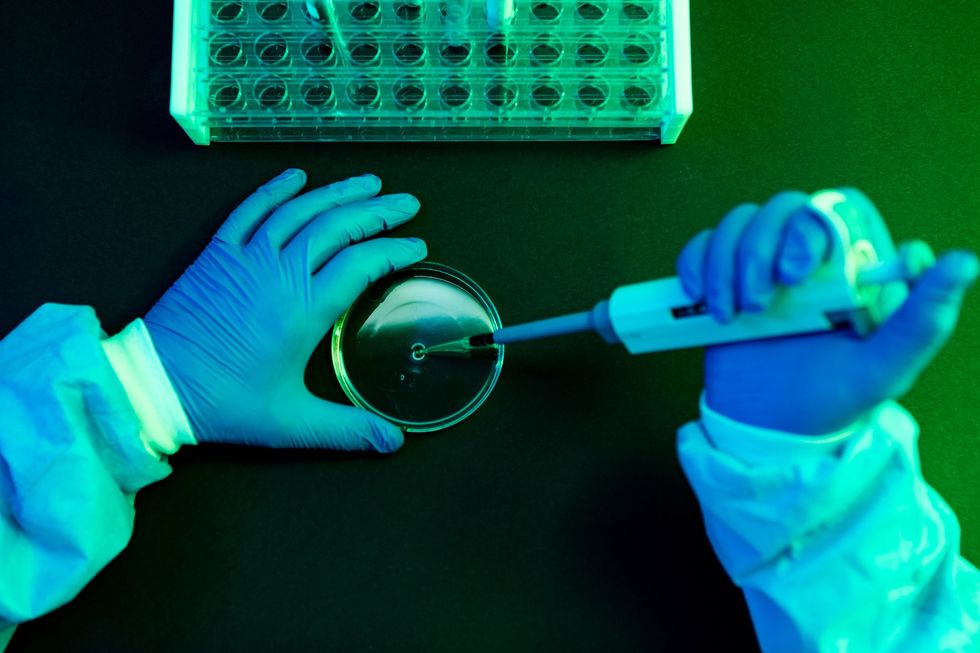
Evo-Φ2147 was brought to life in laboratory conditions
|GETTY
Discussing the breakthrough, Mr Wang said: "If you can control the source code of life, you can create anything and everything.
"The only thing limiting it is our imagination."
Bob Langer, co-founder of vaccine manufacturer Moderna and an adviser to Genyro, called the technology a "remarkable advance".
He said: "One can imagine using artificial intelligence approaches to select DNA constructs that can open new possibilities for new medicines, materials and countless other applications."
Our Standards: The GB News Editorial Charter