










Nasa scienests have revealed that the Sun will one day swallow the Earth, producing two new planets after the carnage.
Scientists predict that our planet will face a catastrophic end when the Sun exhausts its hydrogen fuel in approximately five billion years.
During this transformation, the Sun will balloon to roughly 200 times its present dimensions, becoming what astronomers call a Red Giant.
Research published last year found that stars which had already expanded into red giants were significantly less likely to retain large, close-orbiting planets similar to Earth, with only 0.11 per cent hosting such worlds compared to younger stars.
TRENDING
Stories
Videos
Your Say
As a result, Earth could be completely vaporised by the extreme temperatures or ripped apart by immense gravitational tidal forces as our star swells dramatically.
The process behind this stellar death follows a predictable sequence.
Throughout most of a star's existence, nuclear fusion, converting hydrogen to helium, counterbalances the immense gravitational pressure pushing inward.
Once hydrogen reserves become depleted, the outer layers collapse, generating sufficient heat to fuse helium atoms into carbon.
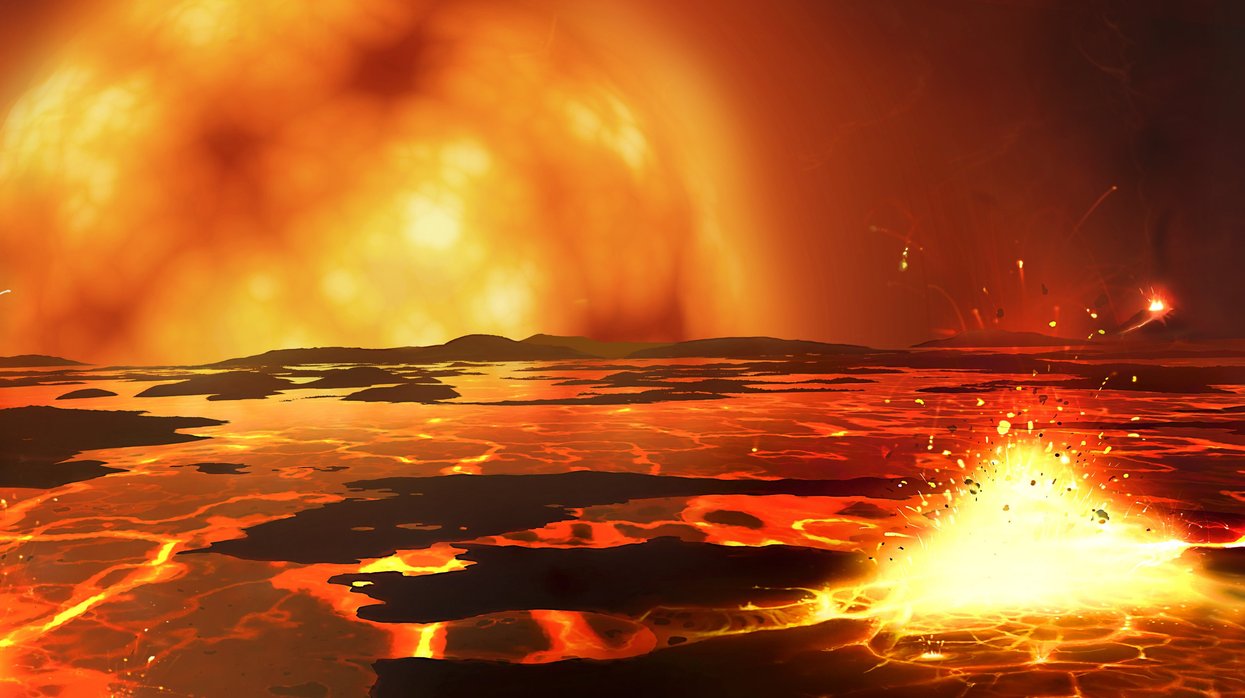
Scientists predict that our planet will face a catastrophic end when the Sun exhausts its hydrogen fuel in approximately five billion years
|GETTY
This energy surge triggers fusion in the outer layers, causing the star to expand dramatically - potentially becoming 100 to 1,000 times larger - and cooling into a Red Giant.
Eventually, the core contracts into a White Dwarf, an intensely hot body roughly Earth-sized, whilst the outer layers disperse into space, forming a planetary nebula like the Helix.
Professor Janet Drew, an astronomer from University College London, suggests this cosmic destruction should be viewed through a different lens.
She described the process as being "really about creation, rather than destruction.""
LATEST DEVELOPMENTS
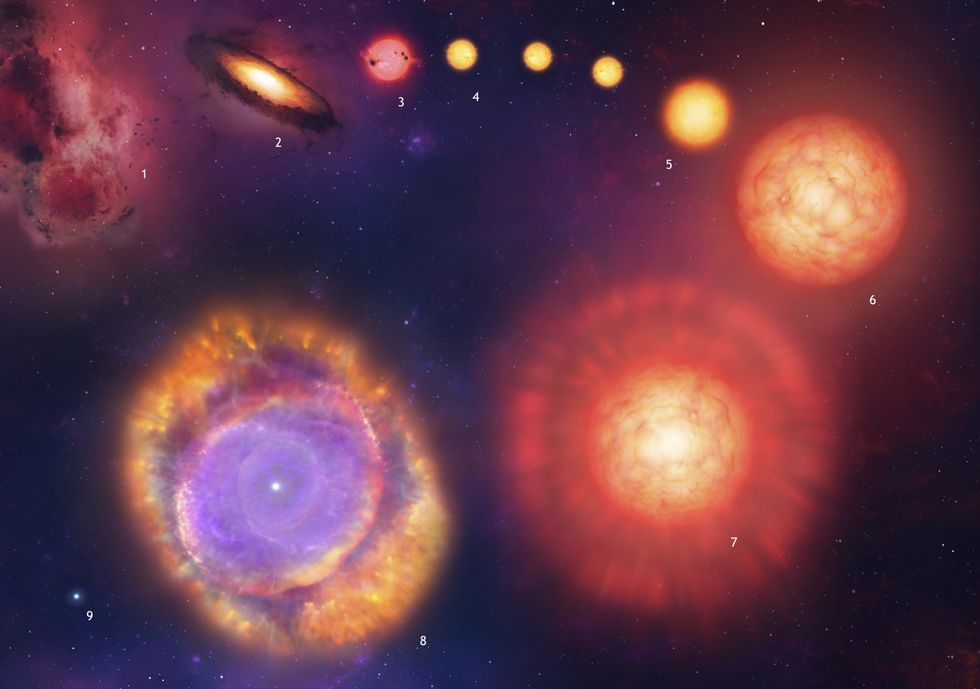
During this transformation, the Sun will balloon to roughly 200 times its present dimensions, becoming what astronomers call a Red Giant
|GETTY
"The chemically enriched material formed in the dying star's envelope will be fed into the interstellar medium, where that material can become available for the next generation of stars and planets."
Nasa's imagery highlights protective pockets within the dust cloud where complex molecules can develop.
"So this is really about where the material comes from that is needed to form a rocky planet and sustain carbon-based life," Professor Drew told the Daily Mail.
The terrifying prediction was revealed after Nasa's James Webb Space Telescope released remarkable new images of the Helix Nebula, a cosmic remnant situated 650 light-years from our planet.
Also known as the Eye of God Nebula, this celestial structure represents the remains of a Sun-like star that depleted its fuel thousands of years ago.
It spans three light-years across and offers what Nasa describes as "an up-close view of the possible eventual fate of our own Sun and planetary system."
These observations surpass previous captures from both the Hubble and retired Spitzer space telescopes, revealing unprecedented detail.
Our Standards: The GB News Editorial Charter