










NASA's Perseverance rover has snapped a stunning selfie on the surface of Mars at the most westerly point the vehicle has reached since touching down more than five years ago.
The composite image, stitched together from 61 separate photographs, was taken at the site dubbed "Lac de Charmes" on March 11, during the mission's 1,797th Martian day.
The rover had just finished grinding into a rocky formation called "Arathusa" when the photograph was captured, with Jezero Crater's western rim visible in the distance.
Katie Stack Morgan, the mission's project scientist at NASA's Jet Propulsion Laboratory, said: "We took this image when the rover was in the 'Wild West' beyond the Jezero Crater rim the farthest west we have been since we landed at Jezero."
TRENDING
Stories
Videos
Your Say
Analysis of this outcrop has revealed igneous minerals scientists believe formed before the crater itself came into existence.
Such rocks, containing large mineral crystals, develop deep underground as molten material gradually cools and solidifies.
"What I see in this image is excellent exposure of likely the oldest rocks we are going to investigate during this mission," said Ken Farley, deputy project scientist at Caltech.
These formations are thought to date back approximately 4 billion years, offering a glimpse into Mars' ancient crust.
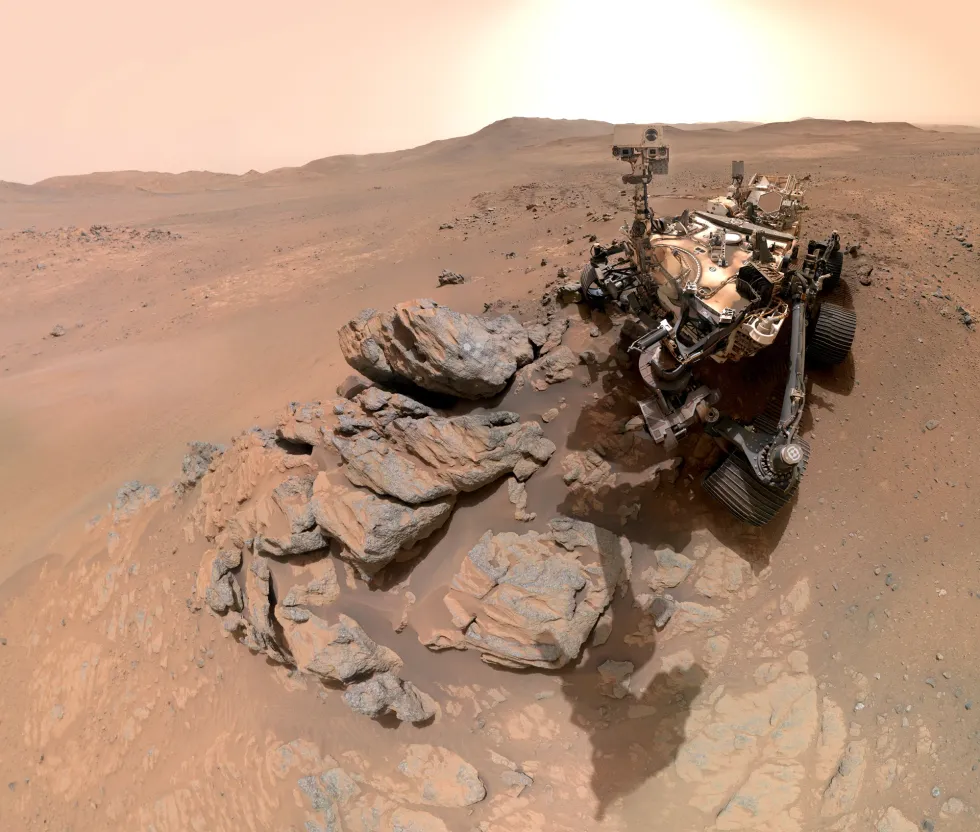
The rover had just finished grinding into a rocky formation called 'Arathusa' when the photograph was captured
|NASA/JPL-Caltech/MSSS
The Lac de Charmes region contains some of the most scientifically significant terrain Perseverance has explored during its fifth science campaign, known as the Northern Rim Campaign.
Unlike the sedimentary rocks found at Jezero Crater's river delta, the formations here include extrusive igneous rocks, which is lava that once flowed across the surface, and impactites created by meteorite strikes.
"The rover's study of these really ancient rocks is a whole new ballgame," said Ms Stack Morgan.
LATEST SCIENCE STORIES
"These rocks especially if they're from deep in the crust could give us insights applicable to the entire planet, like whether there was a magma ocean on Mars and what initial conditions eventually made it a habitable planet."
A panoramic mosaic of the nearby "Arbot" area, assembled from 46 images captured on April 5, has revealed what scientists describe as one of the mission's richest geological vistas, including massive rock fragments.
Some are as large as skyscrapers, thrown by a meteorite impact roughly 3.9 billion years ago.
Following its work at Arbot, the rover will head south to "Gardevarri" to examine olivine-bearing rocks before continuing southeast to "Singing Canyon".
After more than five years on the surface, Perseverance has ground into 62 rocks, gathered 27 core samples, and covered nearly 42 kilometres – just short of marathon distance.
Our Standards: The GB News Editorial Charter