








Scientists have identified a potentially active tectonic boundary forming beneath Zambia, raising the prospect that sub-Saharan Africa could eventually fracture into separate landmasses.
Research from Oxford University published in the journal Frontiers in Earth Science reveals the Kafue Rift, previously thought to be geologically dormant, displays indicators of tectonic activity which could lead to continental division over millions of years.
The rift system extends approximately 2,500 kilometres, stretching from Tanzania through to Namibia and potentially continuing towards the mid-Atlantic ridge.
Analysis of geothermal springs in the region has provided the first geochemical evidence supporting the theory this geological feature represents an embryonic plate boundary in its earliest developmental stage.
Researchers collected gas samples from five hot springs and three geothermal wells across central Zambia, examining the chemical composition of gases bubbling up from heated water sources.
The investigation focused on measuring ratios of different helium isotopes, particularly helium-3 and helium-4, which serve as indicators of the gas origin.
The analysis revealed elevated concentrations of helium-3, a signature indicating that fluids are ascending from the Earth's mantle, situated between 40 and 190 kilometres beneath the surface.
Mike Daly, who contributed to the study, explained "the hot springs along the Kafue Rift of Zambia have helium signatures which indicate that the springs have a direct connection with the mantle".
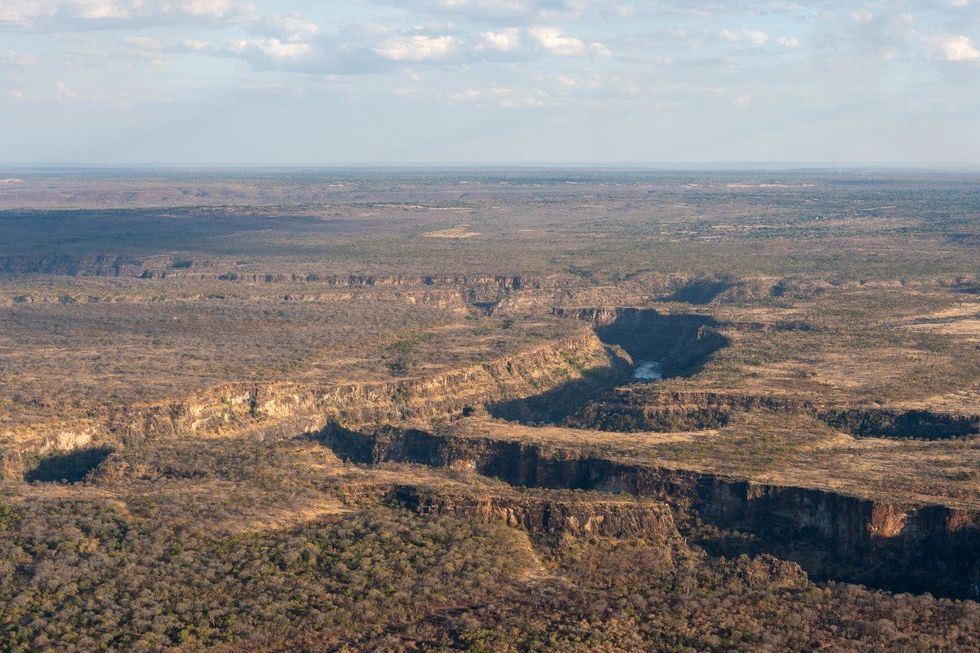
The rift system extends approximately 2,500 kilometres
|GETTY
The carbon dioxide proportions in samples also matched the chemical fingerprint of mantle-derived fluids, providing converging evidence of deep geological activity.
Rūta Karolytė, who spearheaded the investigation whilst at Oxford University, said "what our data confirms is that this system is currently 'awake' and geologically active".
She cautioned rift development does not guarantee ocean formation, adding "an active rift developing doesn't necessarily mean that in 100 million years you're going to have an ocean there. But it is a possibility".
Mike Daly, visiting professor in Earth sciences at Oxford, indicated the transformation could occur within a few million years at the fastest, though the process might take between 10 and 20 million years at the slowest rate.
LATEST DEVELOPMENTS:
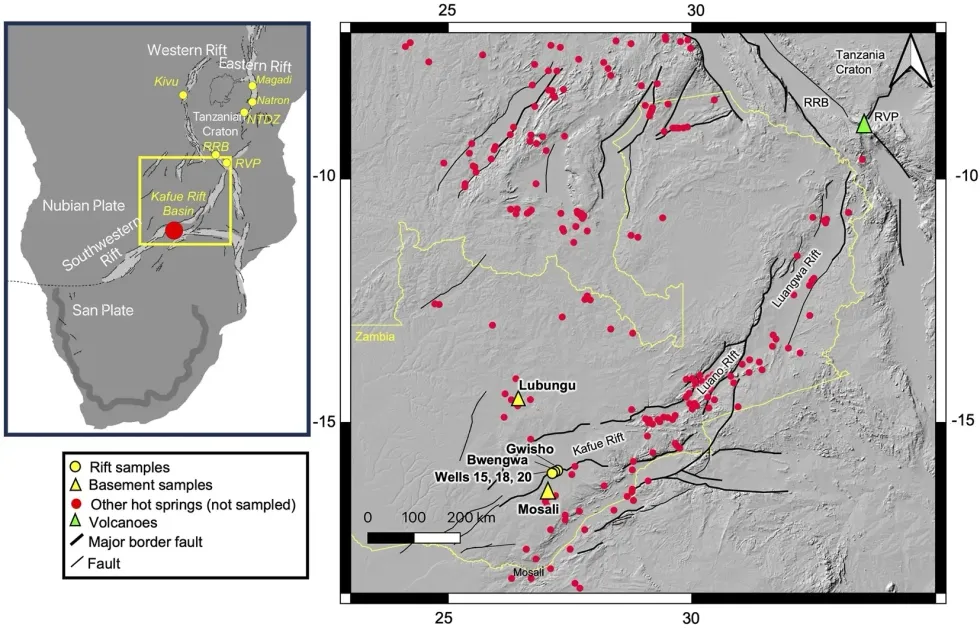
A map showing the Kafue Rift in Zambia
|KAROLYTE ET AL FRONT. EARTH SCI. 2026
He described how the southern portion of Africa would eventually separate, preceded by increased seismic activity, volcanic eruptions with lava flows, and the formation of deep rifts that would initially create lakes before ultimately allowing seawater to enter.
The geological developments present significant economic opportunities for Zambia well before any potential continental separation occurs.
Geothermal plants have already begun emerging in the region, offering the landlocked nation prospects for renewable energy generation from the tectonically active zone.
The rifting process releases helium that has accumulated in rocks over geological timescales, with concentrations reaching 2.3 per cent in surface fluids.
This element represents a valuable resource with critical applications in medicine and high-tech industries, and the elevated levels have already attracted commercial interest.
Karolytė observed that "it's hard to find these tectonic conditions that are just right to concentrate and release helium in a way that it can be captured".
The rift system may also provide access to hydrogen reserves, potentially transforming the economic prospects for the region.